Reflections on Delta 3200

Rob-F

Likes Leicas
Local time
10:59 AM
Joined
Mar 22, 2007
Messages
7,662
Location
The Show Me state
I just shot and developed two rolls of Delta 3200. My goal was to discover the true ISO of this film and shoot it at that speed. I shot one roll at around EI 1000 plus or minus 1/3 stop or so, and developed in DD-X for 7.5 minutes. Good shadow detail, but the negs were flat. So I shot another roll at 1600, and 8 minutes in DD-X. I got very printable negatives, though still a little flat--best results were obtained at grade 3 on Multigrade IV.

So here's what I'm thinking. Delta 3200 is designed for push processing. Most people say its true ISO is 1000 or so. Then I though about Ektachrome EPH, P1600. It is really an ISO 400 film, designed for push processing. If one were to actually shoot it at 400 and process without a push, the images would be flat. The film is deliberately made to be flat without push processing.

I suspect that is what they have done with Delta 3200. Sure, you could shoot it at the true ISO to get full shadow detail. That was my original intention. But I think they designed it to be flat at its true ISO so that it would push well without building excessive contrast. I don't think it's meant to be used at 1000 or 1250 or so. They meant it to be shot at and processed for faster speeds, and designed it to look good at those speeds. So I think I will shoot my next roll at 2000.

If you are wondering why I don't just shoot it at 3200 and be done with it, I have already done that. I though the shadow detail was lacking. Thin negatives. Hard to print. So i'm experimenting to find the best use of this film. I'll try it in XTOL and Microphen as well. But as for DD-X, i suspect it will look best at 2000 with the development extended to 10 minutes or more.

Your experiences?
 
The same.

It's flat, and made for pushing... I thought I could, as you say, shoot it at its real speed for shadow detail, trying to find a perfect development for taking it to an optimal printing contrast. I used several developers including Microphen and DD-X... I tried at least four times with 35mm and MF in the last ten years, and I never felt totally happy... I did it several times, avoiding TMZ just because Delta was the only one in MF...

Then, after pushing Tri-X and Neopan P1600 for ages, I tested TMZ this year, and it's great and punchy at 800, 1600, 3200 and 6400...

Something tells me yellow people won't allow freestyle to rebrand it... 🙂

Cheers,

Juan
 
Last edited:
Almost the same... but not quite. I think one vital bit of info is missing here:

True speed is determined by shadow density. In this regard D3200 comes up around 1000-1200 for me, either in DDX or Xtol. Same as you.

'Flatness' is another word for contrast and this is is determined by development time.

I agree that D3200 is as good as useless at the manufacturers recommended times. My solution? Rate it and develop it such that I get an accurate shadow speed and nice highlights. I do this by developing for considerably longer than the times on the bottle. At 1200 I develop it for anything from their recc 3200 times to slightly longer....

Other solutions to boost highlights would be to go for a more enthusiastic agitation routine i.e. unlike the Ilford recc of agitation every minute, go for twice per minute as per Kodak.

Also note that the faster a film the lower the inherent contrast and also that D3200 negs print with slightly higher contrast than their visual density would suggest.

If I can suffer a one stop drop in speed I far prefer Neopan 1600 at 500-640, but sometimes only D3200 will do. I am experimenting with Tri-X at similar speed as these two using stand processing and long times and so far so good!
 
Almost the same... but not quite. I think one vital bit of info is missing here:

True speed is determined by shadow density. In this regard D3200 comes up around 1000-1200 for me, either in DDX or Xtol. Same as you.

'Flatness' is another word for contrast and this is is determined by development time.

I agree that D3200 is as good as useless at the manufacturers recommended times. My solution? Rate it and develop it such that I get an accurate shadow speed and nice highlights. I do this by developing for considerably longer than the times on the bottle. At 1200 I develop it for anything from their recc 3200 times to slightly longer....

Other solutions to boost highlights would be to go for a more enthusiastic agitation routine i.e. unlike the Ilford recc of agitation every minute, go for twice per minute as per Kodak.

Also note that the faster a film the lower the inherent contrast and also that D3200 negs print with slightly higher contrast than their visual density would suggest.

If I can suffer a one stop drop in speed I far prefer Neopan 1600 at 500-640, but sometimes only D3200 will do. I am experimenting with Tri-X at similar speed as these two using stand processing and long times and so far so good!

I agree with everything you said! I don't think any info is missing. Yes it has occurred to me to try increasing the development time. I thought I might try 10 minutes to start with, rather than 8 minutes. Actually I did agitate for 5 seconds every 30 seconds. Ilford says to agitate for 10 seconds in 60 seconds, but doesn't exactly say that the whole 10 seconds has to be done all at once. I wasn't planning on a drastic increase, out of concern for blocking highlights. I have gotten good highlights at 8 minutes. Maybe I will try a roll at 1250 now at an increased development time, to see what it looks like.

I also agree about Neopan 1600. I get very good results with it at 800 (in Microphen or XTOL 1:1, I can't recall offhand).

I will experiment a little more before I give up on D3200. I've tried TMZ before. I think it has inherently better shadow speed, but I remember it being grainier than D3200.
 
1600/3200 Films

1600/3200 Films

Delta 3200, rated at 1600, only seems to work well in very contrasty situations. That's my experience anyway. I think TMZ gives a nicer result in more normal lighting and gives a full range of tones. Also NP1600 does not give any shadow detail at 1600 no matter what you do with it.
 
I've heard the "Delta 3200/TMZ are flat films designed for pushing" thing before. I've said it a few times myself. After running some semi controlled tests on the matter, I didn't find TMZ to be any flatter than Tri-X or other films, even when shot at EI 800, which is more or less it's real speed. I can't say the same it true for the Delta, but I suspect it is.

While this isn't true for all B&W films, if your results aren't contrasty enough, extend development. It's a knob independent from shadow speed and exposure. There should be a development time for Delta that lets you shoot it at 800 in normal light and gives you negatives that have the proper amount of contrast.

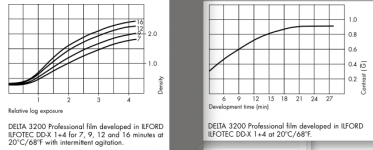
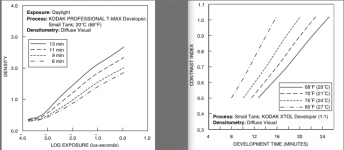
Comparing the Delta 3200 and TMZ spec sheets, it looks like Delta has a much larger shoulder than TMZ, doesn't build as high of densities, and also can't reach the same contrast indices (CI) with extended development. Also, cross referencing the suggested times (for DD-X) with the CI chart, it does look like the CI's for those times might be on the low side. At least compared to the CI's for the suggested times for TMZ in XTOL. Again, I've hardly used the Delta, but this tells me it might be a bit less friendly than TMZ to manipulations through exposure and development since it's is not as linear in either case.

I've attached the curves and CI charts for Delta and TMZ.
 

Attachments

  • delta.png
    delta.png
    40.8 KB · Views: 0
  • tmz.png
    tmz.png
    42.7 KB · Views: 0
I've heard the "Delta 3200/TMZ are flat films designed for pushing" thing before. I've said it a few times myself. After running some semi controlled tests on the matter, I didn't find TMZ to be any flatter than Tri-X or other films, even when shot at EI 800, which is more or less it's real speed. I can't say the same it true for the Delta, but I suspect it is.

Comparing the Delta 3200 and TMZ spec sheets, it looks like Delta has a much larger shoulder than TMZ, doesn't build as high of densities, and also can't reach the same contrast indices (CI) with extended development.

Please correct me if I'm being a bit dumb here but surely these opinions are contradictory. On the one hand you say you 'suspect' that D3200 is no flatter than other films but on the other hand you provide evidence that it is. In fact the curve you supply supports the observations of the other posts that D3200 is inherently flat and that it isn't possible to get a full range of tones out of it except under extreme conditions.
 
Tim, it matches my experience too. The film has a pronounced shoulder, but that can be very useful. Shooting early morning mist scenes towards the rissing sun being one time I got the most beautiful negs from this film.

It is not a film for shooting flat scenes where you want sparkle in the highlights thats for sure. I have generally used it of late when shooting inside dark buildings with windlow light streaming in and hitting people. Keeps those highlights well under control.

FWIW I find that Neopan 1600 at 500-800 (depending on lens contrast and lighting) produces finer grain and noticeably more detail than Tri-X. Not by a mile, but noticeable.
 
Sometime I should get around to fooling around with Neopan 1600 more. I just usually don't care for the results I've seen. I usually use Tri-X. If I need more speed, TMZ is there. If I need more detail and finer grain, TMY is there. I'm not entirely convinced that Neopan 1600 is even faster than Tri-X...
 
Please correct me if I'm being a bit dumb here but surely these opinions are contradictory. On the one hand you say you 'suspect' that D3200 is no flatter than other films but on the other hand you provide evidence that it is. In fact the curve you supply supports the observations of the other posts that D3200 is inherently flat and that it isn't possible to get a full range of tones out of it except under extreme conditions.

I was just saying the oft-mentioned "flat films made for pushing" doesn't necessarily mean anything. It's often said for both TMZ and Delta 3200, and they have pretty different curves.

Having a shoulder is different than being flat, at least in my mind. According to the curves, Delta *does* respond to more development by increasing it's contrast, just not as linearly as TMZ. Looking at the curves, 3-5 stops worth of lower shadow and midtone contrast increases, while the highlight contrast doesn't. So you can tweak the midtones with development, but the highlights lose separation with more development.

TMZ is more linear, but I know from experience that TMZ at 800 printed just fine at grade 2, just like Tri-X at 400 did. That doesn't sound flat to me. You should be able to develop TMZ for contrasty midtones and let the highlights fall where they will (possibly being very dense), or for printable highlights and possibly flatter midtones. So it's workable in either high contrast or low contrast situations by adjusting development.

I have no idea how Delta 3200 stacks up against other Ilford films and other films in general - the spec sheets for those aren't quite as complete. Delta 400 for example does appear to reach higher CIs and a linear characteristic curve, while FP4+ has a *wicked* shoulder if the curve is to be believed. Furthermore, two films that are often quoted as contrasty, Neopan 400 and 1600 (especially the 1600), both have pretty pronounced shoulders. So is Delta 3200 made for pushing and TMZ not or vice versa? Is Neopan made for pushing? Is FP4+? Tri-X is pretty damn linear in some devs, and people love to talk about how well it pushes. Some people love compressed highlights and compensating developers, some don't. I suspect a person's view of how well a film pushes depends on how much shadow detail they like, how contrasty they like their midtones, and how much compression they like in their highlights.
 
Last edited:
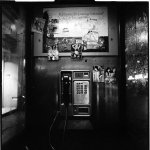
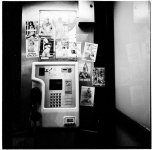
I shot DELTA3200 (120 format) on extreme low light levels some years ago and did push it two or three stops (can't remember properly, say at 12.800 or 25.600 ASA) in D-76

results were good, the neg was a bit thin but i guess it was possible to print...

attached some scans...
 

Attachments

  • telephoto_001.jpg
    telephoto_001.jpg
    45.3 KB · Views: 0
  • telephoto_004.jpg
    telephoto_004.jpg
    43.6 KB · Views: 0
It is. About 1/3 stop in my book. 😀
That's when I turned away from it...

2/3 stop faster in mine (Xtol or DDX), but with finer grain and higher resolution. That 2/3 or a stop can be really useful sometimes. Neopan 1600 looks horrid at 1600 most of the time, but at 500-640 is can be really rather nice with a good tonal scale. I still prefer the look of TriX overall, but if I can get more speed, detail and finer grain then I will use the Neopan 1600. Recently looking through some portraits of people in very low light with a 85 1.2L, generally at f1.2-2.8, it was very clear that the Neopan 1600 (at 640) was giving markedly better detail on eyelashes, skin wrinkles etc than the TriX (at 320/400). Each to their own, but I am amazed what Neopan 1600 manages when one forgets the 1600 rubbish. They should have marketed it as a 800 and a lot more people would have stuck with it I suspect! As for it having no tonal scale (a frequent criticism)... at 1600 it has very abrupt transition from shadow to highlights (no mids), but when exposed and developed for its real speed its just like a faster Neopan 400, but with a look half way to TriX IMO. I can see why people would not like it though.

With Leica/Zeiss lenses I rate it at 500-640 in contrasty/normal light and up to 800 if dead flat. With my EOS, I use 640 and up as the lenses are not so high contrast.
 
Last edited:
I'm amazed at how little resolution Tri-X actually has. I like the film and use it a lot, but TMY has way more detail. TMZ is about as sharp as Tri-X.
 
Back
Top Bottom