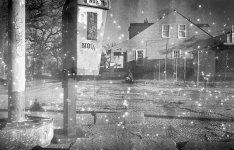
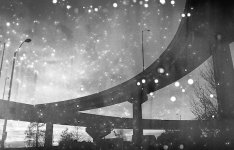
A developing question - what happened here?

seanathan

Established
Local time
11:43 AM
Joined
Aug 1, 2011
Messages
64
Location
somewhere yonder
Hi All,

Just started developing B&W at home a few months ago, and had a question for the gurus about my most recent roll. The negatives turned out starry and in some spots so washed out that the images are completely gone. I surmise this came about because I kept the film in its stop bath for too long (about two minutes, as opposed to thirty seconds), I read that this can cause acidic burns into the negatives. I just wanted to check here and see what y'all have to say about it.

Attached are some examples. Kind of a cool effect actually...
 

Attachments

  • img295_600px.jpg
    img295_600px.jpg
    126.8 KB · Views: 0
  • img290_600px.jpg
    img290_600px.jpg
    89.2 KB · Views: 0
You have several bad things going on. The white spots were not caused by stop bath, they'd be black if they were. It looks like inadequate agitation, which caused air bubbles to stick to the film, and caused the streaking you see in them.
 
I've never seen air bubbles that look like that, but there is always a first time.

Are you using a powder developer? To me it looks like the developer hasn't dissolved fully and neat powder is causing hot spots.
 
I'm using Kodak's D76 powder developer. But I've processed a few rolls before this with the same batch and didn't have this effect. Its about two months old yet, but I'm keeping it in a gallon jug, filled up (basically) to the top, so there is not much room for air. Perhaps I need a better receptacle to keep it in though?

Thoughts?
 
Chris: Been agitating thirty seconds every two minutes. I recall this was how I used to do it in high school photo class, but maybe my times are off. I'll look into this, thanks.
 
I've never seen anything quite like it, and I've been running film for over 30 years. The steaking may be from agitation or bad developer, but there's an overall fog too, which I find baffling unless it happened in camera. Does the camera have a flexible bellows; if so it might be leaking. The white spots are definitely "hot" on the negative, so undissolved developer could be the problem. The graine would settle to the bottom of the jar and might not effect anything until they are close enough to get poured into the soup. In any even, I'd chuck your present developer and mix the next batch strictly according to the instructions, making sure the powder is fully dissolved.
 
I looks to me like the developer wasn't completely mixed leaving undissolved crystals floating around. The crystals would severly overdevelop the spots where they landed on the film. Alternately, the mixed solution was stored too cold and some of the developing agent came out of solution.
 
Thanks for the input, everyone. I'm shooting an M6, so no bellows. Seems like it may be the developer then. Looking at it now, it does seem a bit cloudy. I'll mix up a new batch.
 
I encountered similar thing few months ago; but with smaller white dots. It turned out that my rodinal had formed some crystals. After I filtered it with coffee filter, no more white dot found.

scan120124_011r.jpg
 
Yeah, that looks like the developer recrystallizing. Maybe you could switch to HC-110? No mixing, no worries. If those were pinholes it'd be the acetic acid in the stop-bath causing it. I switched to plain water as my stop-bath because of this a zillion years ago.
 
I've seen something like this on a friends film in the 1980's it wasn't caused by chemicals but rather by poor storage.
His film had got damp leaving small dents in the emulsion maybe some emulsion sticking to the base when rolled possibly even fungus (but we were never sure) this gave those same white dots with streaks during development.

How was the film stored? Was it frozen then thawed? Can you see dents in the emulsion when held at an angle to strong light?

To me this looks like emulsion damage, that caused drag around the damage during development– if so I'd expect to see a badly pitted negative.
 
That could be true as well. However, at least with fungus, the round blobs look a little fuzzier. Had some old slides with that some years back.
 
I've got a "What happened here?" query as well so I hope if it's ok if I stick it in this thread.

I shot some rolls of Ilford HP5 Plus 400 this afternoon to try one of my lenses on an older body. I then developed the rolls in Diafine per usual. All of the photos came out fine except this one which did wierd things in the sky part.

FTn-B-02032013_4-20130203-210312.jpg


This is the unadjusted scan, and as you can see the sky (which was mostly monotone with no distinct clouds etc) got blobby. I've never come across this result before.

While it kind of works visually for this shot, it also ruins the shot for serious application.

Any ideas what happened here? It's just this one image out of 2 rolls that did this.
 
Bubbles in the developer I think. More visible in areas like this of even tone, obscured by subject matter in other shots. Inadequate agitation? And I finish each instance of agitation by rapping the tank on the table to dislodge bubbles.

Edit: Which reminds me that over-agitation is a density killer in Diafine!
 
I agree, it does appear to look like the result of bubbles. However, I was not sure since none of the other photos on that roll had this issue. It was the upper roll, both rolls were pressed firmly down into the tank and onto the spool holder, they were covered in plenty of solution that I could tell.

I know I had plenty of Diafine in the tank to more then cover both rolls of film, but I am wondering if maybe your mention of over-agitation may be what's the culprit.

With DD-X, I always did 10 "flips" of the tank at first, then 4-5 each minute during the process. With the Diafine I typically do 5 to start then 3-4 per minute. However I noticed lots of bubbles this time which I've not seen before and I think maybe I got a little over zealous with the agitation.

My Diafine has only had maybe 10 rolls run through it, so it shouldn't be bad/used up yet. I've read folks using the same batch for months or a year without issues.

I have 2 more rolls to do left and I think I will try to do them using the very gentle agitation instead to see what happens. I am hoping it was just me going a little to aggressive with the tilting of the tank. I did have my mind elsewhere since I had used a broken lens and was not even sure if there was anything worth saving on the rolls. I had way over and way under exposed a few shots just to see what would happen and I got all my shots well within tolerance and adjustable after the fact. So really the only issue I had was that bubbly mess.

I also am very good about the tap of the tank on the counter after each agitation. I had that drilled into me by dozens of how-to and threads about self-developing. So I am going to go with bubbles. AND, the fact that I had, lets say, some issues loading the film into the roll and I had 2 places wehre the film sat wierd. I wonder if the bubbles got trapped there and couldn't diffuse or rise up and out in that spot. I know had one other place where the image had a white spot from where the film touched another piece of film.

I love the nearly instant reward of doing my own development but I am still learning this process, again. This time, unlike when I was a teen, I am doing so with my own money and equipment. It's quite a wonderful feeling.

Even the mistakes are fun, I learn, grow, and get some cool ideas for things to try later.

Thanks for your input!

 
For completeness of picture (no pun intended) of my issue... here are two other photos...

This one is from the same roll on the top of the tank and has streaks and some wierd light/white wiggling lines which i think were a result of the above mentioned agitation and the odd bending of the film in the spool due to my screwed up loading. (I didn't realize I had done this until after it was too late.)

20130204-FTn-B-02032013_30-20130203-232111.jpg


And then a shot from the bottom roll of the the same sky where oyu can see it was not filled with lovely blobs.

20130204-FTn-02032013_25-20130203-232332.jpg


It was one of those shoots were you just end up thinking you'd have been better off staying home. I lost a unique lens cap, a empty fill canister, $5, had a broken lens with half-functional aperture on a camera who's aperture meter was malfunctioning due to operator error when installing the fresh battery, and I dropped one of the lenses and caught it barely before it hit the ground. I still managed to get 2 rolls of 36 exposures shot plus 2 extra per each roll.

Not a lose but not a win. More of a learning experience. That mess may have also been why I was so disconnected to the developing process that I am normally 100% focused on. And why I over agitated.

Let's hope I've learned from it at least.
 
Geez, one of those days, eh... and then the processing problems. The swirls in the sky of that shot of the wetlands are pretty odd. No bubble pattern... but I see two light arcs that indicate kinking, as from problems loading the reel. The swirls could be from fluid movement consistently in the same direction.

But these variations should shake out by the end of the processing, I'd think. Don't know about you, but I feel more comfortable doing 5 min in each A and B as it does no harm and may help even things out. Two min seems awful short...

I agree gentle agitation is the way to go with Diafine; each minute I just get a bit of fluid movement by tipping the tank up 45 deg and let it rap back down, or rotate right 90 deg and back and rap. A little movement to carry byproducts of development off the surfaces is all, otherwise it's rather like still development the way I do it.

Years ago I had a lot of problems with thin negs in Diafine and gave it up, but it later turned out to have been overly vigorous agitation. The agitation isn't important in A, since all it's doing there is soaking into the emulsion. But in B, the activator, over agitation can cause B to wash the A out of the emulsion. Odd but true... and results in less actual development.

I had one other thought about your first neg with the obvious bubble pattern. It looks unusually sudsy, since typical developer air bubbles are generally more isolated in arrangement seems to me. I wonder if it's possible some PhotoFlo got in there, maybe not washed off the reel or tank from the previous session?

Edit: Contaminated developer is certainly another thought... if your A & B were not freshly mixed...
 
Mr Alien
I think your problem is two fold. Firstly you probably didn't have enough solution in the tank, I had a student who did the same a while back his tank said 300ml for 35mm so when he loaded 2 films he still put 300ml into the tank.
His top film was thin and had identical bubbles to yours.

The other is the issue of clean spirals and tanks, do you use wetting agent?
If so those spiral need to be washed in plain water and dried—as in no moisture.
 
To answer your questions, I do not use Photoflo or a wetting agent at this time. I guess I need to add it into the process? I've had such great luck until these two rolls.

I thought I did have plenty of solution in the tank. I believe the tank suggests 290ml per 35mm roll but I had about 600ml in there. At first I was only doing one 35mm roll per session in the tank, just to ensure proper coverage and reduce the amount of liquid I was adding in.

However, my agitation is most likely the major culprit here.

When I first started doing this a while back, I was having leaks with the lid so I was very gently tilting the tank towards me about 90 degrees and back, then I'd turn it around about 90 degrees in rotation and repeat, and do this for each agitation. I was paranoid I was not evenly coating everything, hence the other rotation beyond the tilt for my agitation. I stopped doing the rotation itself after the first set I did came out nice.

I always end each agitation with a hardy thump on the counter to dislodge bubbles as well.

Someone told me to gently 'burp' the lid of the tank when putting it on to increase pressure and create a better seal, which helped stop the leak for the most part. And I may have just gotten careless with my agitation then. Add in the mood I was in yesterday after lots of issues on the photo adventure and my results show it.

As far as cross-contamination and clean spirals. I always clean everything well after each developing session, drying them fully and then put them away. I rinse the funnel well between each for pouring back into the container and rinse the beaker well that is used to measure each. I also keep extra funnels and beakers on hand so I can use one per solution if I desire. None of that was really an issue before. But, I don't want to discount it just yet either.

I am going to do two other rolls tonight and am going to focus on going back to the much gentler agitation in hopes of resolving the issue. I am probably also probably going to order some more Diafine and make the solutions using distilled water, just to remove that variable from the mix. My water here is pretty mineral rich, so better safe then sorry.

If I change everything one thing at a time, it will help me understand where the issue is.

I'll also drop into my camera shop later today and pick up some photoflo and add that into the process to be safe.

Once again, thank you all for your feedback on this, I really appreciate all of the input!
 
Back
Top Bottom