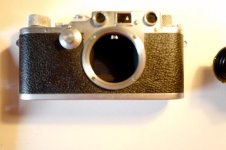
A wartime Leica - So hard to get?

archeophoto

I love 1950's quality
Local time
5:15 AM
Joined
Oct 4, 2009
Messages
252
Hi everybody,
There seem to be very knowledegable people here on this board. I would be interested to know how you guys define a "wartime Leica". When you talk about them do you mean only the cameras that are engraved with military insignia and specially issued to the different military branches or generally the cameras manufactured throughout the war years 1939-45?

The reason I ask is: I'm originally from Germany (I live in Canada now) and my Granddad was documenting the war in for the army (German "Heer") with his private Leica IIIc. My dad told me many stories about my Granddad during the war and he said that it was very common back then that soldiers that documented the war used their private Leicas (and other cameras) to do this. My Granddad was captured in France by the Americans after D-day and unfortunately he had to sell his Leica after the war to buy food for his family and he opened a small camera store after the war.
The "photobug" was passed on to me and I recently found some old photos of my 10 year old dad standing in front of my granddad's camera store.
Now I have this idea to find a "wartime" Leica. By this I mean a camera that was built around 1941 or 42 (that's when my granddad got his) Maybe I'm weird, but I somehow feel I would honor him and his memory by owning and using such a camera.
This camera does not have to have military markings or the likes.

Is that an impossible task as you guys say wartime Leicas are so rare.

Greetings
Herbert
 
Welcome to the forum Herbet.

To answer your question about defining a wartime Leica, I would say one made from 1939-1945 would count as a wartime camera. I do not think you are weird in wanting to find one as a way to honor your grandfather. I understand the feeling you are mentioning. They come up now and then in the classifieds here. Ebay seems to have inflated prices on some of the wartime cameras, specifically the red curtain IIIc's.

Best of luck in finding your camera.
 
Welcome Herbert.

You can identify Leica's manufacturing year via the serial nr. on top of the camera. Here is a complete list:

http://cameraquest.com/ltmnum.htm.

I wouldn't worry about special markings. They either make the camera as collector item very expensive (military markings like Luftwaffe, Heer, etc.), or are signs (SS, runes, etc.) that I would hate to have on anything I own. Your granddad likely had an unmarked camera himself, as he owned it privately.

A good Leica II or III of these years should run you 200 Euro or a little more. You can buy on ebay with risk, or in a shop that deals in used camera equipment. A good shop in Europe is leicashop.com, for instance.

Best,

Roland.
 
Last edited:
http://en.wikipedia.org/wiki/World_War_II

WWII September 1,1939 - May 7, 1945 (War in Europe)

There was significant production of Leicas in 1939-41. So WWII era IIIa,b,c are not that rare. The IIIc was produced in significant numbers throughout the war.

My IIIb appears to have been produced in October 1939. If so, it could be considered
a "phoney war" Leica.

Expert opinion here can tell you more on leica variants specific to WWII.

yours
FPJ
 
Last edited:
Thank you all for your warm welcome to the forum.
Thanks for all your insights. I think I caught the "Leica bug" 🙂

Herbert
 
"Wartime" or "Stepper" Leicas

"Wartime" or "Stepper" Leicas

As has been pointed out by several others, the "Wartime" distinction is very misinterpreted. Personally, I look for only the "Steppers", that is the ones with the small step in the top-plate under the film rewind release lever. These are readily available (I have 28 of them for study) if you avoid the "Military" insignia. I have found them for as little as $137 and as much as $600 in mint condition with the correct lens.

Keep looking.... they are still out there and I just bought one in the 395xxx serial last week.
 
Don't the surfaces of the wartime cameras peal or pit easily? Something about lack of materials during the war. I remember reading that when deciding to get a IIIf instead of a IIIc, but perhaps my memory fails. There was also something about the difficulty in loading modern cassettes on IIIc and earlier cameras. See here https://rangefinderforum.com/forums/showthread.php?t=101163
 
Don't the surfaces of the wartime cameras peal or pit easily? Something about lack of materials during the war. I remember reading that when deciding to get a IIIf instead of a IIIc, but perhaps my memory fails. There was also something about the difficulty in loading modern cassettes on IIIc and earlier cameras. See here https://rangefinderforum.com/forums/showthread.php?t=101163

l will let you know how l get on loading it with modern casettes
 
Don't the surfaces of the wartime cameras peal or pit easily? Something about lack of materials during the war.

It is only a specific batch of post-war Leica IIIc cameras (1947 or 1948 as I recall) that suffered excessively from pealing chrome.

Some people have 'trouble' with the modern film canisters sitting too low in the Leica cameras from the 1930s, so it draws the film across the film plane at a slight angle causing the sprocket holes to be exposed along one edge.
If you seat the film correctly in the guides you should not have this problem. Others have taken to adding a little shim under the cassette to keep it seated.

IIIc steppers? Not very uncommon.

I have paid anything from $125 to $400 for IIIc stepper bodies, varying from red curtain 1940 version to unmarked IIIc"K" cameras delivered to the US Army in 1945.
 
Hi,

As others have said there's a wide range of camera models made in the war period and, of course, cameras sit in shops on shelves for a while. So a 1940 camera might have been sold in 1941 and so on.

Looking in the books, 1940 cameras had serial numbers starting 352 XXX but you can never be 100% certain.

Another factor is how rich your grandfather was then. Even a 10 year old model II would have been desirable and expensive then but that's based on prices etc in Britain then.

As for chrome, it went down slowly in quality but the early 40's were OK.

I'll wish you luck in your search.

Regards, David
 
I very much like the grey panted IIIc's. It is not very important that they have a "K" behind the serial number. The ones without a "K" are more rare.

More important is the condition of the vulcanite. This was painted too, but the paint usually only remains in the grooves of the vulcanite. It gives the cameras a special look.

I think that the older series, before the IIIc (III, IIIa and IIIb) are technically better cameras. Their construction is much more solid.

Erik.

14066750318_a110195a16_z.jpg
 
It is only a specific batch of post-war Leica IIIc cameras (1947 or 1948 as I recall) that suffered excessively from pealing chrome.

Some people have 'trouble' with the modern film canisters sitting too low in the Leica cameras from the 1930s, so it draws the film across the film plane at a slight angle causing the sprocket holes to be exposed along one edge.
If you seat the film correctly in the guides you should not have this problem. Others have taken to adding a little shim under the cassette to keep it seated.

IIIc steppers? Not very uncommon.

I have paid anything from $125 to $400 for IIIc stepper bodies, varying from red curtain 1940 version to unmarked IIIc"K" cameras delivered to the US Army in 1945.
Hi Rick, thanks for the very informative replies, as ever you are a useful font of information, much appreciated🙂
 
I very much like the grey panted IIIc's. It is not very important that they have a "K" behind the serial number. The ones without a "K" are more rare.

More important is the condition of the vulcanite. This was painted too, but usually only remains in the grooves of the vulcanite. It gives the cameras a special look.

I think that the older series, before the IIIc (III, IIIa and IIIb) are technically better cameras. Their construction is much more solid.

Erik.

14066750318_a110195a16_z.jpg


thanks one very nice looking camera🙂
 
Don't the surfaces of the wartime cameras peal or pit easily? Something about lack of materials during the war. I remember reading that when deciding to get a IIIf instead of a IIIc, but perhaps my memory fails. There was also something about the difficulty in loading modern cassettes on IIIc and earlier cameras. See here https://rangefinderforum.com/forums/showthread.php?t=101163

This affected my 1948/49 IIIc quite badly. I had the chrome stripped and the camera repainted black by Peter Grisaffi at CRR and I'm rather pleased with it, even though it isn't 'authentic'.
 
Erik van Straten I very much like the grey panted IIIc's. It is not very important that they have a "K" behind the serial number. The ones without a "K" are more rare.

More important is the condition of the vulcanite. This was painted too, but the paint usually only remains in the grooves of the vulcanite. It gives the cameras a special look.

I think that the older series, before the IIIc (III, IIIa and IIIb) are technically better cameras. Their construction is much more solid.

Erik.

Erik: could you say a little more about why you consider the construction of the older series of Leicas to be much more solid? It is often written that the die cast body makes the IIIC more robust.
 
Back
Top Bottom