Classic Pens - FT and model 1959 - Are these rare?

anj273

Newbie
Local time
12:09 AM
Joined
Apr 26, 2010
Messages
4
Hi guys.

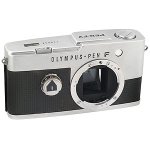
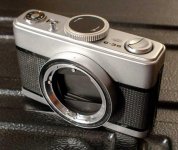
My landlady handed me a box today, filled with old photo gear, most of it was pure junk, but what about these two:

4556372022_413d0a4248_o.jpg

4556005864_1320229a58_o.jpg

4555742877_46e0f0cb47_o.jpg


I am in no way thinking about selling them, but still I've been looking around on the web, trying to find out if they have any value?

Particualry the Non-SLR is hard to find any information about.

Can somebody here help me out?
 
Both are killer finds. That's a wide-angle on the non-FT, right? I believe that is a collector's item.

EDIT: hmm, maybe not...is that the original Pen? Or an S maybe? I thought for a moment it was the W but it isn't...
 
Last edited:
The non-FT is sporting a 28mm f/3.5, which would be something like a 40mm on FF, yes?
The FT is fitted with a 38mm f/2.8.
 
The two-lug 'original' Pen is quite common, but a fantastic & dependable picture taking machine. And yes, right around 40mm..

The FT has the highly-desirable 'pancake' 38. Not at all common these days, and if in good shape, is worth quite a bit.

There are lots of resources out there for the non-slr Pens - here are two: LINK & LINK.

Use & enjoy both, i say. 🙂
 
The 38/2.8 is quite rare and, if clean (looks like yours has a filter on it) can run for US 400 or more. Use them, they are cool cameras.
 
Very nice little cameras, anj273; should be fun to use.
The Pen FT model was introduced October 1966 to join the 1963 model F, adding TTL metering and changing from double-stroke film winding to single-stroke. Rotary focal plane shutter with speeds B, 1-1/500sec with flash sych at all speeds. Some find the metering setup fiddly and inconvenient, but Olympus sold quite a few of the FT model, so they're not hard to find. There were scientific versions, too, made for use on microscopes, etc, and some of these (ones with viewfinder modifications) are unsuitable for general photography, so this is something to be careful about if shopping on eBay, for instance.
 
Great links, thanks alot 🙂
No sweat. I have many more - will dig them up and report back.

If you're planning on using the FT anytime soon, you should plan on having it serviced, otherwise chances are good that it'll start acting up (or just plain lock up) right as it becomes your favorite camera.. John Hermanson @ zuiko.com is your go-to fella for that job.

The Pen 'O' should theoretically be good-to-go 'out of the box', barring any lens maladies (fungus, etc.). There's just not much to go wrong with them!

The pancake 38 is certainly a prime contender in the 'cutie lens dept'., but you might also want to seek out the standard-issue 38/1.8 at some point. Faster, focuses much closer, and is still quite small. Just an all-around stellar lens.
 
I can't wait to get to use these - Especially the Pen 'O' seems like it would be perfect for some street photography. Small, anonymous and very silent 🙂
 
...
The Pen FT model was introduced October 1966 to join the 1963 model F,...

Its more that the FT and its partner in the palace coup, the FV, replaced, rather than joined, the F. The FV being a meterless FT, and could be argued the FT's real replacement. The FV was short lived as meterless SLRs fell from fashion very quickly after its introduction.
 
The original F stayed on for a bit after the FT's introduction, not sure how long, maybe a year or two. And as I understand it, the FV then took the F's position as the less expensive unmetered option, giving up the F's decorative script on the front (as did the FT of course), but gaining the FT's single-stroke film advance.

I have an FV, but its viewfinder isn't as bright as that of one of my FTs... at this point when they're several decades old, I think individual variations in the cameras plays a significant role in condition.

My FV was used for some scientific or medical purpose... while the focusing screen and viewfinder are "normal", the self-timer lever was stubbed off.
 

Attachments

  • Olympus Pen FV.jpg
    Olympus Pen FV.jpg
    30.8 KB · Views: 0
There were scientific versions, too, made for use on microscopes...

The C-35 was the microscope camera--smaller than a Pen, but full-frame 35mm. Microscope cameras tend to have the most drastic and easiest viewfinder conversions--you rip it out. SLRs were never converted to microscope use as focusing is impossible with a ground glass--the C-35 sat above a shutter unit with a focusing telescope.
 

Attachments

  • c_35.jpg
    c_35.jpg
    49.9 KB · Views: 0
Last edited:
All 35mm OMs could be used on Olympus microscopes via an ocular adapter and a special ocular (this the right word ?). I know, I have both at home. There were adapters with and without viewing bino.

Roland.
 
All 35mm OMs could be used on Olympus microscopes via an ocular adapter and a special ocular (this the right word ?). I know, I have both at home. There were adapters with and without viewing bino.

Roland.

Compound research microscopes had/have dedicated cameras, like the C-35. These are mounted with a separate shutter/exposure unit via a trinocular port right above the eyepieces. I have an Olympus Vanox Universal with the last incarnation of the C-35 line (C-35AD-4) as well as a 4x5 microscope camera.

But you are right that you can mount any camera on a microscope. The advantage to the microscope camera is it had no shutter. The shutter was housed in a special mount that isolated the vibration of the motion. The shutter you see on the C-35 is simply a darkside that closes when the camera is removed from the mount--the "shutter release" button simply allows the film to be wound forward.
 
Last edited:
The versions of the F/FT/FV that I was referring to, the ones to avoid on eBay, KEH, etc, have a circular non-focusing viewfinder image. And I think there are variations on this theme. Don't know what kind of instrument they were intended for, but probably dental/medical/forensic labs.
 
The versions of the F/FT/FV that I was referring to, the ones to avoid on eBay, KEH, etc, have a circular non-focusing viewfinder image. And I think there are variations on this theme. Don't know what kind of instrument they were intended for, but probably dental/medical/forensic labs.

i wonder if it was for a gastro camera (the forerunner to an endoscope). Olympus pioneered this technology. They were developing these during the Pen development. A gastro scope would have a small image circle and so a half-frame may be just the ticket and it might explain the circular viewfinder.
 
Last edited:
Back
Top Bottom