CN-film/Rodinal/stand

petronius

Veteran
Local time
9:03 PM
Joined
Oct 4, 2006
Messages
3,177
Location
Southern Germany
I did some tests lately:
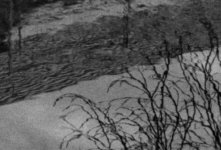
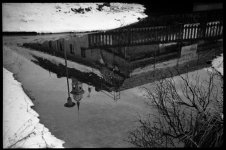
The first example is from a KodakBW400CN, developed in Rodinal 1+100, one hour stand developed (30secs agitation at the beginning)

Camera Olympus Superzoom 120; scanned with Canoscan 8400F, 3200dpi grayscale mode.
 

Attachments

  • BW 2009-036.05.jpg
    BW 2009-036.05.jpg
    42.1 KB · Views: 0
  • BW 2009-036.05crop.jpg
    BW 2009-036.05crop.jpg
    35.9 KB · Views: 0
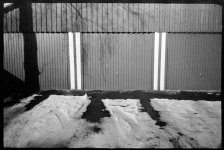
The second example from a Kodak Farbwelt 400, developed together with the film above.
Camera was the Konica C35AF2; same scanning data as above.
 

Attachments

  • BW 2009-035.08.jpg
    BW 2009-035.08.jpg
    44 KB · Views: 0
  • BW 2009-035.08crop.jpg
    BW 2009-035.08crop.jpg
    35.3 KB · Views: 0
I'm considering stocking up on Rodinal since it keeps so very long, and might use it with Kodak 100TMX and 400TMX. It's supposedly alright with Ilford FP4 as well, and just today I found an old Tri-X Pan box with load for five 35-shot films that expired in 1974 🙂

Any chance these will also provide good shots with 18 degree Celcius stand development, you reckon?

Danke sehr für Irhe Auskünfte!
 
Trix and Rodinal 1:100 is indeed possible. I don't have any examples with me as I am not on my home computer, but I use Rodinal 1:100 whenever I shoot Trix at 250 and it produces, to my eye, wonderful results. I use a semi-stand method.
After reading a thread here a while back I tried a true stand method with Trix shot at 400 and using Rodinal at 1:100 and got very high contrast. I think part of the problem was that I needed to expose for highlights instead of the shadows, something that is difficult for me to change.
 
I've grown to like triX at iso800 in Rodinal 1 to 50 for 20 minutes with an inversion every 3 minutes. Thre is grain()!) but the tonality is nice


Mike
 
I thought I'd drag this thread back from the archives to add some results of my own. I had a roll of Kodak BW400CN C41 laying around and decided to use it yesterday and give it a whirl in Rodinal. I mixed up 500ml of developer using 2ml of Rodinal which gives 1+250 of course and stand developed with no agitation after the initial minute for three hours ... I didn't bother to check temperature either.

The results were excellent and if anything a little over developed ... if I do it again I'll probable cut back the Rodinal to 1.5ml as I think that would be sufficient ... or possibly use the same amount but reduce the stand time!


bw400cn_2.jpg


bw400cn_5.jpg
 
Last edited:
Amazing tonality, Keith! Really beautiful. Do you find printing through the orange mask to be a problem or are you just scanning and producing digital prints?
 
Amazing tonality, Keith! Really beautiful. Do you find printing through the orange mask to be a problem or are you just scanning and producing digital prints?


Just scanning Al ... I don't think the heavy orange mask of the Kodak C41 would be too friendly for conventional wet printing. It's actually a little hard to scan also ... mainly time wise! I normally scan at 4800 to give around 50mb tiffs but at that resloution the scanner would take an hour and a half to scan twenty four negs ... reducing it to 2400 it still took forty five minutes.

Those two images took minimal adjusting of curves in post processing. I was surprised at how good the tonality was I must admit!
 
Cracking good results, Keith, especially the second image. Can't say I'm tempted to stray beyond conventional (C41) processing for these films myself; when I want to do my own souping, I just shoot conventional b/w. Doesn't mean I can't enjoy the results of those choose to go the long way 'round. 🙂


- Barrett
 
When you use a B&W developer like Rodinol you're not activating the color couplers in the emulsion. You're getting a pure silver image rather than a dye image. It'd be really nice if somebody came up with a bleach formula for getting rid of the orange mask.
 
Cracking good results, Keith, especially the second image. Can't say I'm tempted to stray beyond conventional (C41) processing for these films myself; when I want to do my own souping, I just shoot conventional b/w. Doesn't mean I can't enjoy the results of those choose to go the long way 'round. 🙂


- Barrett


The only reason I do it myself is I have a few rolls of the stuff laying around and I'm too tight to give the local one hour six bucks a roll to process it! 😛

Great idea Al ... surely some chemist out there can tell us what would do it!
 
Is Digital ICE a no go with these negatives?

Regards, John


You can scan as a colour negative allowing you to use 'ice' but the orange mask influences the results giving a cast that you can remove by greyscaling afterwards.
 
You can scan as a colour negative allowing you to use 'ice' but the orange mask influences the results giving a cast that you can remove by greyscaling afterwards.


Thanks, I was not thinking of that, but can see that is another variable.

I tried several times to use Digital ICE on traditional silver images, and found that it just does not work on silver images, but rather seems designed to be used on dye formed images. It must be shut off for normal B&W negatives.

If the C41 film, if I am reading correctly, is processed this way, and the image ends up being a silver image, I wanted to know if such an image in incompatible with digital ICE.

I was told by a friend that the Digital ICE sees silver grains as a "problem" to be dealt with, the results were rather bizarre.

Regards, John
 
has anyone used the Ilford XP1/XP2 with Rodinal 1:100 stand developing? I "inherited" a bag full of them.
Might shoot a couple and see how it works, but if anyone has already done it - it would save me from "testing".
 
I have a couple of Kodak 400CN rolls in the fridge now and to get them processed locally involves driving 30+ mins to the local place. Can you post the developing times here for Rodinal and technics?

What is this "stand" developing? No agitation for an hour? I am guessing normal B&W fixer should work? I have done some research on C-41 processing and my understanding is there are just a few extra steps to release the dyes but the rest of the chemicals are the stuff we use for B&W.


Is the key ratios like 1+100-250?

Thanks guys!

~m
 
Back
Top Bottom