Despicable practices

Despicable practices

  • Scanning your film negatives to digital

    Votes: 6 4.2%
  • Artificially adding film grain to your digital files

    Votes: 138 95.8%

  • Total voters
    144
  • Poll closed .

MiniMoke

Well-known
Local time
4:09 PM
Joined
Nov 20, 2012
Messages
444
Location
Luxembourg
EDIT: I do not want you to take this too seriously! I do not want to start any wars. The term 'despicable' is used ironically!

Please keep this in mind when reacting to this poll

Thanks


I wonder which of these practices is more despicable.

A poll for the purists among us.....

And please elaborate your choice if you like

Strangely I voted for the scanning option. Scanned film becomes just another digital file, partly loses the inherent quality of film and makes the whole process of shooting film a bit pointless.

On the other hand, adding grain, while not a good practice, might be seen as an aesthetic technique.

But I might be wrong (or change my opinion....)
 
While scanning might be unavoidable if no darkroom / professional lab is present, I don`t get it why people would try to make digital images looking like scanned film.
 
O.k. Scanning film serves me two things, one being archival purposes and the other one being able to show my photos taken on to distant friends.
There is nothing wrong with that.
Imitating film on an all digital photo is something that I don't like. Don't take me wrong on this, I just don't like it.
 
uh oh...scanning film is bad?

uh oh...scanning film is bad?

Scanning film allows you to turn all the great vintage film cameras from yesteryear into digital cameras, for minimal cost after the initial capital outlay if you do negative development at home. I am having such a great time using a plethora of old classics, brewing my own negatives getting delicious superb (IMHO) megapixel images... I wonder why anyone would sit around and fume over this...
 
I wonder why anyone would sit around and fume over this...


Don't understand me wrong, I'm just asking your opinion! Not condemning anyone for anything!

I'm scanning negatives, I added grain to digital pictures, so I'm twice 'guilty'.

I should have put 'despicable' between quotation marks and put some smilies around I guess..... 🙄
 
Not voting.

There is a legitimate reason for adding grain to digital images. Very large prints - say a over a metre across from my 36 MP Nikon D800E - are improved by adding barely visible noise, counter-intuitive though this seems. (The other solution is to sell my house and buy an 80 MP digital back so I can print large!)

(Aside: the large print = greater viewing distance = less image resolution argument has a flaw - people do stand back to view the entire print, but they'll also go up close too, so however large my print, I endeavour to make it as perfect as I can when seen from a few centimetres.)

The added texture breaks up unnatural-looking edges, blocks of solid tone and other artefacts, and also gives the image an extra sharpness. It's a known technique among some professional printers (search the web) - I use it for both inkjet and traditional C-type prints.

I use film grain because it gives a natural appearance at a press of a button. Using "standard" computer-generated noise like Gaussian is unsuitable because it's too crude - too regular, affects highlight and shadow areas equally, etc. The noise needs to be random and affect certain areas differently (e.g. less in the highlights).

Yes, you can modify Gaussian noise with layers and transitions to give the effect wanted, but it's a lot easier to use a "film grain" plug-in in Photoshop! Most of these plug-ins don't create grain that truly looks like it does in real film - but I don't care because they achieve all my other aims.

By the way I shoot both film and digital - not really relevant I know, but just thought I'd point out I am a film user...
 
I personally don't see any issues of having a piece of color negative (or positive) film properly scanned and then printed onto RA-4 paper. That process doesn't lose the qualities of film at all. It still retains all those desirable properties of film and I disagree that the scanned negative becomes some sort of 'undesirable' digital image.

Several years ago I was included in the Huntington's retrospective of the history of Los Angeles photography (http://www.photoeye.com/bookstore/citation.cfm?catalog=MR035) My print was scanned from a 6x9 C-41 negative with the Aztek Premier drum scanner and printed on Fuji Crystal Archive paper with the Océ Lightjet. I happened to also own a 'conventional' print printed on the same paper with a Durst dichro enlarger and printed through a Kreonite RA-4 color processor from that same negative.

The print from the scanned image and the print from the dichro enlarger looked identical. However, I was able to correct and fine tune the file after scanning to where the Lightjet print ended up as the much better looking print (which was used in the exhibition and the book.) The majority of well-known artists who I am personally familiar with and who still use film have their film drum scanned and printed onto chemical based paper (either via Lightjet, Lambda, or Chromira.)

I also find that motion pictures which are captured on film also still have that 'film-like quality' despite that they are being shown via digital projection in the theater. In fact I don't think many of us have seen a film projected in the conventional sense for a while now. Most all theaters have gone to a DCP.
 
Here we go again ... obsessing about the process with little thought for the end result ... an image!
 
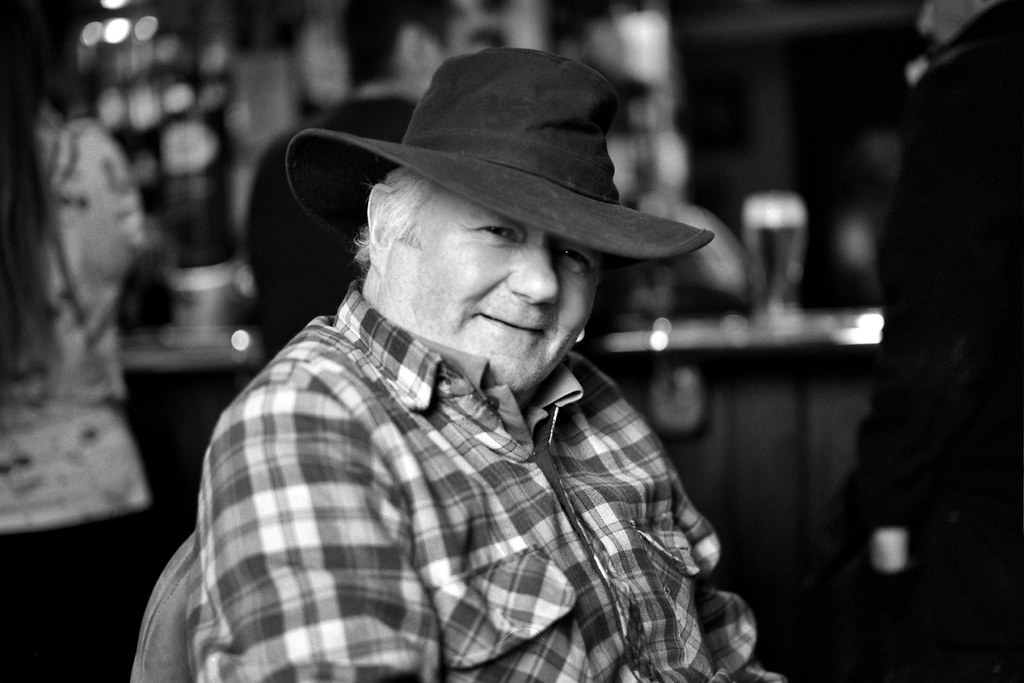
... what Keith said, here is a photo made by one of the above methods

2371471976_b7235c6b92_b.jpg
 
Disregarding the fact that 'despicable' is a totally inappropriate word in this context, it's an absolute fallacy that "scanned film becomes just another digital file, partly loses the inherent quality of film and makes the whole process of shooting film a bit pointless."

The captured image looks totally different when captured on film: not only the color rendition and dynamic range of film, but even other factors such as the transition between in-focus and out-of-focus, the general rendering of highlights, the overall texture of the image and so on. When I was beginning my discovery of film six or seven years ago I made a lot of comparison shots with the same lens on digital and film cameras, and the way the final image turned out was totally different - I was often surprised by how big the difference was.

In addition, I like the quality of the image after scanning. I still use digital, but if I'm shooting in sunlight then nothing beats the look of a film like Portra, in my experience. Scanning may indeed lose some of the dynamic range and/or alter the color rendition somewhat, but I absolutely can't get my digital images to match the beauty of scanned Portra - especially in MF.

As for adding grain to digital files - when I was working in advertising we were doing things like this all the time. I've worked on global campaigns with people like David Beckham and Lionel Messi, where we took images taken with MF digital and the retouch company made them look like they were shot with LF Polaroid. They did an amazing job, but the final image always feels like a fake product to me, and when I do something like this with my own digital images I feel like I'm somehow just fooling around. But people should do what makes them happy.
 
obsessing about the process with little thought for the end result ... an image!

Obsessing about only the process is what can be problematic. But the process and the end result are fully related to each other. What might be better stated is that one should be fully aware of the processes while investing a lot of thought in the end result, i.e., the content and context of the image itself.

Just for fun, remember Process Art of the mid-1960s? They emphasized the process and not the end result. The point being that the very act of production was more important than the object itself. The object was simply a by-product of the physical act of doing (and 'doing' was the art itself.) Anyway, not quite applicable to photography. 🙂
 
OK, sorry to all offended by this poll! 😱

I didn't want to kick loose any storm!

Sorry also to those who didn't understand the term 'despicable' the way I intended it - ironically.

I'm by no means a purist, I'm a miserable dabbler in photography.

Above all, don't take everything so seriously pleeeeeez
 
OK, sorry to all offended by this poll! 😱

I didn't want to kick loose any storm!

Sorry also to those who didn't understand the term 'despicable' the way I intended it - ironically.

I'm by no means a purist, I'm a miserable dabbler in photography.

Above all, don't take everything so seriously pleeeeeez


I know you're intentions weren't malicious and I realise there was a lot of irony in your words ... but the trouble is you opened the door for any process biggot who wants to drop by and vent their spleen! 😛
 
Thanks Keith....!

Guess I opened Pandora's Box.

Only one thing could have been worse I think, like saying Leica makes bad cameras 😀...... (this is irony by the way)!!

Any way to close this poll / thread? Please mods!
 
Back
Top Bottom