(East?) German photography pass?

Terao

Kiloran
Local time
11:13 PM
Joined
Aug 14, 2006
Messages
962
Location
Southampton, UK
Anyone know what this piece of paper means that I got with my Jupiter 9?

Its a small square with the following text (most of which I can hazard a guess at)

"Pass fur fotografisches Objektiv "jupiter 9"

F=84.5 +- 0.85mm
Relative Offnung - 1:2
Schnittweite - 28,8 +- 0,02mm
Auflosungsvermogen:
Zentrum - 33 striche/mm
and den Randern - 18 striche/mm

"Kontrolleur der Abteilung fur Gutekontrolle"

50-72

Stamped 20th of something 1972...
 
Terao said:
Anyone know what this piece of paper means that I got with my Jupiter 9?

Its a small square with the following text (most of which I can hazard a guess at)

"Pass fur fotografisches Objektiv "jupiter 9"

F=84.5 +- 0.85mm
Relative Offnung - 1:2
Schnittweite - 28,8 +- 0,02mm
Auflosungsvermogen:
Zentrum - 33 striche/mm
and den Randern - 18 striche/mm

"Kontrolleur der Abteilung fur Gutekontrolle"

50-72

Stamped 20th of something 1972...
Wow! A German version of the "passport"! Not necessarily DDR. All FSU lenses came with their 'papers' which described their type and tech specs.

The first would tell about the actual focal length of the lens.

2nd line is maximum aperture.

Third line is 'working distance'- 28,8mm +/- 0.02 mm, which refered to the flange-to-film distance the lens will need to focus properly. That BTW is the standard Leica TM working distance.

Third and fourth lines describe the lens resolution at the centre and edges of the frame. The figures would seem low, but it could be that the Soviets used different standards/ film resolutions for determining values.

And last is the ID of the person who inspected it. The date of manufacture was often also included. These Passports are often found in Russian.

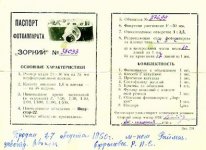
"Passports" were also issued for cameras. Seehttp://jay.fedka.com/index_files/Page334.htm
 

Attachments

  • image764.jpg
    image764.jpg
    35.9 KB · Views: 0
Last edited:
My grandfather in Holland had a passport for his Rollei. And my uncle in East Germany had a passport for his Leica. Camera's where very valuable these days and they had to be declared when passing the border. To prevent smuggling, passports where made for lenses and cameras for an official ownership.
 
It seems to be a QC inspection check card.
Can´t tell you if its genuine or not, but it carries some data of the lens plus the tolerance to which it´s made, as well as the resolution in lines /mm.
The stamped date should be the valid one.
If the card is genuine, your lens was an export version and probably it was really checked before leaving factory.
Hope it´s not a fake card.

Ernesto
 
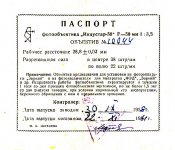
These "passports" contained very little in them, other than the serial number of the item, which could be used for proof of ownership. What it had were just the lens' technical data. Passports were issued to all lenses, whether for domestic or export consumption. These papers were in the 'bundle', along with the instructions leaflets, if there were any. Passports were part of the package, to the extent that front and rear caps were.

Attached is a 1958 passport for an Industar-50 lens for FED, Zorki, or, given its specs, even a Leica! 🙂
 

Attachments

  • I-50passport.jpg
    I-50passport.jpg
    79.5 KB · Views: 0
Last edited:
ErnestoJL said:
If the card is genuine, your lens was an export version and probably it was really checked before leaving factory.
All Soviet lenses came with QC inspection certificates, domestic or otherwise. Two of my Jupiters have exact same passports, albeit in Russian.
 
Interesting 🙂

I had visions of it being something issued by the secret police giving you the authority to carry the lens 😀 but then I was brought up on John Le Carre.

Mine's a nice example, complete with plastic screw-top case and correct front and rear caps. Focuses accurately on my R-D1, very clean but with massively oily blades. The paper matches the lens in that it has the serial number on it, given its condition I would say its genuine (has been folded in four to fit in the bottom of the case...)
 
Hi,

You can usually find prices on these papers, or on the pakaging. Sometimes prices are engraved or stamped on the products. An interesting evidence of Soviet ecomony.😀 However, prices were not fixed over the years. I saw price rise on my Jupiter-9s. After about 1991-1992, prices were no longer indicated when Russia went capitalist.

Cheers,

Zhang
 
Back
Top Bottom