


- Forums
- Rangefinder Forum
- Image Processing: Darkroom / Lightroom / Film
- Film / Developing / Chemistry
You are using an out of date browser. It may not display this or other websites correctly.
You should upgrade or use an alternative browser.
You should upgrade or use an alternative browser.
Got this after developing my first t-max!
- Thread starter Rhodes
- Start date
- Latest activity Latest activity:
- Replies 19
- Views 2K


dfoo
Well-known
Looks like lots of dirt/dust, and you didn't have enough developed in the tank.
Rhodes
Time Lord
I see, but the volumes were correct to that tank. The fixer time was less that i should be. Many of the white spots are pink spots on th negative!
dfoo
Well-known
What type of tank is it? And how much developer did you put in? How long did you fix the negs? You could try re-fixing the negatives and see if the problems go away. However, if you are using rapid fix, it fixes the negatives quite quickly...

bsdunek
Old Guy with a Corgi
I would agree with dfoo. Also, it could be some sort of sediment that stuck to the film and dried there. How well did you wash? Did you use a wetting agent? How clean was the room you hung the film to dry? Part of the problem could be in these areas.
Of course, I've never had any of these problems, so don't get discouraged. Just analyze your process and try some more - you'll get there!
Of course, I've never had any of these problems, so don't get discouraged. Just analyze your process and try some more - you'll get there!
Rhodes
Time Lord
Some many questions...ehehe it’s a paterson universal tank model II. 310 cc for 35mm film, by my math, it's about 62 ml of developer+248 ml of water. The fixing was 5m, but according to kodak, this time of film has to have a longer fixing. Yes, I use ilford rapid fixer. Didn’t know I could re-fix a film, thanks. By the way, during the fixing, should I invert the tank 10s or 5s every 1 minute? More invertions? Or less?
Well, I wash during 20m, only water. The room was "normal" clean, it's a bathroom.
I always have trouble during the load of the reel; I described my adventure in another thread here.
Well, I wash during 20m, only water. The room was "normal" clean, it's a bathroom.
I always have trouble during the load of the reel; I described my adventure in another thread here.
dfoo
Well-known
I think you need 350ml for that tank. 5 minutes is plenty long for fixing. When I fix I agitate the tank for the first 30s, and then let it sit for 4:30. Actually, I doubt any agitation is necessary. If you stick a piece of film in the fix, it will clear very quickly.
Rhodes
Time Lord
I see, thanks.
Well, in the cover of the tank, the solutions for the various type of films, 35mm is 310cc, so I follow it, since, first time, do by the book! 250ml is the mininum, since with that volume, the film reel is completly immerse ( And i did it to develop a small fragment of film and is did the work). If 350 is better, since it takes more cheamicals, i'll do this next time.
Well, in the cover of the tank, the solutions for the various type of films, 35mm is 310cc, so I follow it, since, first time, do by the book! 250ml is the mininum, since with that volume, the film reel is completly immerse ( And i did it to develop a small fragment of film and is did the work). If 350 is better, since it takes more cheamicals, i'll do this next time.
dfoo
Well-known
I'm not 100% sure... but it definitely looks like the reel was not fully immersed. See the dark streak at the top of the negative. Is it a multi-reel tank? Perhaps you didn't have the reel pegged down? In a multi-reel tank its always better to use all reels whether or not they have film on them.
One way to avoid this issue is to fill the tank up all the way. What I did for a while was use straight up D76 with a two reel tank. I'd have a 1L bottle, and then fill the tank up all the way. I'd then develop 10 rolls of film in the straight D76 reusing the developer each time. This worked out very well, and all the negatives were well developed.
One way to avoid this issue is to fill the tank up all the way. What I did for a while was use straight up D76 with a two reel tank. I'd have a 1L bottle, and then fill the tank up all the way. I'd then develop 10 rolls of film in the straight D76 reusing the developer each time. This worked out very well, and all the negatives were well developed.
Rhodes
Time Lord
I do not know. It as space for one more reel, but I do not have it. One half of the rell is attatch to the shaft, the other half is moveble one. I didn't do a 30 second inversion all the time. It was more 1 minute by one minute. The kodak sheet says to do 5 to 7 invertions each 30s. But the 310 ml of solution, the reel is tottaly imerse. I did with water to see if it was, and yes.
Last edited:
dfoo
Well-known
There should be a clip which holds the reel to the shaft. Are you using that? I don't think this is a agitation issue. I do 30s continuous at the start, and then 5-10s (5-10 inversions) every minute depending on the contrast I want to achieve.
Rhodes
Time Lord
The half that I can remove, yes. I was a clip, and the shaft has the various points for the various sizes of film. The other half is like "glue" or "cement" to the shaft and it's the lower half. I can take pictures of it and post here! (mobile phone pics...)
http://www.photomemorabilia.co.uk/Paterson/Developing_Tanks.html#anchorS2
Mine is the "Second Generation Paterson Developing Tank - '35' II and Major II"
http://www.photomemorabilia.co.uk/Paterson/Developing_Tanks.html#anchorS2
Mine is the "Second Generation Paterson Developing Tank - '35' II and Major II"
Last edited:
Bassism
Well-known
For helping with dust, I've found that using a bathroom, the best thing is to run a hot shower while washing the film. The steam in the air keeps the dust down.
Also, the streaks at the edges look to me like it might be dried sediment from your wash water. I get similar looking patches if I don't use distilled water and/or photoflow for my final wash. Not usually as dark or uniform as what you've got, but I suppose anything's possible.
But I'll leave it to the more experienced to speculate about developing issues.
Also, the streaks at the edges look to me like it might be dried sediment from your wash water. I get similar looking patches if I don't use distilled water and/or photoflow for my final wash. Not usually as dark or uniform as what you've got, but I suppose anything's possible.
But I'll leave it to the more experienced to speculate about developing issues.

maddoc
... likes film again.
One way to avoid this issue is to fill the tank up all the way. What I did for a while was use straight up D76 with a two reel tank. I'd have a 1L bottle, and then fill the tank up all the way. I'd then develop 10 rolls of film in the straight D76 reusing the developer each time. This worked out very well, and all the negatives were well developed.
When you develop 10 rolls of film by reusing one liter of straight D76, do you have to compensate the developing time ? (for partly exhausting developer ?)
dfoo
Well-known
I didn't compensate, although I did filter the developer after 5 rolls. I chose 10 rolls per liter because minimum D76 stock per roll is 100ml. Looking back on my negatives from that time, they're all pretty good! I was shooting in very contrasty conditions at that time, using delta 100. Compared to the negatives I'm processing these days, they look very good. I'm using XTOL these days 1+1... Perhaps I should go back to D76!
dfoo
Well-known
...
Also, the streaks at the edges look to me like it might be dried sediment from your wash water. ...
Its a good point. How did you dry your negatives? Did you hang the film strip vertically? If so, its highly unlikely that these are drying marks. If you left them in the reel to dry or somehow dried them horizontally this could be the problem!
maddoc
... likes film again.
I didn't compensate, although I did filter the developer after 5 rolls. I chose 10 rolls per liter because minimum D76 stock per roll is 100ml. Looking back on my negatives from that time, they're all pretty good! I was shooting in very contrasty conditions at that time, using delta 100. Compared to the negatives I'm processing these days, they look very good. I'm using XTOL these days 1+1... Perhaps I should go back to D76!
That sounds very good to me ! I will give this a try (albeit mostly using "old" type of BW films like Tri-X)
I also used XTOL after I had used D76 for a long time but don't like the 5 liter package that much ...
These days I use mostly HC-110 (easy to mix and long-life) and Diafine.

wjlapier
Well-known
I'm just a beginner like you, but after 6 rolls I'm happy with my results, so maybe I can share how I'm doing mine and see if that might help.
D76 1+1 and develop as manufacturer suggest. My tank calls for 375cc, but there is plenty of room so I mix everything to 400cc. Last roll was Ilford Delta 400 and was a 14 minute develop--10 sec agitation to begin and 10 secs per one minute.
Water rinse--30 seconds agitation
Fixer--5 minutes with 20 sec agitation to begin and 20 secs per one minute after.
Hypo clear--2 minute agitation
Rinse--5 minutes. At this point I turn on the shower with hot water and let the bathroom get steamy.
Photo Flo for 30 seconds and then it's off to the bathroom to remove film from reels. Turn off shower, no windows are open and the fan is off--only a light is on. I hang the film on SS clips and leave it to dry for ~ 3 hours. Turn out the light, close door when I leave and tell kids and wife to stay out of bathroom until I say it's clear.
After the drying is over I carefully take the film to a table in my kitchen and slowly and carefully cut the negs into strips of five images each and put into a Print File holder. Then it's off to the scanner downstairs and again, I carefully make sure I don't touch the negatives too much.
I do my developing in the kitchen and open the reels in the bathroom after the Photo flo was been in the tank for 30 seconds. Everything is the same with the exception of developing time for different types and speeds of film. So far I've done well I think.
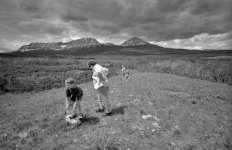
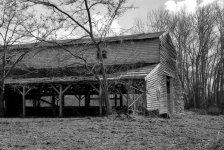
Sorry about being so long, but I wanted to be as thorough as I could. Here are a couple of shots. I'm still working on a workflow from scanner to print.
D76 1+1 and develop as manufacturer suggest. My tank calls for 375cc, but there is plenty of room so I mix everything to 400cc. Last roll was Ilford Delta 400 and was a 14 minute develop--10 sec agitation to begin and 10 secs per one minute.
Water rinse--30 seconds agitation
Fixer--5 minutes with 20 sec agitation to begin and 20 secs per one minute after.
Hypo clear--2 minute agitation
Rinse--5 minutes. At this point I turn on the shower with hot water and let the bathroom get steamy.
Photo Flo for 30 seconds and then it's off to the bathroom to remove film from reels. Turn off shower, no windows are open and the fan is off--only a light is on. I hang the film on SS clips and leave it to dry for ~ 3 hours. Turn out the light, close door when I leave and tell kids and wife to stay out of bathroom until I say it's clear.
After the drying is over I carefully take the film to a table in my kitchen and slowly and carefully cut the negs into strips of five images each and put into a Print File holder. Then it's off to the scanner downstairs and again, I carefully make sure I don't touch the negatives too much.
I do my developing in the kitchen and open the reels in the bathroom after the Photo flo was been in the tank for 30 seconds. Everything is the same with the exception of developing time for different types and speeds of film. So far I've done well I think.
Sorry about being so long, but I wanted to be as thorough as I could. Here are a couple of shots. I'm still working on a workflow from scanner to print.
Attachments
Last edited:
dfoo
Well-known
That sounds very good to me ! I will give this a try (albeit mostly using "old" type of BW films like Tri-X)
I also used XTOL after I had used D76 for a long time but don't like the 5 liter package that much ...
These days I use mostly HC-110 (easy to mix and long-life) and Diafine.
Funny thing is that I didn't actually want to use Delta. I was in a rush before Chinese New Year (when all the stores close for 6 days) and went to the shop to buy a brick of HP5 and and came home with delta 100! :bang: Doh!
BTW, when I did the D76 experiment I always filled my 2 roll tank to the brim with undiluted D76. I'm trying to find the original post that I found discussing this technique. I think it was on photo.net or apug.
edit: I looked, and I cannot find it. I did find some posts saying you should compensate +10% for each roll. There is a post on photo.net from David Lyga claiming 20+ rolls for 1L of D76 with no replenishment! http://photo.net/black-and-white-photo-film-processing-forum/00QqOZ
The reason I started down that road was because I wanted to use D76 undiluted, without having to mix up and pay for all that D76! I would be interesting to try it again...
Last edited:
Rhodes
Time Lord
Its a good point. How did you dry your negatives? Did you hang the film strip vertically? If so, its highly unlikely that these are drying marks. If you left them in the reel to dry or somehow dried them horizontally this could be the problem!
Yes, I hang it vertically! I do not use Hypo clear and Photoflow, may consider begining to! As I said, the marks on the negs are pink spots, when doing the scan, the resault is like having dust/dirt on the negs.
Similar threads
- Replies
- 15
- Views
- 2K
- Replies
- 17
- Views
- 477

- Replies
- 40
- Views
- 2K
