Handheld meter question

colyn

ישו משיח
Local time
7:05 AM
Joined
May 31, 2006
Messages
4,531
Location
CowTown, Texas
I am looking for a fairly new light meter that is capable of reading in low light such as street lights, candle light, etc.
I plan to do some nighttime shooting.
 
The Gossen Luna Pro F and Luna Pro SBC are pretty good in low light. Several RFF folks heartily recommend the Calcu-Light XP for low light work, given that it will meter to -7 EV. Unfortunately, this meter is no longer in production, but examples do show up on eBay occasionally.
 
Last edited:
colyn said:
I am looking for a fairly new light meter that is capable of reading in low light such as street lights, candle light, etc.
I plan to do some nighttime shooting.

Okay, let's do some number-crunching. According to a table I found here, an average full moon produces light amounting to about LV -3.5. Bright moonlight might get up to LV -1.8, while street scenes might range from LV +1.0 to LV +3.0 according to the table.

(The person who made up this table defines LV as EV at ISO 100; that's also how a lot of meter specifications are quoted, so we'll use EV and LV interchangeably from here on.)

That means that to meter a moonlit scene, you need a meter with a sensitivity range that goes down to EV -3.5. One meter people think of when it comes to low-light sensitivity is the Gossen Luna-Pro (or Lunasix in Euro markets) and according to its specs page on the Gossen website, it does indeed read down to -4 EV... just barely enough to meter the light of a full moon.

That figure is tough to match. The best low-light rating I could find among the other Gossen meters was EV -2.5; the best I could find among Sekonic meters was EV - 2.0. (Note that the popular "dual mode" meters that take both incident and spot readings usually only get down to their lowest ratings in incident mode, because of light loss through the optics of the spot meters.)

Among "vintage" meters, one that I happen to own that goes pretty low is the Weston Ranger 9, which also gets down to -2.5 EV. This is a relatively compact meter with relatively narrow acceptance angle and a little bright-frame viewfinder to help you aim it accurately. One big downside to the Weston is that it uses a no-longer-available battery, although I'm told that Quality Light Metric can recalibrate it to use a modern battery.

So overall, I'd say your best bet is a Luna-Pro, and even that will peter out under lighting conditions dimmer than full moonlight. But considering that really low light levels typically also involve correcting for "reciprocity law failure" (the fact that films lose effective sensitivity at really long exposure times) your exposure readings are only going to be starting-point guesses anyway. Be sure to take notes!
 
jlw said:
Among "vintage" meters, one that I happen to own that goes pretty low is the Weston Ranger 9, which also gets down to -2.5 EV. This is a relatively compact meter with relatively narrow acceptance angle and a little bright-frame viewfinder to help you aim it accurately. One big downside to the Weston is that it uses a no-longer-available battery, although I'm told that Quality Light Metric can recalibrate it to use a modern battery.

I have a couple of good working Ranger 9 meters that work good for downtown night metering. Check out my page for modifiying this meter for silver oxide batteries here

jlw said:
So overall, I'd say your best bet is a Luna-Pro, and even that will peter out under lighting conditions dimmer than full moonlight. But considering that really low light levels typically also involve correcting for "reciprocity law failure" (the fact that films lose effective sensitivity at really long exposure times) your exposure readings are only going to be starting-point guesses anyway. Be sure to take notes!

Someone mentioned the Calcu-Light XP. How does that compare?
 
I wasn't able to turn up any specs for the Quantum Calcu-Light XP on the web... not surprising, since it's been discontinued for many years.

I remember trying one out when they were new -- seemed to have good circuitry, but a really crummy case and controls. I passed.
 
Steph, I believe that the Luna Pro F is the US name for the LunaSix F. Gossen web site has manual downloads for old meters.

http://www.gossen-photo.de/pdf/ba_lunasixf_e.pdf

The Luna Pro F is a great meter, if kinda bulky and heavy. When I chose to use the Luna Pro F, I generally keep it in a coat pocket, belt mounted case from the Gossen Luna Star F, or a fanny pack. Big heavy meter, not too friendly worn around the neck, IMO. Also, I would recommend the Luna Pro F/LunaSix F over some of the older models because the "F" uses the readily available 9v battery. Some of the older LunaPro/LunaSix models use mercury batteries. Confirm the baterry type before buying one.
 
Last edited:
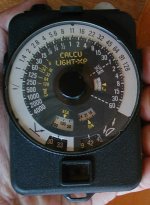
I use a Calcu-light XP and it is small, light and amazingly sensitive. Since I got it I no longer use the Euromaster (Weston V) or Minolta IIIF. It is a great little meter and reads down to -7EV at 100ASA. A pic of mine below, as you can see a nice easy-to-read dial. It gives you a digital read (incident or reflected) then you dial to the number and you have your range of f stops/speeds. It also has a memory button that recalls the last read.
 

Attachments

  • xp3.jpg
    xp3.jpg
    90.5 KB · Views: 0
Luna Pro SBC on eBay from USA seller with a BIN price of 58 bucks. I think that this is a pretty good price- normally go for 80 to 100 bucks. This one works down to EV -4 at ISO 100 (-5 at ISO 50, as shown on the table on the back of the meter).

Standard disclaimer; no connection with seller. I would be tempted to buy this, but already have a Luna Pro F and Luna Star F.
 
I found another possible candidate, the Spectra Professional IVA..

This meter is intended for cinematographers (although it also reads out in still-camera units) so it quotes its specifications in footcandles rather than EV; its low end is 0.1 footcandle. I couldn't find a clear-cut conversion from footcandles to LV numbers, but it appears that this is pretty comparable with the Luna-Pro and within 1-2/3 LV of the Quantum Calcu-Light XP (which is out of production.)

One feature it includes that seems pretty sensible for ultra-low-light work is a backlight for the display panel, so you can read the exposure data you're metering!

Anybody own one of these and care to comment?
 
I swear by my Minolta VF, which is also good for working out the zone system when you feel lazy.

Stu 🙂
 
Go with the best you can get. The Luna Pro sounds pretty good for the low light stuff. Me, I never could stand using the Gossen. Checked a couple out at the local stockist but just did't like them based on the wheel and then transfer the number after the reading and then yadda, yadda, yadda. I like digital readouts anyway soooo, I went with a Sekonic L-558. It only goes down to -2 EV but anything lower then that and I start getting scared of the dark. One thing though, the Sekonic meters feel big and they look big which does not go along with the rangefinder mentallity. Frigging light meter as big if not bigger then your camera! OH well. Works for me.
 
egpj said:
Go with the best you can get. The Luna Pro sounds pretty good for the low light stuff. Me, I never could stand using the Gossen. Checked a couple out at the local stockist but just did't like them based on the wheel and then transfer the number after the reading and then yadda, yadda, yadda. I like digital readouts anyway soooo, I went with a Sekonic L-558. It only goes down to -2 EV but anything lower then that and I start getting scared of the dark. One thing though, the Sekonic meters feel big and they look big which does not go along with the rangefinder mentallity. Frigging light meter as big if not bigger then your camera! OH well. Works for me.
I used a Luna-Pro for many years. Great meter... that's why it's a classic. The calculator is not really as bad as it seems. But if one has the money... the L-558 is the greatest. I just got one and I'm totally impressed with the breadth of capability. Size is an issue with it, though!
 
Luna Pro or Luna Pro S. I have them both. Great for low light. Most sensitive meter (EV -4 @ 100asa) that I have used. The S variant has a calculator dial for using filters. I've never had to got lower than -3.5.

My F1N SLR will go down to -2. My mechanical F1 with the special prism is -3.5. How sensitive is the OM SLR?

I've seen that Calculight XP number of -7 before. That's tough to believe. I've metered nighttime scenes with my F1 and special prism, that I could not see! The dial may read -7, but the sensitivity is probably higher. Their other models list only -3 on their web site. My Luna Pro dial reads down to -8, even though their specs state the sensitivity is -4! Isn't -7 below human vision in most circumstances?
 
lmd91343 said:
I've seen that Calculight XP number of -7 before. That's tough to believe.

My Minolta Auto Pro has -7 on the scale but the closest I can get to that is -3 at 6asa which translates to ev 1 at 100asa.
 
colyn said:
My Minolta Auto Pro has -7 on the scale but the closest I can get to that is -3 at 6asa which translates to ev 1 at 100asa.


What was the Canon ad for the F1N?

"If you can see it, you can shoot it"

The F1N can meter down to -2 EV at asa100.
 
lmd91343 said:
I've seen that Calculight XP number of -7 before. That's tough to believe. I've metered nighttime scenes with my F1 and special prism, that I could not see! The dial may read -7, but the sensitivity is probably higher. Their other models list only -3 on their web site. My Luna Pro dial reads down to -8, even though their specs state the sensitivity is -4! Isn't -7 below human vision in most circumstances?

Meters need those lower numbers to accommodate film speeds lower than 100.

Remember, an EV number by itself does NOT have anything to do with light levels -- it's just a shorthand for a set of shutter speed/aperture combinations. For example, EV 0 refers to 1 sec. @ f/1 or any equivalent combination, such as 2 sec. @ f/1.4 or 4 sec. @ f/2. It's just a way of designating camera settings by a single number.

To get this number to specify a light level (to avoid confusion, let's call this an LV number) you also need to specify an ISO film-speed rating. Customarily the rating used is ISO 100. So for example, the amount of light we call LV 0 is the amount of light for which an exposure of 1 sec. @ f/1 gives you a correct exposure on ISO 100 film.

If you're using a slower film under the same lighting conditions, you'll obviously need to give more exposure. For example, with ISO 25 film (two stops slower than 100) you'd need to give two stops more exposure -- 4 sec. @ f/1, for example. The EV number -- remember, this is just a way of specifying camera settings -- that corresponds to a setting of 4 sec. @ f/1 is EV -2.

So, even though the light level is still LV 0, your meter needs to read down to EV -2 to show you the correct settings for ISO 25 film at that light level.

It may sound confusing, but if you get out a dial-type meter and play with the different dial settings, it should become clear quickly. Just set the pointer to a particular light level and leave it there. Set the calculator dial for ISO 100 and note the reading you get in the EV window. Now set different film speeds and notice that you'll see different EV readings -- even though the light level hasn't changed.

That's why you may see really low EV numbers on a meter that isn't particularly sensitive. Those low numbers simply let you read out exposure values for slower films. My Weston Ranger 9, for example, can be set for ISO numbers as low as 1.5! (yes, there used to be films that slow.) At that ISO setting, an LV of 0 (for ISO 100, remember) translates to an EV of about -6! That's because a film with a speed of ISO 1.5 would be about six stops slower than an ISO 100 film, so you'd need to give it six stops more exposure under the same lighting conditions.


Now, getting back to what human vision can do: According to the chart I referenced in my last post, an LV of -7 corresponds roughly to the light of a quarter moon.

No, that's not much -- but if you're reasonably young and in good health, and give your eyes enough time to get adapted to the dark, you can see well enough by a quarter moon to at least avoid tripping over the landscape, although that's probably about all you can see. If you ever go camping, though, getting well away from city lights and letting your eyes get well-adapted to the dark, you'll be surprised at how well you can function under the light of even a crescent moon (LV -10.)

And all of us who have ever done darkroom work know that after you've sat in a dark darkroom for a while, you can start to perceive shapes and movement from even tiny light leaks; surely you've had the sensation while loading film reels of saying, "I can see my hands moving, my film is going to be fogged!"

There's no light meter that can match the eye's sensitivity to these really dim light conditions, although film itself can easily record an exposure if you leave the shutter open long enough.


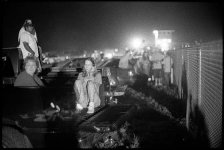
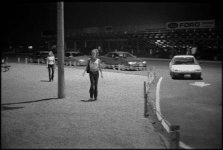
For a couple of practical examples of photography on the darker fringes, I've attached two of my late-night drag racing pictures. These were taken outdoors, lit by distant street lamps, under light so dim I couldn't quite read my meter dial: I just set the slowest shutter speed I thought I had a prayer of hand-holding, which was 1/8 sec., and cranked my Canon 50/0.95 lens open to full aperture.

This combination translates to an EV of 3; allow for the fact that I was using Kodak T-Max P3200 film rated at 1600, and you can see that the corresponding LV was -1. Under these light levels I had no trouble seeing well enough to move around without running into things. On the other hand, it wasn't until I got home and developed the film that I was able to see that the woman sitting in the truck bed in picture 1 was talking on a cell phone, or that the girl in picture 2 was wearing a midriff-baring top. You can also see that my hand-holding ability at 1/8 was actually pretty crummy; for serious pictorial photography under these conditions, you'd definitely want to use a tripod!

These results suggest that a meter capable of reading down to LV -2.5 should get you right down to about the limit of the dimmest light under which you can photograph "casually." This would be a light level requiring an exposure of about 1/8 sec. @ f/1 on ISO 3200 film. Since 3200 is about the fastest practical film speed rating (if you care about shadow detail at all), f/1 is the fastest lens you can buy, and 1/8 sec. is the absolute dicey limit of hand-holding for most of us, this combination of settings is pretty much rock bottom for hand-held photography.

Anything significantly dimmer than that and you're going to be in the realm of tripod-mounted long exposures and reciprocity-law-failure calculations -- conditions under which you're probably going to want to make several bracketed exposures and pick the one that gives you the results you like, rather than assuming a single "correct" exposure based on a meter reading.

 

Attachments

  • 02-08-01_34.JPG
    02-08-01_34.JPG
    61.9 KB · Views: 0
  • 02-08-02_06.JPG
    02-08-02_06.JPG
    60.3 KB · Views: 0
Last edited:
Jlw,

Thank you for the answer on the human vision. It has been so long (decades) since I've done wet darkroom stuff, I forgot what the extreme light was like.

In the first part of my post I biased the EV values against asa100. My point was that the Calculight XP sensitivity spec seems too extreme. For instance, Just because my Luna Pro has EV values on the dial down to -8 does not mean it can measure to -8 (asa100). I wonder if the calculight spec is wrong.

I have not encountered anything outside, that my Luna Pro or my F1 with the special prism could not measure. Like you, I found things in the shot I did not see. Using my F1, I've had to guess focus because I could not see thru the prism! Most of my dark shots have been here in L.A., where even with a new moon there is always ambient light. That could be why I never gone below -3.5EV (at asa100)

I've used Kodak C41 Supra 800 emulsion (at 800 & 1600), that will handle exposures to 10 seconds without reciprocity corrections. So I've never given a second thought to reciprocity. Then of course C41 has a lot of latitude too, giving mis-exposed shots a good image on celluloid.


jlw said:
Meters need those lower numbers to accommodate film speeds lower than 100.

Remember, an EV number by itself does NOT have anything to do with light levels -- it's just a shorthand for a set of shutter speed/aperture combinations. For example, EV 0 refers to 1 sec. @ f/1 or any equivalent combination, such as 2 sec. @ f/1.4 or 4 sec. @ f/2. It's just a way of designating camera settings by a single number.
 
Back
Top Bottom