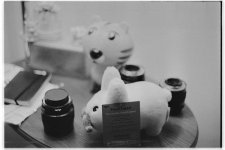
Having an issue with 1+100 rodinal semi stand development

gerbilthemistake

Well-known
Local time
7:43 PM
Joined
Nov 30, 2007
Messages
205
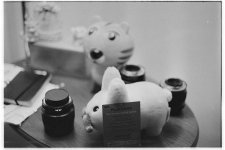
After reading the thread about the benefits of standing development, I thought i'd give it another shot. The outcome was pretty good except for the white line that has come across each negative. Here are the steps i took:

test roll of 10-15 frames on 35mm Arista Prem 400
Hewes Reel
4+400 Rodinal
1st min I did slow inversions
30min mark I did 3 Inversions
Hour I poured out and rinsed
Fixed
Washed
Wetting agent
All taken with a working Olympus OM1 50 1.8

If anyone can tell me why each of these pictures have that white line across it thatd be great.
 

Attachments
  • 3.jpg
    3.jpg
    22.1 KB · Views: 0
  • 4.jpg
    4.jpg
    20.8 KB · Views: 0
Last edited:
My theory is, these stripes come from exhausted developer running down the film to the bottom of your can.

I've been experimenting with swirling instead of inverting and leaving the can upside down for the second half of development time. My results show improvement, but no eradication of these effects.

Sometimes even the edges of the negative "glow".

Arista Premium 400 is the films that reacts the strongest to this method of development. I get black water when I pour out the developer at the end of the hour...100 speed film and modern emulsions seem to be much more forgiving.

I have not tried a modern 400 speed film.

You might also want to try a 5mn presoak and keeping all your chems, including water, at room temperature.

We have quite a few threads about this but no solutions so far.
 
Thanks, yeah i'll try to keep the water at room temperature because i'm pretty sure its usually a bit colder than the rest. I was hoping to use this standing development so I could shoot this film between 400-1600 ISO all within one roll, I think multiple people on this board have said they've done it with what seems like more success. I did a presoak of 2-3 minutes with cold water straight from the sink, i dont know if that would have a negative effect.
 
The benefits of almost all trick developers and trick development techniques are wildy overstated by their more fervent devotees. Sometimes there's no advantage at all, and they're only seeing what they want to see; sometimes there are modest advantages and no real drawbacks; and sometimes the advantages are outweighed by the drawbacks.

Do not expect too much.

Cheers,

R.
 
Last edited:
Yeah, I'm not sure either about multiple ISO on the same film either.

I only use this technique to achieve a certain look (that suits me at the moment in NYC) were halos and excessive edges are welcome. It also forces the grain out. I do not advertise this technique if you shoot lots of even monotone surfaces such as snow or sky or if you are looking for something "classic".

I can tell you it does not magically even out your exposures to perfect...
 
Last edited:
I understand that this way of developing is not the end all be all and should not expect perfection out of it. I am just curious as to why I would get those white bars no matter the exposure. Thanks
 
The benefits of almost all trick developers and trick development techniques are wildy overstated by their more fervent devotees. Sometimes there's no advantage at all, and they're only seeing what they want to see; sometimes there are modest advantages and no real drawbacks; and sometimes the advantages are outweighed by the drawbacks.

Do not expect too much.

Cheers,

R.

I can't tell any difference between 1+100 Rodinal stand/semi-stand and 1+50 Rodinal with normal agitation or with agitation every three minutes. Every three minutes is my longest sitting period that I don't get some goof ups. And I hate goof ups. For some reason I can go five minutes with HC-110h, but why push it.
 
As I mentioned in the other Rodinal 1+100 thread, I've developed 5 rolls of film in the past few days using semi-stand (10s initial agitation, 1 inversion at the half way point; total dev time 25 minutes) and the results are very very good. Very fine grain, nice negs. All in all a very easy dev process.

http://www.flickr.com/photos/mnewhook/4515731859/

4515731859_7bcbda7bc0.jpg
 
I can't tell any difference between 1+100 Rodinal stand/semi-stand and 1+50 Rodinal with normal agitation or with agitation every three minutes. Every three minutes is my longest sitting period that I don't get some goof ups. And I hate goof ups. For some reason I can go five minutes with HC-110h, but why push it.

Charjohncarter...

Do you scan, or print wet? I only scan, and I have seen the benefits of 1:100 stand development in that context. I have heard a lot of negative comments about this form of development by those who only use a wet darkroom, and I think that is unfortunate. If I was developing for the wet process I would never do stand development, but I need highly compensated, rather low contrast negatives for scanning, and I have found that stand development suits that end. After that it's up to me and Photoshop.

Cheers...

Rem
 
Charjohncarter...

Do you scan, or print wet? I only scan, and I have seen the benefits of 1:100 stand development in that context. I have heard a lot of negative comments about this form of development by those who only use a wet darkroom, and I think that is unfortunate. If I was developing for the wet process I would never do stand development, but I need highly compensated, rather low contrast negatives for scanning, and I have found that stand development suits that end. After that it's up to me and Photoshop.

Cheers...

Rem

I'm scanning and I was pretty impressed with the low contrast negative that came from it, once i find out how to get rid of those white lines going across them i'll be even happier.
 
Hi guys, I don't post here very often, hardly ever, but I'm here every day and reading what you guys have to say. I just wanted to make a comment;
I see the density change in the background above each lens. I think you are right on about streaking and that can be controlled by a change in development method. However what bothers me more is the horizontal white line just above the bottom of the frame. If that is a scratch or abrasion from wind on or a reflection from scanning I would want to get to the bottom of it.
Lynn
 
Hi guys, I don't post here very often, hardly ever, but I'm here every day and reading what you guys have to say. I just wanted to make a comment;
I see the density change in the background above each lens. I think you are right on about streaking and that can be controlled by a change in development method. However what bothers me more is the horizontal white line just above the bottom of the frame. If that is a scratch or abrasion from wind on or a reflection from scanning I would want to get to the bottom of it.
Lynn


That was my main issue when scanning the negatives, they arent scratches or abrasion.
 
Well, very low contrast negatives (even under direct sun) can be obtained without stand development, but if you've found it's better for you...

Cheers,

Juan

I understand and I am usually very happy with the 1+50 dilution I normally develop in, but the threads about standing development just peaked my interest so just experimenting right now to see if it will work for me.

So you do you see the line on the negative when viewed with a loupe?
Lynn

Yeah the line is on every negative on this roll.
 
Back
Top Bottom