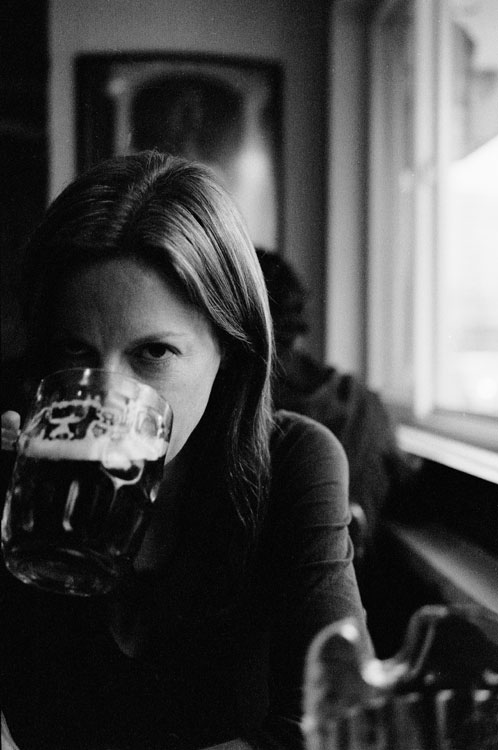
Ilford Delta 3200 - what's your experience?

lilmsmaggie

Established
Local time
8:16 PM
Joined
Sep 24, 2010
Messages
139
Location
Elk Grove, CA
Picked up a couple of rolls of Delta 3200 to play with. Night photography came to mind but I may try it in other low-light situations or even daylight.

Ilford rates DELTA 3200 Professional with an ISO speed rating​
of ISO 1000/31º (1000ASA, 31DIN) to daylight. According to the literature, this film has a lot of latitude in terms of EI exposure ranges. I'd be curious to find out at what ISO settings people have acheived the best results in terms of a balance between grain, contrastiness and loss of shadow detail. I'll be having the film process in a local lab -- Xtol development.

Do you shoot at ISO 800, 1000, 1600, 3200 or higher?

Does there seem to be a sweet spot?


Delta 3200 is great, but I don't like it for everything. I've used it a lot for night time 'city scape' type work in 120, and it is great for that purpose. It's lower contrast complements those scenes. For my 35mm work, I prefer Kodak 3200 for it's sharpness and better tonality, but when I want a smoother look Delta 3200 esp in 120is a better choice.

Kodak 3200 in 35mm printed with a condenser or a Focomat for impact; Delta 3200 printed with a cold light for smoothness and grain minimization.

Delta is best at EI 800, but 1600 is OK too. If you need higher that that Kodak 3200 is much better IMO. The "sweet spot" is 800 for both of these films though... For daylight Delta can be a little flat...

If you want a smooth look, I would recommend getting your Delta developed in a lab that uses XTOL replenished (Panda lab in Seattle does a terrific job). For Kodak 3200 XTOL 1:2 @EI800 small tank, or TMAX developer or Acufine for higher speeds, and a gritty but pretty look.
 
Last edited:
I haven't had much success with it. You need a suitable developer to work with it. The grains are golf ball size ! I prefer Tri-X pushed 2 stops , a bit more 'punchy' and finer grain.
Good luck with yours. And like everything else, use it on your own first before making your own preference. It might work for you.
 
In Xtol it works best at about EI 1000 (close to its ISO speed). Does the lab you use replenish their Xtol or hand develop? In replenished Xtol, 800 might be closer to the mark. It would be worth talking to the lab and asking them what works best in their opinion.

To shoot it faster it helps if you can use TMax, Microphen or another push developer.

img034ab.jpg


Now I've put it in, I can't remember if that one is Delta3200 or TMZ. I think it's Delta3200.

Marty
 
In Xtol it works best at about EI 1000 (close to its ISO speed). Does the lab you use replenish their Xtol or hand develop? In replenished Xtol, 800 might be closer to the mark. It would be worth talking to the lab and asking them what works best in their opinion.

To shoot it faster it helps if you can use TMax, Microphen or another push developer.

img034ab.jpg


Now I've put it in, I can't remember if that one is Delta3200 or TMZ. I think it's Delta3200.

Marty


Excellent idea Marty! According to their web site they use Xtol in a Refrema automated dip & dunk processor. -- BTW - love the photo.
 
Last edited:
Excellent idea Marty! According to their web site they use Xtol in a Refrema automated dip & dunk processor. -- BTW - love the photo.

Thanks - I like that one too.

It sounds like a replenishment system, but do check with them. If they've got that kind of gear they are likely to know what will work. A good lab is an excellent resource - there aren't many around anymore.

Marty
 
I've tried it once and I quite like it.

This one is shot at 1600 at night. I can't remember the developer because I had a friend who helped develop it. IF I'm not wrong, it should be with HC-110. Not sure what's the solution though.

3642613111_ed92664e74_z.jpg


This other one, also shot at 1600 but in the day (from the same roll).

3634254897_fb391c180f_z.jpg
 
I have liked the results @ 3200 and developed and scanned by NCPS with my Fuji 6X9s. When the photos are reduced they look great. But there is plenty of gran (click on image) in the full sized scan.

This example was shot @ ISO 3200 on the Manhattan Beach (California) Pier about 30 minutes after sunset with my GW690.


I have been less pleased with the 35mm version. I actually am happier with HP5+ at 1600. You can see some examples here.

Chris
 
Last edited:
Delta 3200 is great, but I don't like it for everything. I've used it a lot for night time 'city scape' type work in 120, and it is great for that purpose. It's lower contrast complements those scenes. For my 35mm work, I prefer Kodak 3200 for it's sharpness and better tonality, but when I want a smoother look Delta 3200 esp in 120is a better choice.

Kodak 3200 in 35mm printed with a condenser or a Focomat for impact; Delta 3200 printed with a cold light for smoothness and grain minimization.

Interesting. I've found the exact opposite: I significantly prefer the tonality of Delta 3200, and I've found it both sharper and grainier. Both the latter impressons are born out by the actual figures, but of course, tonality is much more subjective. Must be developer variation.

Although I've tried other developers, mainly Microphen, I always use DDX, where the true ISO is near enough 1250 (at 1000-1250, according to dev, it's about 1/3 stop faster than TMZ at 800-1000). I've never tried it in Rodinal but Ilford says that gives you the lowest speed (as low as 650, or 800 at best) and the biggest grain. Like many people, if we're pushing, we develop it for the next higher EI, eg if we're shooting at 3200 we'll develop as for 6400.

My wife and I have been using it since before it came out (we were among those who tested it for Ilford) and we've used it at everything from EI 1000 to EI 12,500. We've shot literally hundreds of rolls of 35mm and 120, possibly even thousands (well, 1000, anyway).

For maximum quality I'd recommend 1600-2000, and for low light we rarely push it beyond 2,500 and more. A long-toe film like this may actually give slightly inferior results at its true ISO (inferior totality) as compared with a slight push.

Cheers,

R.
 
I feel like delta 3200 is lacking contrast. I used to shoot it but got very grey images. Tmax 3200 was always much better for me.
 
Interesting. I've found the exact opposite: I significantly prefer the tonality of Delta 3200, and I've found it both sharper and grainier. Both the latter impressions are born out by the actual figures, but of course, tonality is much more subjective. Must be developer variation.

Although I've tried other developers, mainly Microphen, I always use DDX, where the true ISO is near enough 1250 (at 1000-1250, according to dev, it's about 1/3 stop faster than TMZ at 800-1000). I've never tried it in Rodinal but Ilford says that gives you the lowest speed (as low as 650, or 800 at best) and the biggest grain. Like many people, if we're pushing, we develop it for the next higher EI, eg if we're shooting at 3200 we'll develop as for 6400.

My wife and I have been using it since before it came out (we were among those who tested it for Ilford) and we've used it at everything from EI 1000 to EI 12,500. We've shot literally hundreds of rolls of 35mm and 120, possibly even thousands (well, 1000, anyway).

For maximum quality I'd recommend 1600-2000, and for low light we rarely push it beyond 2,500 and more. A long-toe film like this may actually give slightly inferior results at its true ISO (inferior totality) as compared with a slight push.

Cheers,

R.

Photography is funny. It's amazing how, for such an intrinsically subjective study, we all try to define it so precisely. 🙂

Anyways, I would agree that Delta can appear more grainy; it does have a lumpy grain pattern at least, whereas TMZ has a more fine grain pattern, even if those grains may be spaced out pretty well 😉

Having worked in camera repair, and having little faith in accuracy of metering and the consistency of shutters and emulsion, I'm not super precise with speed numbers. I just say Delta and TMZ are about, around, close to EI ~800-1000 ish. I do know that for really big pushes Delta starts to fall apart. One of my favorite images I've ever made was with TMZ at 12,500 in TMAX developer (to be fair it required a little mercuric too...). I don't personally like Delta above 1600.

Perceptions of sharpness is notorious too, right? I'm of the "sharpness" is more perceived crispness of medium sized details in an image. I would not be surprised if with some developers Delta may have more actual detail though...

Not to inflict another developer on you, but if you like Delta 3200 I can highly recommend replenished XTOL with it.

Cheers
 
Last edited:
Back
Top Bottom