Photography : a political act ?

Marc-A.

I Shoot Film
Local time
10:02 AM
Joined
Jan 31, 2006
Messages
1,191
Location
Paris (France)
As intriguing as it is, a major part of exposed and published photographs is about social or political life, so that photography seems to be primarily a political activity intending to arouse indignation and refusal. Personally, I appreciate very much social and political photography, and a lot of praised photographers consider themselves as committed photographers, from HCB to Willy Ronis (see the RFF thread on Ronis and his interview here), from Dorothea Lange to Sebastiao Salgado …etc. But then a question arises: is that art? In other threads, we have already addressed at length the question about how photography can be considered as an actual art. There is no problem here for me. But how social photography, let’s say “committed photography”, can be considered as art?
Read me carefully: I don’t question only committed art, which is in itself a deep problem. I wonder how photography in particular, when used for social and political purposes, could be seen as art. This problem is deeper than the previous one, mainly because photography is often supported by mass media and used for journalistic purposes, hic et nunc. How a photograph about famine in Darfour or poverty in Bombay can be seen as a piece of art? For instance, a lot of people criticise Salgado for making art and money (art is money!) at the expense of suffering human beings.
Well, I do not deeply disagree with such criticism, but I must confess there are strong reasons in its support. I have my own view on this question, but let see what you think about it.

Best,

Marc

PS: in RFF, we have very talented committed photographers, even if I’m pretty sure they would refuse to be labelled as such. I am particularly touched by Simon Larby (Simon Larbalestier, which comes from the old French and means “the crossbowman”) and dg_2101 (whose great photographer is behind this screen-name?). They are two of my 5 top favourite RFF photographers. Just two photographs to see exactly what I am talking about:

004.jpg


U2297I1117627461.SEQ.0.jpg


I would like to add this one among others by X-Ray (a very different kind of political photograph)

U2450I1119569690.SEQ.0.jpg
 
Why does all forms of photography have to be considered art at all. I don't think it is.

In my eyes some photography is journalism without being art. Criticism, without being art. Propaganda, without being art. All this and more, yet in my eyes not being art.

Photography is a media, and as wonderful and creative as it is as a form of art, it also is manipulative, demonstrative and powerful too not as an art form.
 
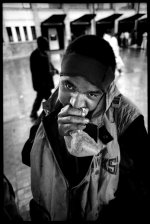
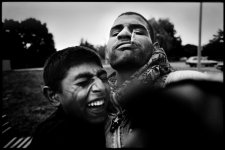
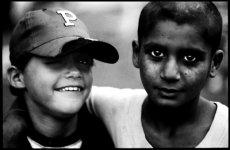
My recent work on social issues is photojournalistic and committed - I hate when it is labelled "art". There is nothing fancy about it. When I see a Romanian kid dieing of sniffing glue I don't think "Hey, how could I make this shot more artsy?" and when I see a woman with five children living in a one-room apartment in oh-so-civilised Belgium I don't wonder if the pictures would be better if I took them with a Leica.

At least, that's one side of the issue. It is true that snapshots wouldn't cut it - the images need an appeal that is also aesthetic to be viewed by a larger audience, which is of course necessary for social photography to function and trigger change. As Nachkebia says below it's about communication, not about art.

It's a thin line to balance - content, aesthetics, objectivity.

But it's not art - it's journalism.

Good journalists use style to emphatise without overly dramatising the content of their articles, it does not make their texts (or photos) art, it makes their texts good and powerfull journalism.
 

Attachments

  • ro4.jpg
    ro4.jpg
    139.7 KB · Views: 0
  • ro13.jpg
    ro13.jpg
    167.8 KB · Views: 0
  • ro1.jpg
    ro1.jpg
    195.5 KB · Views: 0
Last edited:
Its not about making it arty, its about making it more dramatic, so more people can share and feel the pain or happyness... its about communication and not about arty or smarty...
 
At least, that's one side of the issue. It is true that snapshots wouldn't cut it - the images need an appeal that is also aesthetic to be viewed by a larger audience, which is of course necessary for social photography to function and trigger change.

Your talent as a photographer, and the way you go about creating your images I see as being exactly the same as someone who is creating a work or art, but as you say, the purpose and intent of your work is different. Interestingly, the aesthetic qualities of a work of art is what makes it appealing, and those same qualities of a documentary work are what make it powerful and thought provoking. There are many similarities in process among the differences in the final products.
 
First, the majority of published photography is in advertising. Journalistic photography is not the mainstream.

Second part of your question. That would depend on your definition of art. It is interesting you question photography. Do you think Picasso's polital subjects were not art? One of his most defining pieces and maybe his greatest masterpieces could be interpreted as political or even journalistic.

Now, is art limited by subject? Can a portrait of a healthy, wealthy person be art, but a sick, poor person not be art? Obviously the subject does not define art, but the execution of the image. Cartier-Bresson did not photograph anything unusual in Paris, but his work is a lot more compelling than other photos taken of the very same things.

What art, and I assume you mean Fine Art, comes down to is a discussion of "quality." This is not just technical quality, but a inherent quality that that is more transient - meta-quality if you like. The question is where that quality lies. Is it in the work or the audience? A bit of both? This question will most likely have no answer. Mostly because I doubt the appropriate research will be done and the question will be left to art critics who are not really capable of answering it. Certainly our reaction to art is a psychological response. The work must be able to elicit that. But is that response personal or universal? Art is thought to have a universal appeal, but how can that be tested? What is the difference between a personal and a universal response? Is the universal response simply a statistical chance of people having a similar experience or can that response be more ingrained and transend experience? Certainly we can have strong reactions to things we have no previous experience with.

Naturally, this conversation is going to be tough. Art means different things to different people. Any discussion is going to be supported by assumptions that may or may not be supported - just because I can come up with an idea, does not mean the assumption behind the idea is actual. I guess the best answer to your question is a definate maybe (or maybe not).
 
Art?

Art?

I second Finder's point that the subject does not determine if it is art or not. Great painters painted scenes that were controversial in their day. I think of van Gogh's self portrait, the one where he shows his mutilated ear, as a tale of madness, suitable for psychological study. Goya is another that comes to mind. Each has subjects that might not make it to "fine art", but they are hailed worldwide as great artists and their work sells for millions. Some of Lange's work is sociological, but that does not make the photos "fine art". This is a debate that I have had with others and I usually settle on what Finder said so clearly, maybe or maybe not, or something to that effect but more intellegently.:bang:
 
Photography is a form of expression. Whatever the photographer chooses to express is a unique experience for each viewer. Guernica is without question a political statement but every person who views it comes away with their own interpretation. I believe Picasso said "I make the painting for the painting" and he understood that others would ascribe meaning where he did not, or he did differently. Whether a photograph is "committed" or not everyone sees it differently.
 
Marc-A. said:
I am particularly touched by Simon Larby (Simon Larbalestier, which comes from the old French and means “the crossbowman”) and dg_2101 (whose great photographer is behind this screen-name?).

Marc-A,

dg_2101 is the screen name of photojournalist David Gillanders, here is his (great) website, whit tons of pictures:
http://www.davidgillanders.com/

Cheers,

Abbazz
 
I was expecting such replies, because it's natural to be reluctant to call art a photo of a "Romanian sniffing glue". Now, I should clarify my thought. Firstly, I agree very much with Finder when he says:

Finder said:
Now, is art limited by subject? Can a portrait of a healthy, wealthy person be art, but a sick, poor person not be art? Obviously the subject does not define art, but the execution of the image.

Social or political photography is not necessarily about showing the poor and the lame. But showing the poor and the lame does not make photographying a pure journalistic activity. I also agree very much with Finder when he writes:

Finder said:
Do you think Picasso's polital subjects were not art? One of his most defining pieces and maybe his greatest masterpieces could be interpreted as political or even journalistic.

Maybe Finder thinks of Guernica, which was a political painting against Franco's massacre of the Basque village, Guernica. When writing the subject of this thread, I had another reference in mind, The massacre of the Innocents by Nicolas Poussin. Anyway, it could be interesting to discuss why Guernica or The massacre of the Innocents are pieces of art. It could also be interesting, and this is my primary purpose in this thread, to discuss why the photos of the Serra Pelada by Salgado are not only journalistic photographs.

My idea is that art provides visions of the eternal reality of humanity: Beauty, but also ugliness; Power, but also weakness; Wealth, but also poverty; Health, but also misery and disease. The difference between mere photojournalism and photography as an artistic expression lies in the fact that photojournalism is only about what happens hic et nunc, here and now. Photography shows us the reality of the human condition. That's why we can still be touched by the "Migrant Mother" by Dorothea Lange.

Another thought: why taking in picture a Romanian sniffing glue. If you are really concerned by his condition, why taking a photograph instead of working for a charity? There is no personal attack here, I just want to provoke some thoughts. There is another thread on war and photography: when a photographer make a picture of a child tortured by soldiers, he has three options:
- intervene and risk being killed
- turn his head away and pretend nothing happened
- or take a photo that will be published and maybe have an impact
But in your case, what do you hope? For me, it is unclear. Judging by the high quality of the aesthetic aspect of your pictures, I would say you're trying compose a piece of art in order to provoke feelings ... but those feelings are not aroused in order to intervene right hic et nunc. They are just feelings of general indignation .... which is good in my view, and which leads me to think that your work is an example of committed art.

Finder said:
The question is where that quality lies. Is it in the work or the audience? A bit of both? This question will most likely have no answer.
Interesting question; I guess it's a major issue for our concern.

Hope I made my point clearer.

Best,

Marc
 
Last edited:
Marc-A. said:
I wonder how photography in particular, when used for social and political purposes, could be seen as art.
"Art" is in the eye of the beholder ... one man's art is another man's kindling and vice versa.
As has been proven many times over, anything can be art from the Mona Lisa to piles of rotting meat.

Peter
 
Marc-A. said:
Another thought: why taking in picture a Romanian sniffing glue. If you are really concerned by his condition, why taking a photograph instead of working for a charity? There is no personal attack here, I just want to provoke some thoughts.

Easy enough to answer: taking these pictures is working for a charity. I don't take them for my personal enjoyment. I cooperate with NGO's who use photos like these to raise funds. I write articles to accompagny the photos, these get published in various magazines and small papers, and I'm also planning to do presentations with photo-slideshows at schools, rotary-clubs, etc. I may not be changing the world but I know that my photos and texts will at least contribute to money-raising that will help the NGO get one, two, three, four or even more of these kids off the street... I want to believe that photographing them may not help them directly but it does help them eventually. I try my very hardest and I would (and will) give up everything I have so I can do this work the rest of my life.

I am young and I don't know what the future will bring but I know one thing... I would give up my life just to do this work, to help. It is the one and only goal I have in life.
 
Marc-A. said:
But in your case, what do you hope? For me, it is unclear. Judging by the high quality of the aesthetic aspect of your pictures, I would say you're trying compose a piece of art in order to provoke feelings ... but those feelings are not aroused in order to intervene right hic et nunc.

Yes, they are. I understand it may not be clear when you see only the pictures. When published they are accompagnied by text, written by me, with a call for money, donations, volunteers, ...

I chose not to study photography because I don't care about art. I chose to study history and Dutch because it teaches me about objectivity, social issues (I'm choosing modern time - socio-economic issues lessons for all free space and I will major on the same subject), understanding people and not silverhalides or binaries; and the language for being able to express it, to call for attention and help; all in hope of being a journalist/photojournalist that can help and do his part by working for NGO's, magazines, newspapers, ...
 
But how social photography, let’s say “committed photography”, can be considered as art?...


A very interesting question Marc, and the very thoughtful replies do hint at directions a proper answer might take. If I understand your question correctly the problem is with the compatibility of a 'social/journalistic' aspect with an 'aesthetic' one (presumably because acceptance of one implies the automatic exclusion of the other). Let me add a few intuitions on the subject.

1. Aesthetic judgement makes use of a distinctive vocabulary (typically 'beautiful', 'inspiring', 'graceful' etc. etc.) that is not reducible in other modes of discourse. In other words, any attempt to paraphrase statements of aesthetic judgement into judgements of some other sort, will fail to convey the emotive (or, to avoid controversy, aesthetic) content of the original statement.

2. I also assume (tentatively) that 'Social photography' is primarily represantational in character. The viewer is effectively asked to engage in the 'pictorial symbol system' to which the photo belongs and through which the photos (are expected to) impart information. The mode of discourse is descriptive in nature and utilizes a vocabulary that is clearly distinct from the aesthetic one.

3. The aesthetic (and quasi-normative) judgements do not contradict in any way the descriptive ones. How could they? A flat contradiction could only arise by the use of the same domain of objects relative to which the names and predicates of the two distinct vocabularies (the 'aesthetic' and the 'descriptive/journalistic') are interpreted. This is not the case and so a photo may be said to have both descriptive and aesthetic qualities.

Simon's and David's photos are a case in point. Their photos impart information relative to the descriptive content and an aesthetic response pertinent to the artistic merit of the image (subjective as that may be).

As I said, a very, very interesting question, the proper development of which requires (as hinted by other responses) an adequate account of art and aesthetic judgement in general - a labour of Hercules that I admit far exceeds my powers.

Best,
 
Marc, I was thinking of Guernica by Picasso. The interesting thing about that image is Picasso used some mythological symbols. It is more than just an image of fact, but something that transends that event and can have many "meanings." So a work of art can stand by itself without any knowledge of its background - I saw the image long before I knew the story (and not knowing the story did not diminish the strength of the work).

I think Joyce's definition of art in his novel "A Portrait of an Artist as a young man." may be relavant to your post. Joyce basically says their are two forms of art - proper and improper art. Improper art is art in sevice of something else. This art is moves the view either to posses the object (called pornography (all advertising art is pornographic because it makes you want the object illustrated)) or be replelled by the object (didactic art (journalism is didactic)). Proper art is static in that it holds you in aesthetic arrest. Joseph Campbell who talked of Joyce's ideas a great deal basically said this is echoed in Buddhism. Improper art is moving you by fear or desire. Proper art holds you in the still point (enlightenment). So when you view a photo by Salgado, you are not replused by the horror of the situation, but rather you are captured by the beauty. You recognize a perfection within life regardless of any moral judgement which by its nature is a motion of approval or disapproval (fear/desire). The Indians had similar ideas for their theater where things like terror and desire would ultimately be experienced as shanti (peace). Although you do not like the play, Hamlet ends this way. You do not say no to the hero's death. Like Hamlet, you learn to say yes to life regardless of a moral position that may repulse you (Hamlet's problem). So Hamlet goes to his death and it is a proper one.

Beauty is a difficult word. I think Kant had a good way to distingush "beauty" and "sentimental beauty." I don't remember the exact quote (my books are in storage at the moment), but essentially, beauty was our view of the world without concept and sentimental beauty was with concept. This is also echoed in Buddhism and Joyce where in proper art we are viewing something without placing our ideas or concepts into the work. Or maybe the work does not require those concepts to be elicted. Make sense?

Those folks where obviously influenced by metaphysics. Whether we can subscribe devinity to art is a difficult topic. The discussion of metaphysics is as difficult as the one about art. I do think there many ways to approach the subject by it requires a great deal of flexibility.

The interesting thing is that to create art, you don't need to know about any of this. Art existed before our ideas of it. While I have always enjoyed this subject, I know it has little to do with the images I make - controlling exposure and focusing is far more of a pertanant topic. This is more like gear talk - an interesting conversation, but little to do with photography. I just wanted to let any beginner who wander into this thead that this is just chat and not something you really need to know.
 
Photography is not a political act. It's photography.

Its use can be political; can be artistic.

Take a can of soup, for example. Or a woman sitting in front of a bus. Or a boy enjoying a pair of shoes.

Defining photography by how it's used is twisting it. Photography is photography: "written" light.
 
I believe art is defined by the viewer, not the creator.
Haven't we all had the experience where someone has looked at one of our photos, one we would not consider our best or favourite, and say "that should in a gallery"?
The best artists don't label themselves as such but create out of a compulsion to do so.
A strong image of a child in poverty may be created with the intention of raising awareness and finding help for the situation, but if someone is so moved by the image for a completely different reason that they must have a print on their wall, is it not art?
 
This quote may be instructive ...

Why photograph war? Is it possible to put an end to a form of human behavior which has existed throughout history by means of photography? The proportions of that notion seem ridiculously out of balance. Yet that very idea has motivated me. For me, the strength of photography lies in its ability to invoke a sense of humanity. If war is an attempt to negate humanity, then photography can be perceived to be the opposite of war. And if it is used well, it can be a powerful ingredient in the antidote to war.

In a way, if an individual assumes the risk of placing himself in the middle of a war in order to communicate to the rest of the world what is happening, he is trying to negotiate for peace. Perhaps that's the reason why those in charge of perpetuating war do not like to have photographers around.

In the field, what you experience is extremely immediate. What you see is not an image on a page in a magazine ten thousand miles away with an advertisement for Rolex watches on the next page. What you see is unmitigated pain, injustice and misery.

It's occured to me if everyone can be there just once to see for themselves what white phosphorous does to the face of a child, or what unspeakable pain is caused by the impact of a single bullet, or how a jagged piece of shrapnel can rip someone's leg off. If everyone can be there to see for themselves the fear and the grief just one time then they would understand that nothing is worth letting things get to the point where that happens to even one person, let alone thousands.

But everyone cannot be there, and that is why photographers go there ... to show them, to reach out and grab them and make them stop what they are doing and pay attention to what is going on. To create pictures powerful enough to overcome the diluting effects of the mass media and shake people out of their indifference. To protest, and by the strength of that protest, to make others protest.

The worst thing is to feel that as a photographer that I am benefitting from someone else's tragedy. This idea haunts me. It is something I have to reckon with everyday, because I know, if I ever allow genuine compassion to be overtaken by personal ambition, I will have sold my soul.

The only way I can justify my role, is to have respect for the other person's predicament. The extent to which I do that is the extent to which I become accepted by the other. And to that extent, I can accept myself.

James Nachtwey, Epilogue, War Photographer, 2001.

All war photography is anti-war photography. Thus, all war photography is political. Political import is not a contradiction to artistic value. These qualities are not mutually exclusive. Indeed, photography of the highest social impact encompasses both qualities.

Does great political photography move you, shake you, change you? If it does, it is art and more.
 
Back
Top Bottom