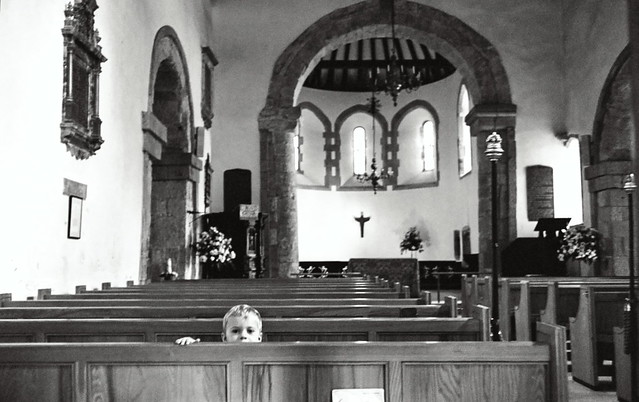
Why B&W on vintage camera ?

lotech

Member
Local time
11:00 AM
Joined
Jul 27, 2024
Messages
44
Location
Hong Kong
I am interested in vintage cameras, especially RF, and I found that there's a common practice for those reviewers to shoot B&W, why ? I eagerly wanted to see how those old lenses perform in full color, but rarely can I find such reviews. Why do most photographers "automatically switch to B&W mode" when shooting with vintage cameras, especially RF ? Colour film has been around for over 100yrs.
 
Black and white avoids odd colour casts in old lenses. People who retain or acquire old cameras are likely devotees of black and white photography. The lower contrast, and the different effects of scratches, "cleaning marks" and internal haze produce atmospheric effects. This can be nice on Ektar colour as well as on Tri-X Black and white. Black and white film bulk loaded and developed in the bathroom sink saves some money. Not that you can't do C41 processing at home. Colour negative film negatives are not as easy to read and evaluate as black and white negatives, Expired black and white film is more durable. Some are channeling their inner HCB/Kertesz. Finally, colour is harder. You have to justify the colours. Were they doing anything in the image? Composing in colour is different to composing in black and white. The colour can crowd what would be a more effective black and white image. Some colour compositions don't work at all in black and white.
 
I see your point. I did home process some slides and it was hard, especially without proper temperature and timing control. I've seen Ansel Adams' Zone System photos, they are terrifying pretty ! I am going to see how good some highly regarded old lenses perform in full color, such as the Soviet 'radioactive' Industar, on micro four third body.
 
I am interested in vintage cameras, especially RF, and I found that there's a common practice for those reviewers to shoot B&W, why ? I eagerly wanted to see how those old lenses perform in full color, but rarely can I find such reviews. Why do most photographers "automatically switch to B&W mode" when shooting with vintage cameras, especially RF ? Colour film has been around for over 100yrs.
It's like old retro-grouches who still ride lugged-steel-frame bicycles and insist on wearing woolen jerseys. It's a schtick, really, but if it floats your boat, well hey, it's your boat!
 
It's like old retro-grouches who still ride lugged-steel-frame bicycles and insist on wearing woolen jerseys. It's a schtick, really, but if it floats your boat, well hey, it's your boat!
I’m stubborn and poor, and my Soviet RFs are beaten up either with curtain leak or jam, so I can only try those vintage lenses on MFT body. What I'm after is the nostalgic palette color on classic movies, and I expected to see that on those old lenses. Of course I can get that result via digital post but that's another story.
 
I see your point. I did home process some slides and it was hard, especially without proper temperature and timing control. I've seen Ansel Adams' Zone System photos, they are terrifying pretty ! I am going to see how good some highly regarded old lenses perform in full color, such as the Soviet 'radioactive' Industar, on micro four third body.
If you refer to the Industar 61 LD as radioactive (which it actually is not, or not more than any other lens), you should not expect it to deliver a fancy old school color palette. Out of the soviet rf lenses, it is the one with the most modern rendering.
 
I've always shot color slides in my cameras from the 1960s and 1970s.

Not sure when my Rolleiflex T was made, but it does wonders with color.

I had a Voigtlaender Bessa II folding 6x9 camera with the Color-Skopar lens (a Tessar-type). This camera was from the 1950s, and it produced beautiful color slides.

My grandmother shot color slides on her Kodak Pony from around 1951. (I have that camera now.)

- Murray
 
If anything, I would say that the newer generation of photographers are using colour film with vintage cameras 🤔

For me, it is about cost. I would love to go back to shooting slides like I used to do back in the 1990s but for the cost of one roll of slide film plus developing, I can shoot 3 to 5 rolls of b+w film.

People who want to avoid all this cost and developing / scanning / printing hassle, switch to digital.
 
My *uneducated* guess is that some of those lenses (of course not all - and depending on the maker and period) were designed with B&W film in mind (not corrected for chromatic aberrations) and thus, the reviewers wanted to take advantage of that fact - to exploit its qualities- and perhaps take advantage of the B&W aesthetic.

I believe a lot of early RF lenses were later corrected with either coating improvements or redesigns to better correct for color photography. But it's a good question.

I have shot color with some of my vintage RF equipment (and some of the color renditions are decent and interesting) but the B&W images always give more of the warm fuzzies...

One lens that shines in B&W but no so much in color (at least for me) is the 35mm f2.8 Summaron-M.

Some good examples here and some excellent color examples as well:
 
I mainly shoot B&W in my vintage cameras because the slower pace of shooting with those cameras encourages me to focus more on light, shadow, and shapes. I find color distracting at times. Also, I can more easily develop and scan B&W at home. I know technically I can do color at home, but I haven't tried it yet. B&W seems trivial in comparison (especially the scanning part).

Therefore, I have made the decision to mainly shoot B&W in my film cameras and use digital for color. I'll sometimes shoot digital B&W and color film, but that is by exception.

Chris
 
I shoot in black and white because
  • I prefer black and white photos. For me, a lot of colour photography generally fits into "oooh, look at how red this is" or is just clutter. Black and white strips that back.
  • I prefer the process. Developing my own black and white film and then printing it is a much enjoyable experience than any colour workflow.
  • I was spoiled by colour slide film and nothing else comes close.
All that said, someone else asked me this exact same thing on Flickr years ago, @lotech: "Why don't you test these lenses with colour film? I want to see how they render colour". The problem with that is that unless you're comparing E6 transparencies from different lenses from the same scene in the same lighting shot on the same roll, you're not really seeing anything the lens has produced, colour-wise. Whether it's C41 or a digital body, there is so much interpretation and colour correction in the final image - no matter how it's produced - that the native colour rendering of the lens is somewhat moot.

People may say X lens is "warm" and Y lens is "cool", but with one tweak of a slider in the scanning process, you honestly can't tell the difference.
 
i'd say go for one of the uncoated lenses if you want that very old colour look. might look a bit crappy but also very 'old'. those lenses are somewhat hard to get for soviet rangefinders though. Look for a Fed-10 lens with aperature going up to f.18 instead of f.16

or maybe just shoot black and white and Trichrome everything 😀
 
Last time I checked it wasn't much color film left and it was arm and leg to buy and pay for developing with mediocre files in return. Which are not much better than digital colors files from digital cameras.

And nothing really else.

BW could be purchased in bulks.
Easy to develop at home.
And possible to get final result in original form. Known as dark room prints.

Somehow bw from film is still appealing more than digital bw.
 
While it is true that color film technology developed over a century ago, the use of color in publications did not really get underway until after WWII. So I think a lot of us who lived through that period still associate the use of the old film cameras with black & white -- ie: Adams, Cartier Bresson, etc.
 
From my own experience which only covers few cameras, colour works perfectly well in my old super ikonta 533/16 I think made in the mid 50s . Also used colour film (gold 200} in an old ensign and tha was ok. If you can get a reasonable picture from a disposable camera with a plastic lens the wy not an old camera. But I agree that home processing is preferred with b+w.
 
Back
Top Bottom