bkrystad
Established
One of my tasks in my new darkroom was to do a maximum black test on my equipment with my current film of choice. Here's the setup:
1) Beseler 23C Series II enlarger w/ condenser head
2) Minolta C.E. Rokkor-X f/2.8 50mm lens
3) Ilford HP5 Plus ASA 400 film
4) Ilford Multigrade IV glossy paper
I set up the enlarger height for 6"x9" enlargments of 35mm film. I put a developed blank frame in the negative carrier and set my timer to 2 seconds. I marked 2cm intervals on a piece of 8x10 paper and had my piece of opaque cardboard ready. I ran the timer 10 times, each time moving he cardboard 2cm over the paper. That's the test.
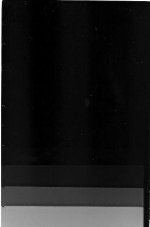
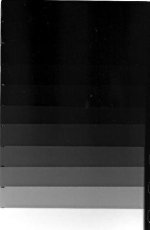
I've attached (poor) scans of the results, just for an indication. The first is at f/16 and the second is at f/22. At f/16, the interval at which I can't perceive a change in black is between 12 and 14 seconds. At f/22, the interval is clear up to or beyond 22 seconds. Makes sense, given reciprocal exposures.
Now I'm trying to make sense of the results. Here are my conclusions. I would appreciate any comments on my thinking -- from "that's about right" to "that doesn't make any sense at all."
1) This is a fast enlarger lens, that's why I'm getting to maximum black so quickly at f/16. (I did a test at f/11 as well, that went black at around 6 seconds, as you might imagine.) Apertures faster than f/16 are for bigger enlargements with the lens positioned higher (relatively less light reaching the paper).
2) Given the speed at which the paper gets to maximum black at f/16, I'm safe using that f-stop for low contrast negatives. That allows the blacks to get black and the contrast to be higher.
3) I'm safe using f/22 for high contrast negatives, as it allows more midtones to develop before getting to maximum black.
I'm going to be working on multigrade filters next, which of course is more appropriate for manipulating contrast in prints. But I just want to get a sense of how I should be using this test information when I'm making straight test prints. Should I lean toward using f/22 or f/16 as a starting point?
1) Beseler 23C Series II enlarger w/ condenser head
2) Minolta C.E. Rokkor-X f/2.8 50mm lens
3) Ilford HP5 Plus ASA 400 film
4) Ilford Multigrade IV glossy paper
I set up the enlarger height for 6"x9" enlargments of 35mm film. I put a developed blank frame in the negative carrier and set my timer to 2 seconds. I marked 2cm intervals on a piece of 8x10 paper and had my piece of opaque cardboard ready. I ran the timer 10 times, each time moving he cardboard 2cm over the paper. That's the test.
I've attached (poor) scans of the results, just for an indication. The first is at f/16 and the second is at f/22. At f/16, the interval at which I can't perceive a change in black is between 12 and 14 seconds. At f/22, the interval is clear up to or beyond 22 seconds. Makes sense, given reciprocal exposures.
Now I'm trying to make sense of the results. Here are my conclusions. I would appreciate any comments on my thinking -- from "that's about right" to "that doesn't make any sense at all."
1) This is a fast enlarger lens, that's why I'm getting to maximum black so quickly at f/16. (I did a test at f/11 as well, that went black at around 6 seconds, as you might imagine.) Apertures faster than f/16 are for bigger enlargements with the lens positioned higher (relatively less light reaching the paper).
2) Given the speed at which the paper gets to maximum black at f/16, I'm safe using that f-stop for low contrast negatives. That allows the blacks to get black and the contrast to be higher.
3) I'm safe using f/22 for high contrast negatives, as it allows more midtones to develop before getting to maximum black.
I'm going to be working on multigrade filters next, which of course is more appropriate for manipulating contrast in prints. But I just want to get a sense of how I should be using this test information when I'm making straight test prints. Should I lean toward using f/22 or f/16 as a starting point?