
Leica Cameras of the Future: A Long-time Leica Fan’s Wish List
An upgraded M EV1, a Leica I (Model A) replica, a slim retro compact!
By Jason Schneider
On October 23, 2025, Leica Camera AG released the Leica M EV1, the first M-system camera to incorporate an integrated electronic viewfinder (EVF) in place of the traditional optical-mechanical range/viewfinder (OVF) that first appeared (in 3 frame line form) in the legendary Leica M3 of 1954. The release of the M EV1 in the U.S. was held up by delays with its Federal Communications Commission (FCC) authorization caused by the recent federal government shutdown, but it finally became available in the U.S. on November 24, 2025.

Front and back views of Leica M EV1 with 50mm f/1.4 Summilux-M ASPH. Note non-tilting touchscreen LCD on back, snazzy diamiond textured covering.
Before the M EV1 arrived, many Leica fans and tech writers speculated that it might be the electronic equivalent of a traditional Leica M rangefinder camera that provided basically the same viewing and shooting experience. Others conjectured that it would offer both an optical viewfinder (OVF) and an EVF, though exactly how that could be achieved was never made clear. The actual M EV1 is basically a mirrorless camera with an M-mount on the front and the form factor of a Leica M11 or M11-P, albeit without the classic viewfinder, rangefinder, and frame-illumination windows on the font of the top plate. Though disappointing to some, it is a workable, conservative, manual focus design that achieved two important goals for Leica: 1. it could be offered now rather than, say, 5 years from now, when an “improved” version might be largely irrelevant. 2. It provides an alternative EVF camera for M-system fans that expands their shooting options without replacing any existing camera, a wise decision both in terms of marketing and profitability.

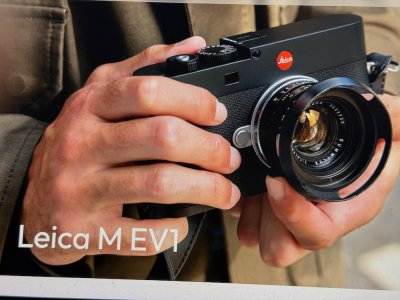
Image from Leica M EV1 brochure cover showing compact camera with 50mm f/1.4 Summilux lens held in hands.

Leica M EV1, official Leica tech data flyer, page 1 showing schematic views of camera at bottom/
Leica M EV1 features: More and less than an electronic M11
The Leica M EV1 is a full-frame camera that features an integrated electronic viewfinder (EVF), a 60MP BSI CMOS sensor, and Leica Content Credentials technology. It includes a high-resolution 5.76m-dot EVF (basically the same as the one in the Leica Q3) with a 0.76x magnification, a 2.95-inch touchscreen, and an electronic shutter that provides speeds up to 1/16,000 sec. Unlike previous M cameras, the EV1 relies solely on the EVF for composing the picture and it enables focus aids that include magnification and focus peaking.
Key features:
The Leica M EV1's main upsides include its electronic viewfinder (EVF) that provides a precise, accurate preview of the captured image in terms of both composition and exposure, helpful focusing aids like focus peaking, versatile M-mount lens compatibility, and the same superb 60MP sensor as the one in the Leica M11.
Downsides include significantly shorter battery life compared to the M11, a slow 3-second startup time that affects both the viewfinder and shutter, and that its EVF provides less satisfying or “visceral” viewing and shooting experience than an optical rangefinder for some users.
Upsides synopsis:
Electronic Viewfinder: Provides a "what you see is what you get" (WYSIWYG) view, showing accurate exposure, color, and focus before you take the shot.
Focusing Aids: Includes tools like focus peaking and magnification to help with critical focus, especially useful when using fast, wide-aperture lenses.
Versatility: Works with all M-mount lenses and provides a more versatile shooting experience than traditional optical rangefinders.
Image Quality: Shares the same 60MP sensor as the M11, meaning it produces identical, excellent image quality.
Durability: The EVF is potentially more rugged and less prone to mechanical issues than a traditional rangefinder/viewfinder unit.
Lightweight body: The body is lighter than other M-series cameras.
Downsides synopsis:
Battery Life: Significantly shorter battery life compared to the M11 (244 shots per charge on the EV1 vs. 700 on the M11).
Startup Time: A slow 3-second startup time is more noticeable because the EVF is black during this period, unlike the M11 where you can still use the optical viewfinder.
EVF Experience: Some users may find that the EVF is not as “special” or as “direct” as a traditional optical range/viewfinder.
No Video: The camera does not record video.
High ISO Performance: Some reviewers report that the high ISO performance of the M EV1 is not very good at ISO 6400 and above
No Autofocus: The camera is manual focus only.
The Leica M EV2: A proposed successor to the present Leica M EV1:
Two obvious additions that would enhance the overall performance parameters of a “Leica M EV2” would be adding autofocus (AF) capability and a suite of cine modes. This would be challenging but not impossible to achieve with existing manual focus Leica lenses. And adding, say, an EV2-compatible 28-90mm zoom lens to the optical mix would also make the camera more competitive with less expensive mirrorless models from Sony, Fuji, etc. Other ideas: an upgraqded battery that delivers more shots per charge, plus a quicker startup time, an upgraded 60MP sensor with improved high-ISO performance—maybe even an “OVF” mode that simulates the traditional range/viewfinder experience. Finally, it would be wonderful if Leica could maintain or even lower the price of the Leica M EV2 a bit, to expand its market potential and address the lingering complaints of some ardent Leica enthusiasts that the M-EV1 (at $8.995 body only) was priced too high to begin with. The main challenges for Leica in designing a future Leica M EV2: Coming up with a product that maintains its distinctive Leica M identity while significantly enhancing its performance parameters and offering it all at an enticing price.
A Leica I (Model A) replica: A pocketable masterpiece for the ages?
Leica brought forth the Leica O Replica, a fully functional version of the original 1923/24 Leica “O” series prototype, in the year 2000, to celebrate the 75thanniversary of the Leica (and the 125th birthday of its designer, Oskar Barnack). The camera was greeted with mixed emotions. Enthusiasts applauded its coated 50mm f/3.5 Leitz Anastigmat lens (a tweaked version of the 4-element, 3-group 50mm f/3.5 Elmar), and the fact that (unlike the original) it could be loaded with standard 35mm cartridges. However, many potential users were disappointed that the O replica was fitted with a non-self-capping focal plane shutter that required capping the lens (with the not so handy tethered lens cap) while advancing the film and cocking the shutter, and also that the numbers on the shutter speed dial indicate slit widths in millimeters rather than actual shutter speeds. Why oh why didn’t they just give us a Leica I (Model A) replica with the new coated lens and be done with it?

Leica O Replica of 2000: It's drop dead gorgeous and has notable upgrades, but it's bear to shoot with (see text).

The Real Deal No. 1: Leica I (Model A) No. 2295 with accessory shoe behind seriel number in between shutter speed dial and optical viewfinder.

The Real Deal No.2. Spectacular Leica Luxus I No. 48401 on the front cover of "Leica An Illustrated Guide" by James Lager published in 1975.
That question is still just as relevant today as it was 25 years ago, and many diehard Leica fans (including yours truly) hope that Leica Camera AG will relent and give us a lovingly executed recreation of one of the greatest street cameras ever made. I believe it would be possible to offer a fully functional replica of the standard black-enamel-finished Leica I (Model A) with the upgraded coated lens at $10,000 per copy and still turn a handsome profit. And for the well-heeled collectors among us how about a buff gold-plated, lizard skin clad limited edition version priced at $25K? Hope springs eternal.
A retro-styled Leica digital point & shoot? Why not?

Front view of Leica Luxus I replica. No, it's not the real thing, but it gives you a rough idea of what a retro styled digital Leica might look like.
One of the greatest selling points of the most successful Leica cameras is their signature Leica form factor. Wouldn’t it be great if we could have a compact slimline digital Leica with a form factor inspired by a Leica Standard (Model E), or a Leica If or Ig? Add a high-res image sensor, EVF, and LCD, a high-spec 28-90mm zoom lens, plus basic specs, or go whole hog with a cutting-edge digital feature set and you’d have a camera could sell very well at a good profit margin without affecting sales of, say, the Leica Q3 43. Heck, if this jewel could be priced at under $6K, even a crotchety old skinflint like me might spring for one!
Heartfelt thanks to noted Leica historian James Lager for providing the photos for this article.
An upgraded M EV1, a Leica I (Model A) replica, a slim retro compact!
By Jason Schneider
On October 23, 2025, Leica Camera AG released the Leica M EV1, the first M-system camera to incorporate an integrated electronic viewfinder (EVF) in place of the traditional optical-mechanical range/viewfinder (OVF) that first appeared (in 3 frame line form) in the legendary Leica M3 of 1954. The release of the M EV1 in the U.S. was held up by delays with its Federal Communications Commission (FCC) authorization caused by the recent federal government shutdown, but it finally became available in the U.S. on November 24, 2025.
Front and back views of Leica M EV1 with 50mm f/1.4 Summilux-M ASPH. Note non-tilting touchscreen LCD on back, snazzy diamiond textured covering.
Before the M EV1 arrived, many Leica fans and tech writers speculated that it might be the electronic equivalent of a traditional Leica M rangefinder camera that provided basically the same viewing and shooting experience. Others conjectured that it would offer both an optical viewfinder (OVF) and an EVF, though exactly how that could be achieved was never made clear. The actual M EV1 is basically a mirrorless camera with an M-mount on the front and the form factor of a Leica M11 or M11-P, albeit without the classic viewfinder, rangefinder, and frame-illumination windows on the font of the top plate. Though disappointing to some, it is a workable, conservative, manual focus design that achieved two important goals for Leica: 1. it could be offered now rather than, say, 5 years from now, when an “improved” version might be largely irrelevant. 2. It provides an alternative EVF camera for M-system fans that expands their shooting options without replacing any existing camera, a wise decision both in terms of marketing and profitability.
Image from Leica M EV1 brochure cover showing compact camera with 50mm f/1.4 Summilux lens held in hands.
Leica M EV1, official Leica tech data flyer, page 1 showing schematic views of camera at bottom/
Leica M EV1 features: More and less than an electronic M11
The Leica M EV1 is a full-frame camera that features an integrated electronic viewfinder (EVF), a 60MP BSI CMOS sensor, and Leica Content Credentials technology. It includes a high-resolution 5.76m-dot EVF (basically the same as the one in the Leica Q3) with a 0.76x magnification, a 2.95-inch touchscreen, and an electronic shutter that provides speeds up to 1/16,000 sec. Unlike previous M cameras, the EV1 relies solely on the EVF for composing the picture and it enables focus aids that include magnification and focus peaking.
Key features:
- Integrated EVF: The first M camera to feature a built-in electronic viewfinder, with a 5.76m-dot resolution and 0.76x magnification.
- 60MP BSI CMOS sensor: A high-resolution sensor that provides detailed images, with options for digital cropping at 1.3x and 1.8x.
- Manual focus aids: The EVF offers focus aids like focus peaking and the ability to magnify the scene for critical focus, which can be set to automatically activate when the focus ring is turned.
- Leica Content Credentials: A built-in technology to verify the authenticity of images.
- Electronic shutter: Provides shutter speeds up to 1/16,000 sec, which is helpful for shooting with fast lenses in bright conditions.
- 2.95-inch touchscreen LCD: A high-resolution touchscreen for navigating menus & reviewing images, protected by Gorilla Glass.
- Lightweight design: hand assembled with a magnesium and aluminum body, it is the lightest digital M camera to date, weighing in at 484g (17.07 ounces) with battery, and 413 g (14.6 ounces) without battery.
- Digital zoom: Includes 1.3x and 1.8x digital zoom options, which are reversible in RAW files.
- Internal memory: Features 64GB of internal memory, which can be used with or in conjunction with an SD card.
The Leica M EV1's main upsides include its electronic viewfinder (EVF) that provides a precise, accurate preview of the captured image in terms of both composition and exposure, helpful focusing aids like focus peaking, versatile M-mount lens compatibility, and the same superb 60MP sensor as the one in the Leica M11.
Downsides include significantly shorter battery life compared to the M11, a slow 3-second startup time that affects both the viewfinder and shutter, and that its EVF provides less satisfying or “visceral” viewing and shooting experience than an optical rangefinder for some users.
Upsides synopsis:
Electronic Viewfinder: Provides a "what you see is what you get" (WYSIWYG) view, showing accurate exposure, color, and focus before you take the shot.
Focusing Aids: Includes tools like focus peaking and magnification to help with critical focus, especially useful when using fast, wide-aperture lenses.
Versatility: Works with all M-mount lenses and provides a more versatile shooting experience than traditional optical rangefinders.
Image Quality: Shares the same 60MP sensor as the M11, meaning it produces identical, excellent image quality.
Durability: The EVF is potentially more rugged and less prone to mechanical issues than a traditional rangefinder/viewfinder unit.
Lightweight body: The body is lighter than other M-series cameras.
Downsides synopsis:
Battery Life: Significantly shorter battery life compared to the M11 (244 shots per charge on the EV1 vs. 700 on the M11).
Startup Time: A slow 3-second startup time is more noticeable because the EVF is black during this period, unlike the M11 where you can still use the optical viewfinder.
EVF Experience: Some users may find that the EVF is not as “special” or as “direct” as a traditional optical range/viewfinder.
No Video: The camera does not record video.
High ISO Performance: Some reviewers report that the high ISO performance of the M EV1 is not very good at ISO 6400 and above
No Autofocus: The camera is manual focus only.
The Leica M EV2: A proposed successor to the present Leica M EV1:
Two obvious additions that would enhance the overall performance parameters of a “Leica M EV2” would be adding autofocus (AF) capability and a suite of cine modes. This would be challenging but not impossible to achieve with existing manual focus Leica lenses. And adding, say, an EV2-compatible 28-90mm zoom lens to the optical mix would also make the camera more competitive with less expensive mirrorless models from Sony, Fuji, etc. Other ideas: an upgraqded battery that delivers more shots per charge, plus a quicker startup time, an upgraded 60MP sensor with improved high-ISO performance—maybe even an “OVF” mode that simulates the traditional range/viewfinder experience. Finally, it would be wonderful if Leica could maintain or even lower the price of the Leica M EV2 a bit, to expand its market potential and address the lingering complaints of some ardent Leica enthusiasts that the M-EV1 (at $8.995 body only) was priced too high to begin with. The main challenges for Leica in designing a future Leica M EV2: Coming up with a product that maintains its distinctive Leica M identity while significantly enhancing its performance parameters and offering it all at an enticing price.
A Leica I (Model A) replica: A pocketable masterpiece for the ages?
Leica brought forth the Leica O Replica, a fully functional version of the original 1923/24 Leica “O” series prototype, in the year 2000, to celebrate the 75thanniversary of the Leica (and the 125th birthday of its designer, Oskar Barnack). The camera was greeted with mixed emotions. Enthusiasts applauded its coated 50mm f/3.5 Leitz Anastigmat lens (a tweaked version of the 4-element, 3-group 50mm f/3.5 Elmar), and the fact that (unlike the original) it could be loaded with standard 35mm cartridges. However, many potential users were disappointed that the O replica was fitted with a non-self-capping focal plane shutter that required capping the lens (with the not so handy tethered lens cap) while advancing the film and cocking the shutter, and also that the numbers on the shutter speed dial indicate slit widths in millimeters rather than actual shutter speeds. Why oh why didn’t they just give us a Leica I (Model A) replica with the new coated lens and be done with it?
Leica O Replica of 2000: It's drop dead gorgeous and has notable upgrades, but it's bear to shoot with (see text).
The Real Deal No. 1: Leica I (Model A) No. 2295 with accessory shoe behind seriel number in between shutter speed dial and optical viewfinder.
The Real Deal No.2. Spectacular Leica Luxus I No. 48401 on the front cover of "Leica An Illustrated Guide" by James Lager published in 1975.
That question is still just as relevant today as it was 25 years ago, and many diehard Leica fans (including yours truly) hope that Leica Camera AG will relent and give us a lovingly executed recreation of one of the greatest street cameras ever made. I believe it would be possible to offer a fully functional replica of the standard black-enamel-finished Leica I (Model A) with the upgraded coated lens at $10,000 per copy and still turn a handsome profit. And for the well-heeled collectors among us how about a buff gold-plated, lizard skin clad limited edition version priced at $25K? Hope springs eternal.
A retro-styled Leica digital point & shoot? Why not?
Front view of Leica Luxus I replica. No, it's not the real thing, but it gives you a rough idea of what a retro styled digital Leica might look like.
One of the greatest selling points of the most successful Leica cameras is their signature Leica form factor. Wouldn’t it be great if we could have a compact slimline digital Leica with a form factor inspired by a Leica Standard (Model E), or a Leica If or Ig? Add a high-res image sensor, EVF, and LCD, a high-spec 28-90mm zoom lens, plus basic specs, or go whole hog with a cutting-edge digital feature set and you’d have a camera could sell very well at a good profit margin without affecting sales of, say, the Leica Q3 43. Heck, if this jewel could be priced at under $6K, even a crotchety old skinflint like me might spring for one!
Heartfelt thanks to noted Leica historian James Lager for providing the photos for this article.
Attachments
Last edited:


