OM Systems OM-3 - new retro body for 2025

On a couple of recent roadtrips I have used my micro four thirds system as my general wandering around outfit, using a GX8 with 12-60 and a G9 with 8-18mm and a 15/1.7 and 9/1.7 in my bag, all Panaleica lenses. I find it much lighter, the evf's are amazing, all the lenses are good wide open, the G9's ibis is astonishing, often sharp on exposures over 1 seconds, and the Raw files seem to need very little work, they just seem right.
In very low light my SL2-S is unbeatable, but for most things m43 has surprised me.

1769078769751.png

RP is same size, twice bigger sensor. It never gave me problems indoors. Just crappy build 🙂
I'm still not convinced M43 sensors are good for family pictures indoors.
 
View attachment 4885948

RP is same size, twice bigger sensor. It never gave me problems indoors. Just crappy build 🙂
I'm still not convinced M43 sensors are good for family pictures indoors.
Frankly, this is a terrible comparison because you're comparing a 24-50mm zoom with a 28-84mm equivalent. That's where the M43 system wins out: "long" lenses that are nothing like as long as their full frame equivalents. The bodies will always have certain size limitations for batteries, electronics, ergonomics and the like.

Hell, even if you take the same lenses from any full frame system and adapt them to M43, they immediately double in "reach". That's why M43 is so widely used by wildlife photographers - birdwatchers, especially.
 
Now 43 sensors are 25mp and I assume this will remain the case for the next 3-5 years at least.
Well, only the 2 top-end Panasonics have a 25mp sensor (G9II and GH7). No OM models which have come out subsequently have been above 20mp. I would say 20mp is very much still the standard for now. It remains to be seen how those 25mp sensors could behave in a smaller camera body (heat dissipation has always been a bit of a concern with Micro 4/3 sensors when tech advances. Bigger size means easier dissipation and better heatsink abilities. Hard to know if they could implement the 25mp sensor in, say, a GX9 II body without running into problems.

I'm sitting at the desk right now with the SL2S and G9 beside the keyboard, so I know this struggle well, hahaha. In my endless ruminations about travel gear, I sometimes think about going overseas with just the G9, GX85 and a few lenses, and leaving the SL2S and M9 behind. Gasp!
A couple of years ago, I went to Greece with just the E-M5ii and 12-45mm f4 Pro, and a Ricoh GRIIIx. The light weight and small size was a dream. I did end up wishing for more resolution than 16mp. My next trip, I don't even own Micro 4/3, so it's going to be a Pentax DSLR and a few lenses. I may regret it!! But at least I'll get more resolution for pulling the details out of scenery.
 
Frankly, this is a terrible comparison because you're comparing a 24-50mm zoom with a 28-84mm equivalent. That's where the M43 system wins out: "long" lenses that are nothing like as long as their full frame equivalents. The bodies will always have certain size limitations for batteries, electronics, ergonomics and the like.

Hell, even if you take the same lenses from any full frame system and adapt them to M43, they immediately double in "reach". That's why M43 is so widely used by wildlife photographers - birdwatchers, especially.
Did you read my concern before getting on high horse ?

Hint: I don't need long zoom for family pictures indoors. 28 is not always wide enough. We are large family🙂
 
Well, only the 2 top-end Panasonics have a 25mp sensor (G9II and GH7). No OM models which have come out subsequently have been above 20mp. I would say 20mp is very much still the standard for now. It remains to be seen how those 25mp sensors could behave in a smaller camera body (heat dissipation has always been a bit of a concern with Micro 4/3 sensors when tech advances. Bigger size means easier dissipation and better heatsink abilities. Hard to know if they could implement the 25mp sensor in, say, a GX9 II body without running into problems.


A couple of years ago, I went to Greece with just the E-M5ii and 12-45mm f4 Pro, and a Ricoh GRIIIx. The light weight and small size was a dream. I did end up wishing for more resolution than 16mp. My next trip, I don't even own Micro 4/3, so it's going to be a Pentax DSLR and a few lenses. I may regret it!! But at least I'll get more resolution for pulling the details out of scenery.
#121
Has link to cameras sizes compared.
One of those is Pentax DSLR I have.
 
Did you read my concern before getting on high horse ?

Hint: I don't need long zoom for family pictures indoors. 28 is not always wide enough. We are large family🙂
I wasn't on a "high horse", just pointing out that you're comparing apples and oranges. I've got no skin in this race - my other half uses M43, but I'm happy with my M240 - but it seems that every lens in the M43 ecosystem is much smaller than its full-frame (and even APS-C) equivalents.

I bought her Panasonic's 14mm f/2.5 for Christmas, for instance. You'd struggle to find a full-frame 28mm f/2.5 with autofocus that was even close to how small that thing is.

So while the bodies may be similar in size, it's the lenses that make the difference.
 
I wasn't on a "high horse", just pointing out that you're comparing apples and oranges. I've got no skin in this race - my other half uses M43, but I'm happy with my M240 - but it seems that every lens in the M43 ecosystem is much smaller than its full-frame (and even APS-C) equivalents.

I bought her Panasonic's 14mm f/2.5 for Christmas, for instance. You'd struggle to find a full-frame 28mm f/2.5 with autofocus that was even close to how small that thing is.

So while the bodies may be similar in size, it's the lenses that make the difference.
Correction:
14 2.5 is 28 5.

It means you have to compare m43 f2.8 lenses with FF f4 lenses.
 
Love old film cameras, but I have come to the conclution that I want my digital cameras to be modern. I have an xh-1 now, and I think the mix between old and modern is confusing. Should I use the dial or one of the programmable wheels to change the shutter?

I keep it as simple as I can: My Leica M10-M/-R work in almost exactly the same way my M4-2 and M6TTL do. Once set, I ignore all the additional modes and features (there are a few) unless they are absolutely necessary.

Same goes for my Hasselblad system.

My EM-1 remains a fine camera, but it takes me a day or three to remember all the settings and options ... the result being that I tend not to use it as much any more.

G
 
Correction:
14 2.5 is 28 5.

It means you have to compare m43 f2.8 lenses with FF f4 lenses.
As a m43 shooter I hate to say it, but for some types of lenses, getting the equivalent to full frame in m43 can cost more and result in a larger lens.

For example, I just picked up the Pana Leica 12mm f1.4. It's a beautiful lens with excellent build quality and IQ, but it's expensive and fairly large. For less than half the price, one could get a Sony 24mm f2.8 semi-pancake and have the advantages of Sony's full frame sensors. And the lens is also half the length and weight.

Similarly, the Olympus f1.2 primes are uniformly sizeable and weighty, and cost around $2000 AUD retail. They have beautiful IQ and build quality. For $1000-1500 one can get Panasonic 35/50/85 f1.8 lenses that are faster, weigh slightly less, and are roughly the same size. They lack the manual focus clutch and build quality of the Olympus Pro primes, but they have the advantage of full frame sensors, and have excellent IQ.

The size advantage is in lenses is outside of those parameters, where you want the smallest lenses possible while maintaining a reasonably wide aperture.

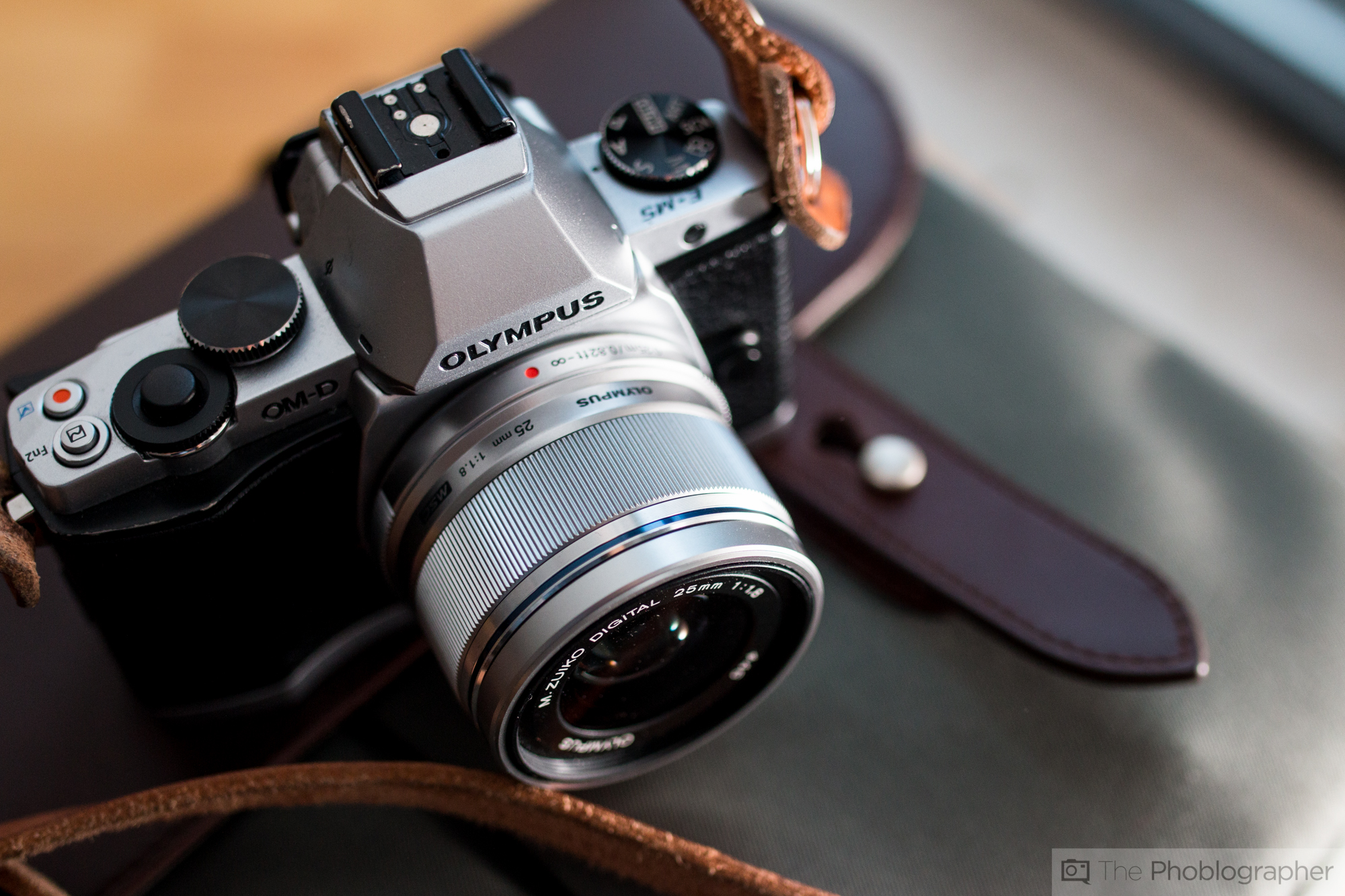
Oly and Pana f1.7/1.8 primes are similar in size to M mount lenses and half the weight or less.

Chris-Gampat-The-Phoblographer-Olympus-25mm-f1.8-review-product-images-3-of-6ISO-4001-60-sec-at-f-2.2.jpg


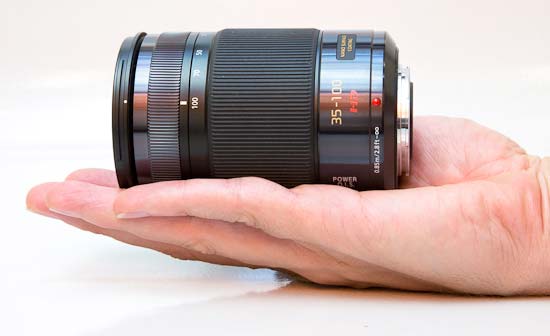
The Panasonic 35-100 f2.8 gives you the reach and constant aperture of at full frame 70-200 in the size of a can of Coke.

panasonic_lumix_g_x_vario_35_100mm_f2_8_asph_11.jpg


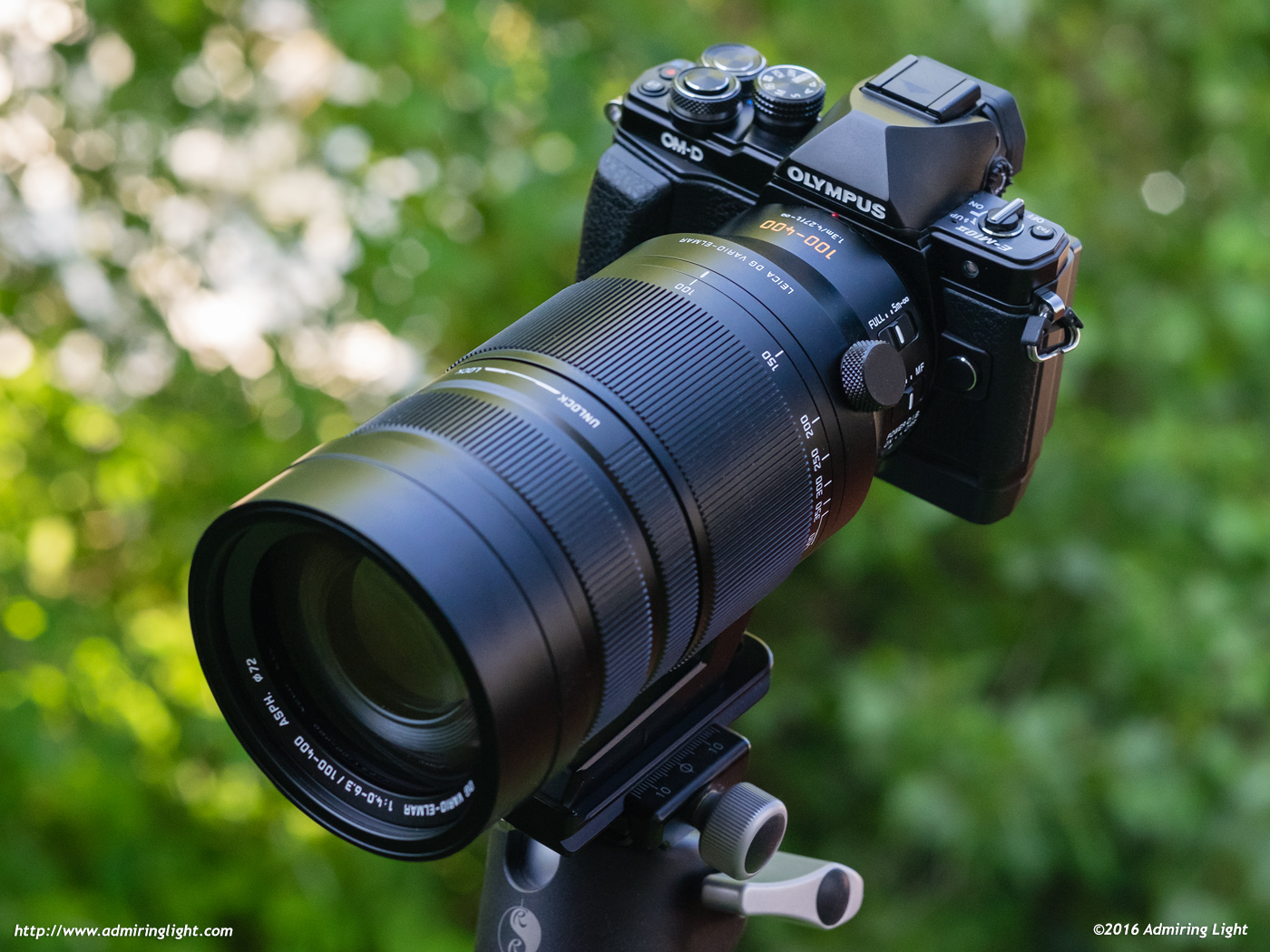
A Pana or Oly 100-400 is slightly smaller than a Canon 70-200 f4 and gives the reach and range of a 200-800mm full frame lens almost twice the size and weight.

pl100-400_full.jpg


There's always the tradeoffs between full frame and 43 sensors in terms of dynamic range, aperture ranges, depth of field, size and weight. It's up to the user to determine what is most important at any given time and situation.
 
About the size comparison, even my Nikon Z7 II is not substantial bigger compared to my OM-3 but it is 705g vs. 496g. The - for me - ideal hiking lens for the OM-3 is the 12-45 F4 PRO with a weight of 254g. Total weight of body and lens is 750g. The Z 24-70 F4 is 500g, total weight with Z7 II is 1205g, a substantial difference not only in weight but also size (the Z mount zoom lens is huge) when hiking.
 
As a m43 shooter I hate to say it, but for some types of lenses, getting the equivalent to full frame in m43 can cost more and result in a larger lens.

For example, I just picked up the Pana Leica 12mm f1.4. It's a beautiful lens with excellent build quality and IQ, but it's expensive and fairly large. For less than half the price, one could get a Sony 24mm f2.8 semi-pancake and have the advantages of Sony's full frame sensors. And the lens is also half the length and weight.

Similarly, the Olympus f1.2 primes are uniformly sizeable and weighty, and cost around $2000 AUD retail. They have beautiful IQ and build quality. For $1000-1500 one can get Panasonic 35/50/85 f1.8 lenses that are faster, weigh slightly less, and are roughly the same size. They lack the manual focus clutch and build quality of the Olympus Pro primes, but they have the advantage of full frame sensors, and have excellent IQ.

The size advantage is in lenses is outside of those parameters, where you want the smallest lenses possible while maintaining a reasonably wide aperture.

Oly and Pana f1.7/1.8 primes are similar in size to M mount lenses and half the weight or less.

Chris-Gampat-The-Phoblographer-Olympus-25mm-f1.8-review-product-images-3-of-6ISO-4001-60-sec-at-f-2.2.jpg


The Panasonic 35-100 f2.8 gives you the reach and constant aperture of at full frame 70-200 in the size of a can of Coke.

panasonic_lumix_g_x_vario_35_100mm_f2_8_asph_11.jpg


A Pana or Oly 100-400 is slightly smaller than a Canon 70-200 f4 and gives the reach and range of a 200-800mm full frame lens almost twice the size and weight.

pl100-400_full.jpg


There's always the tradeoffs between full frame and 43 sensors in terms of dynamic range, aperture ranges, depth of field, size and weight. It's up to the user to determine what is most important at any given time and situation.

Looks like nothing new here for now.
Want light tele - get M43.
Need it wide and fast or indoors, forget about M43.
 
Looks like nothing new here for now.
Want light tele - get M43.
Need it wide and fast or indoors, forget about M43.
Why do you say indoors? I'm wondering because I see a variety of different lenses of speed, size and focal length available, AF and MF.

I know that from a light getting into the film/sensor, an f-stop is an f-stop. Combined with the wide range of focal lengths from manufacturers and others, so what am I missing?

I've seen a lot of writings about an f2 on a M43 being equivalent to an f4, but I think that speaks to subject isolation, which confuses the crap out of me.

Can you please help me understand better your perspective?

Thanks.

B2
 
...
I know that from a light getting into the film/sensor, an f-stop is an f-stop. Combined with the wide range of focal lengths from manufacturers and others, so what am I missing?
I've seen a lot of writings about an f2 on a M43 being equivalent to an f4, but I think that speaks to subject isolation, which confuses the crap out of me.
...
As you surmise, an f/stop is an f/stop regardless of lens focal length or the format the lens is going to illuminate. This is because the light gathering power expressed by an f/stop is normalized by the division in the expression, that is "f/2" means "focal length divided by 2" in long hand which specifies the aperture opening diameter in whatever units it is being calibrated to (usually millimeters), so f/2 with a 50mm lens means an opening of 25mm, f/2 with a 100mm lens means an opening of 50mm, and f/2 with a 25mm lens means an opening of 12.5mm. It turns out that the light transmission through a lens is always consistent and linear with respect to the ratio of the focal length to the diameter of the lens opening, which is why this system works so consistently ... thus f/2 with all three of those focal lengths transmits the same amount of light per unit time.

---
The notion that "f/2 on M43 being equivalent to an f/4" is relating the difference in the depth of field created between lenses which image the same field of view on a 35mm FF format (36x24mm) vs a FourThirds format (13x17.3mm) at the same f/stop setting. This is because Depth of Field is dependent upon format size, focal length, distance to the subject for primary focus plane, and lens opening, always with respect to an 8x10 inch size reference print. Depth of Field is the range of "acceptably in-focus distance" both in front of and behind the set critical focus plane.

For example, consider a 50mm lens on a FF sensor set to f/2 and 6 feet focus distance. The resulting depth of field in that reference 8x10 inch print will be
Depth of field
Near limit 5.75 ft
Far limit 6.27 ft
Total 0.51 ft

In front of subject 0.25 ft (48%)
Behind subject 0.27 ft (52%)

The equivalent field of view lens on a FourThirds format sensor is a 25mm focal length, so fit a 25mm lens on a FourThirds sensor, set it to f/2 and 6 feet focus distance. The resulting depth of field in that reference 8x10 inch print will be
Depth of field
Near limit 5.52 ft
Far limit 6.57 ft
Total 1.05 ft

In front of subject 0.48 ft (46%)
Behind subject 0.57 ft (54%)

You can see immediately that the total depth of field at f/2 for these two different but equivalent camera/lens pairings differs by a factor of 2, thus the mFT camera's f/2 setting is equivalent to an f/4 setting (2 stops smaller) on the FF camera. The reason for this has to do with the amount of magnification required to take the smaller format's captured image and scale it to the 8x10 inch reference image size using the same aperture on the equivalent focal length lenses needed to achieve the same field of view.

Yeah, it's complicated. LOL! 🤷‍♂️

G
 
So the depth of field (in terms of mm or inches of depth at the subject...) is the same for a given focal length and aperture (and focal distance I guess), regardless of sensor or film size; that's quite a simple idea, if you can keep the notion of equivalent focal lengths or field/angle of view out of it - like when adapting a given lens to different mounts/systems.
 
Last edited:
So the depth of field (in terms of mm or inches of depth at the subject...) is the same for a given focal length and aperture (and focal distance I guess), regardless of sensor or film size; that's quite a simple idea, if you can keep the notion of equivalent focal lengths or field/angle of view out of it - like when adapting a given lens to different mounts/systems.

Yes, but that is not the point of what people intend when they say "f/2 on M43 being equivalent to an f/4". My intent was to explain that often-made statement.

The imaging characteristics of a given lens at set distance and lens opening are invariant, yes. But that says nothing about what you're going to get as you move the lens from one format camera to another. As you do that, you're going to get differing field of view and differing depth of field. Which I think is somewhat important to be aware of ... 😉

Of course, in the end, you stick any lens you got in front of whatever sensor/film you have, take some pictures at different settings, and see whatcha got to work with. LOL! 🤣

G
 
There is no such thing as equivalent aperture.

 
So the depth of field (in terms of mm or inches of depth at the subject...) is the same for a given focal length and aperture (and focal distance I guess), regardless of sensor or film size

That's not correct. Smaller sensors/film formats require greater enlargement to achieve a given print size, which means a more stringent circle-of-confusion criterion, which means less depth of field. You can see this if you play with a depth-of-field calculator - keep all the parameters constant except for the format size - change that and see what happens.
 
There is no such thing as equivalent aperture.

With all due respect to Ctein and you, the specific notion that I suggested in my example above (a 35FF 50mm f/2 lens on 24x36 vs a 25mm f/2 lens on 13x17.1) are definitely "equivalent focal lengths" based on comparing the field of views on the different cameras, and the exhibited DoF that each camera/lens combination creates shows that an equivalent aperture on the 35mm format camera to match what you get with the mFT camera would be about two stops different. The numbers show it clearly.

I can barely make out what Ctein meant, terrible writing IMO, and I certainly disagree with his descrying the use of the word "equivalent." And I'll drop the discussion at that point.

G
 
Last edited:
Why do you say indoors? I'm wondering because I see a variety of different lenses of speed, size and focal length available, AF and MF.

I know that from a light getting into the film/sensor, an f-stop is an f-stop. Combined with the wide range of focal lengths from manufacturers and others, so what am I missing?

I've seen a lot of writings about an f2 on a M43 being equivalent to an f4, but I think that speaks to subject isolation, which confuses the crap out of me.

Can you please help me understand better your perspective?

Thanks.

B2

In theory - for FF indoors to get family in focus I need f5.6 with 24 mm.
And ISO 4000 at least, but usually it is 6400. For M43 this will be f2.8 and 3200.
This is for static situation. But I don't like just static family photos.

On practice I haven't seen much family indoors pictures with M43. My own experience wasn't good.
 
In theory - for FF indoors to get family in focus I need f5.6 with 24 mm.
And ISO 4000 at least, but usually it is 6400. For M43 this will be f2.8 and 3200.
This is for static situation. But I don't like just static family photos.

On practice I haven't seen much family indoors pictures with M43. My own experience wasn't good.
Your family is much bigger than mine.

Interesting perspective, thank you.

B2 (;->
 
Back
Top Bottom