30x spotting scopes but no 30x slr lenses. Why?

trashcan diameter front element. hahaha. think Im gonna need a bigger boat... uh I mean a bigger tripod. Grab and end will ya? ahha

images
 
Almost any good telescope can be used with your camera using a T adapter and a T ring. I routinely use both Celestron C8 (2000mm) and C90 (1250mm). To get really REALLY high magnifications, you will need an eyepiece projection adapter. Then, the light is the limit.


Thanks micro thats awesome!
 
Put a scope-adapter on your 300mm to have a 30x telescope. Try "lens2scope" at Amazon or find the Nikon item used.

But for your 30x camera: Put a Nikon 1 on your 400mm f/4 lens and I think you'll have it. Or, just get a high-quality capture on your DSLR and crop.
 
I'm thinking of what focal length 30x would be. 30 x the normal focal length of 50mm? So 30 x 50mm = 1500mm? And a 60x would then be 3000mm. Not for hand-holding, that's for sure!
 
I'm thinking of what focal length 30x would be. 30 x the normal focal length of 50mm? So 30 x 50mm = 1500mm? And a 60x would then be 3000mm. Not for hand-holding, that's for sure!

The in EVF image stabilization of the Olympus E-M5 is something to behold. The E-M1 is probably even better.
Largest I've used is a 180mm lens at x2 equiv and x10 focus zoom = 3600mm. You can even crank it up to x14 giving 5000mm equiv in the viewfinder.
The Leica R 180/3.4 APO is also capable of large crops if needed.
 
Hi,

A couple of points; a lot of astronomy clubs run workshops during the year for member to make their own Newtonian telescopes. They are not the most complicated things to make. Whenever I used to get the chance I'd scrounge time of 'scopes in observatories etc and some of the home-made ones have been very impressive.

A typical 'scope would be a 6" reflector at f/8 meaning the tube was over 4ft long. Now do the maths for (say) f/4 and f/2...

I think Leica used to make an adapter for one of their film P&S's to fit their small spotting or similar scopes.

Regards, David
 
Not sure if this is clear from the discussions above, but spotting scope magnification comes from the ratio between focal length of the objective and the viewfinder..

My 16-48x scope has a 384mm focal length and 8-24mm finder. That 384mm focal length isn't wildly different from a 70-300 zoom.. It's the finder that does the magnifying trick. Like David said, there are adapters that allow you to mount your camera on the eyepiece of a spotting scope again for high levels of magnification.. (a.k.a. digiscoping).

Because the projected image from a spotting scope viewfinder is not flat, a small sensor P&S works best for digiscoping..

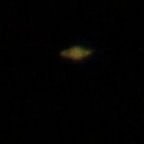
Attached a 100% crop of Saturn at 48x projected on an APS-C sensor..
 

Attachments

  • Saturn.jpg
    Saturn.jpg
    2.9 KB · Views: 0
Hi,

That reminds me, there is or was a great, if slightly old fashioned, Russian made Newtonian 'scope called TAL 150, perhaps (nominal 6 inch mirror and f/8) and those clever Russians fitted the eyepiece up so that a M42 threaded camera could sit on it. That could be interesting but being an astronomical 'scope it would give an inverted image. I guess the maths would be simple...


Regards, David
 
That reminds me, there is or was a great, if slightly old fashioned, Russian made Newtonian 'scope called TAL 150, perhaps (nominal 6 inch mirror and f/8) and those clever Russians fitted the eyepiece up so that a M42 threaded camera could sit on it. That could be interesting but being an astronomical 'scope it would give an inverted image. I guess the maths would be simple...

They also ran that the other way around. The Soviet MTO 1000 came with an eyepiece tube to give some ungodly magnification, around 60X, I think...

11968744346_c8b45a7581_o.jpg
 
Hi,

Nice to see a neat Maksutov, I wanted one but they ruined my local dark spot and the next one is out of easy walking distance (sigh).

Regards, David
 
Back
Top Bottom