
A different J-12 question

rbiemer

Unabashed Amateur
Local time
2:54 PM
Joined
Sep 17, 2004
Messages
5,091
Location
Cortland, NY
So as to not hijack any of the other J-12 threads:
I have a good LTM example of the J-12. Good glass, smooth accurate focus. I was looking at mine a little closer while putting it on my Zorki today and noticed the paint(?) around the rear of the lens is flaked away and thin in spots.
This seems to me like it could cause some problems? Lower contrast, perhaps?
The photos I've taken with this lens look OK to me but I wonder:
If I repaint this should I expect any improvement?
If I decide that I should do this, what type of paint?
Thanks!
Rob
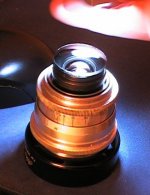
Here is a digicrap picture of the worst part of the back edge:
 

Attachments

  • JUPITER-12.JPG
    JUPITER-12.JPG
    32.9 KB · Views: 0
The paint is probably to help cut down internal reflections. How much difference it will make, I am not sure. I would use a flat black enamel that is sold in hobby stores.

Kim
 
Testor's sells the flat black enamel paint in a pen-type applicator. Very handy.

I found mine at Hobby Lobby.

-Paul
 
The unpainted bevel of ground glass will cause a strange sprite effect rather then low contrast, no scanner to show you sorry. At least I not seen any sprites since I painted all my J12.

Black board paint is recommended (acrylic), you may need two coats, you will need a steady hand and a fine brush.

Noel
 
Kim and Paul,
Thanks!
I think you're correct, Kim, about internal reflections and I think I will repaint the edges of this lens.
Paul, I have used Testor's paints(though not recently)and I'll look for some enamel as you and Kim have suggested. I probably will use a brush rather than a pen-type: It's easier for me to paint up to the corner on the edge and not go past it with a brush
Rob
EDIT: Noel, Thanks as well!
 
Last edited:
Painting the edge of lens groups in black is a standard practice even for those mounted in cells. The J-12 (and its Zeiss original) is one of many lenses where the rear groups are not cell-mounted, so it is easy to see the black edge painting.

When you examine such a lens and notice flaking of paint, see if the flaking starts at the cement joints between the elements. If this be the case, it might indicate more deep-seated issues.

Since the rear group of this type of construction has no metal cell around it, what hold it in one piece is just the cement between the elements. If improperly stored, the cement can "creep", making the elements to slip out of alignment, even though on visual inspection the cement can still appear to show no fault at all. But the element slip can crack the edging paint layer and make it flake. So, a lens of this type showing pristine, original edging paint indicates a specimen in good condition, you need to be very careful if you consider the purchase of one with flaking paint, or has been repainted by a previous owner.

In fact, many large-format wide-angle lenses are constructed as such, and I tend to be extra cautious when examining them. One example is the Schineider Angulon which has a bad reputation among photographers but I think the reports on poor performance were due to examples which had suffered element slip.

Back to the J-12: the proper way to store it is to have it on its end, as in keeping its optical axis vertical; this will reduce the likelihood of element slip even if the cement creeps.
 
I did not mean to say that!

The exposed bevel of ground glass, on the outer periphery of the rear element, that many late J12 have - will lower the contrast substancially, it will also when there is a light source like the sun in the wrong place i.e. from just out of frame and closer to the optical axis cause a peculiar off axial fash, - altheratively my Kievs has self repaired such a light leak.

It is desirable to inspect any J12 without a metal rear barrallel as the factory process was to omit pianting the bevel. In addition some lens do have damaged paint.

Note some of the factories did paint the rear bevel.

Noel
 
Back
Top Bottom