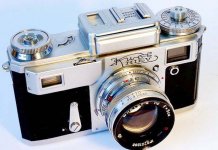
A Fantasy Speculation About The Quality Control Issue

I think that there is no doubt that the quality of the later Kievs was poor compared to earlier production. That does not mean that 'quality control' was poor. I think that we can be confident about that because due to their complexity relatively few Kievs have been taken apart by their owners. The screw-mount cameras are easy to dismantle and hence there are many that are no longer in the state in which they left the factory. Unlike modern precision manufactured products each item had to be adjusted by hand for correct performance. The loss of this adjustment over the years causes present day buyers of old cameras to complain about 'poor quality control'.
 
If you get a good one , cherish it , if you don't , either pay the realistic money to fix it , or go back to using far-more-sensible-priced-SLRs - or a comparitively reliable Leica IIIc .
No one ever made us buy ex-USSR cameras !!!
I shall have my best Kiev II / III cla , but my Oleg Kiev 4m , may be worse quality , but it takes great photographs , and that is what matters .

... and quality control was not a feature of much UK engineering at times !

dee
 
dee said:
If you get a good one , cherish it , if you don't , either pay the realistic money to fix it , or go back to using far-more-sensible-priced-SLRs - or a comparitively reliable Leica IIIc .
No one ever made us buy ex-USSR cameras !!!
I shall have my best Kiev II / III cla , but my Oleg Kiev 4m , may be worse quality , but it takes great photographs , and that is what matters .

... and quality control was not a feature of much UK engineering at times !

dee

Some precision cameras are collected, and IMHO, Soviet Contax are more collecable for their unique historical background. For use, a Kiev 4AM or Kiev 5 is a better choice. Some later Kievs are less smooth, but this does not bother me that much.

A 1960's Kiev 4 or 4A in mint condition and well serviced is the best of all Contax-Kiev family. They still have the pre-war Contax reliable long base rangefinder, a Contax 3a's flat bottom, and a western standard finish. Many good examples are still way under valued today. Look how beautiful a 1960's Kiev 4 is.😀

My 0.2 rouble.

Cheers,

Soviet
 

Attachments

  • 55571_1106195128.jpga.jpg
    55571_1106195128.jpga.jpg
    64.1 KB · Views: 0
Quality as a metric is hard to quantify, especially in a society where 'production quotas' are the norm, and manufacturing standards have not advanced beyond the WWII era. Of course, that's not just the FSU I could be referring to; think of how many crappy broken plastic cameras from the '60's and '70's are sitting around. Or have been long ago discard to the waste bin as being not worth contemplating fixing up. Or how many faulty toys have recently been recalled, having been manufactured just recently in the PRC.

Or the current era of disposable consumer electronics, where fixing something 'out of warranty' is a laughable joke.

One of the biggest hindrances to quality manufacturing is product feedback from the field. This is a problem that continues to plague even top-notch manufacturers. I can't count the hundreds (even thousands) of dollars I made repairing Sony TV's because they all had the same faulty solder connection in the tuner AFC module. And this went on for years, over half a decade. Or the continuing problems Toyota had with head gaskets on their early V6 truck engines; and this wasn't just one or two model years, but again, half a decade. Or the trouble plaguing the big US truck makers right now, with poor metallurgy on engine and exhaust fasteners. Or VW's notorious power window mechanism - these have been breaking for almost a decade. No design change, no desire to make the product better.

Those manufacturers that do solicit realtime product feedback and really do something about it can engineer continual product design improvements that make their reliability better. But in the case of auto manufacturing, a bad dealer network in a country (like VW of North America for a classic example of how not to sell cars in a foreign market) can be a hindrance to getting that accurate, realtime product reliability data back to the manufacturer. Hell, I'd wager that a sizable portion of their dealer network are submitting faulty warranty claims anyway, so how is VWAG getting accurate product failure data for analysis?

Back on thread, I'm really surprised the FSU cameras work as well as they do, given the years of abuse and disrepair most samples have seen, and the manufacturing philosophy of the day that disparage continuous improvement.

Of course, compared to the contemporary world of disposable consumer electronics, it's no wonder people are rediscovering these gems of mechanical construction.

~Joe
 
Last edited:
A few minutes ago I ended a very interesting conversation with an immigrant from Latvia, who left the FSU at the age of 20. What he specially knows is the Lada cars factory.

When he speaks about the stories of that factory, it sounds like you are hearing the story of the Arsenal factory, with all the elements we already know.

However, concerning the Lada factory he adds an intriguing additional factor he said was found in other factories as well: a parallel second line of production, either for export and for the nomenclatura, this one being the greater quality one.

Of course, like we already know, manufacture in general was plagued with many obstacles, yet at this second line there were no pardons nor discounts.

Has been there a second line at the Arsenal factory ?

Cheers,
Ruben
 
Weren't Soviet factories typically on a quota system? As I recall, too, they'd occasionally go all out to set production records and, hence, gain favor with the party and the regime. Certainly, QC must have dropped on days when the workers were on deadline to meet a quota.

Multiply these factors throughout the supply chain and it's easy to see how quality would range all over the map.
 
wgerrard said:
Weren't Soviet factories typically on a quota system? As I recall, too, they'd occasionally go all out to set production records and, hence, gain favor with the party and the regime. Certainly, QC must have dropped on days when the workers were on deadline to meet a quota.

Multiply these factors throughout the supply chain and it's easy to see how quality would range all over the map.

I've read that certain cameras were designed as "quota cameras." Very simple and easy to produce, these had minimal features and were usually marketed toward children or beginers. They also allowed the factories to meet the production figures assigned to them. The KMZ Yoonkor or Belomo Shkolnik are examples.

Another opinion on Soviet QC that I've recently read attributes the late-60's decline in quality to the arrival of the Brezhnev era. Apparently (I don't know enough of the history to say for sure), civilian production was given high priority under Krushchev, but when Brezhnev came to power the military was given priority for almost everything. As a result, quality of civilian items suffered.
 
Yet the most intriguing aspect of the quality issue, for me at least, is not so much the lower end, but the upper one. How this was achieved in spite of the many obstacles in the way.

My Latvian acquintance may be having the answer.

Now, let's not forget two highly important factors and a third one regarding optics.

First, it would be quite reasonable to reckognize that the "Kontax" was designed for manual assembly, and as such it is a fairly difficult job by itself.

Secondly, up to the 70's the average Kievs we find are quite good, or beyond if I am to compare with the average Yashica Lynx I have bought.

Thirdly, it is amazing that among the standard Jupiters we find "many" that are Sonnar-like quality, most are high quality and a minority are rather crappy. But here another laberynt: the highest quality optics are not at all divided according to periods of production and I have found it in lenses made by the late 80's.

Cheers,
Ruben
 
40oz said:
Remember who made the AK-47. And who's planes and space program rival or surpass anyone's. Those aren't products of a society incapable of quality manufacture or precision engineering.

Strangely ironic analogy, given the resemblance of the AK-47 to the StG-44.
 
a parallel second line of production, either for export and for the nomenclatura, this one being the greater quality one

IMHO this is quite possible, or even probable. Export of goods was quite important to the FSU economy. They couldn't export poorly assembled cameras, because they wouldn't sell. As we know, the cameras were exported to UK, to all allied socialistic countries etc. I read somewhere that almost entire production of Orion 28/6 in Kiev mount was exported to UK.

On the other hand - citizens of FSU had very few choices (if any) when buying a camera. Shops were always undersupplied, so they could only buy camera that was available at the moment. They wouldn't complain to poor quality. And even if they would - who would listen?

The key to this might be the engraving (letters).
IMO if you buy a camera engraved in cyrilic you are likely to get a camera aimed at the home market. OTOH cameras engraved in latin might come from the line intended for export. Similar with lenses.

Does that imply that cyrillic engraved equipment is of lower quality ? I don't know...

But this is just my speculation... so take it as such.
 
landsknechte said:
Strangely ironic analogy, given the resemblance of the AK-47 to the StG-44.
Actually the resemblance is quite superficial. The AK-47 was certainly inspired by the StG 44 and shares a number of design elements with it (just like practically all other assault rifles from the same period do, and just like the AK-47 incorporates elements of other common rifles of the time as well). Nevertheless, the AK-47 is a substantially different design, much more reliable and easier to produce, certainly a much better rifle overall, and one of the most successful weapons in the history of warfare, whatever that's worth.

There's a reason why it was the AK-47 that was copied everywhere, including Finland, Israel and East Germany, instead of its German predecessor.

Philipp
 
zhang xk said:
As I worked in such a factory for many years, I could understand the situation. The system did not encourage hard working, as even you work yourself to death, you did not get a penny more.😡
I don't know Chinese factories obviously, but in the Soviet Union it would not have been out of the question for a worker or a brigade to receive rewards when they substantially exceeded they quota. The most famous example is of course the coal miner Stakhanov, who supposedly exceeded his quota by some 14 times in 1935 (it was later revealed that he had collaborated with others who credited their surplus output to him) and after whom the Stakhanovtsy phenomenon was named.

Philipp
 
brachal said:
Another opinion on Soviet QC that I've recently read attributes the late-60's decline in quality to the arrival of the Brezhnev era. Apparently (I don't know enough of the history to say for sure), civilian production was given high priority under Krushchev, but when Brezhnev came to power the military was given priority for almost everything. As a result, quality of civilian items suffered.
That is certainly true. The shift was probably not so much towards military goods rather than from consumer goods towards investment goods, of which military products could be called a subcategory. The latter are easier to produce in a planned economy, for the obvious reason that nobody consumes them and hence there are few problems estimating demand.

With consumer goods the focus shifted towards the mass production of relatively simple, tried-and-true products that could be worked and repaired everywhere with little effort. In cameras, you can observe this with the shift in the 1960s from sophisticated, somewhat experimental cameras like the Zorki-5/6, Drug etc. towards mass-produced designs like the Zorki-4 and FED-3/4/5 with only gradual improvements. Or you would have highly standardized car designs cranked out in millions, with the result that today you can get your Lada repaired in every village.

Incidentally I wouldn't say that quality suffered necessarily. We have to distinguish a little bit between reliability and quality control. The Zorki-5/-6, Drug, Leningrad etc. all had the reputation of being somewhat capricious and unreliable, which the later FEDs did not have, in spite of a FED-5 having the same features as a Zorki-6 and then some. Maybe your camera would arrive misaligned, but then you would take it to your local watch repairman, he would set it up just fine, and then you'd have a reliable camera. (I'm exaggerating somewhat of course, but that's the general idea.)

Philipp
 
One has to account situation in USSR - while Stalin were alive, many areas in USSR seemed to be "developed", as if key person could roll out claim, then responsible person(-s) very quickly could get so called "free ticket to North" or maybe even worse (not so typical post war). And mind, who worked in factories then - people were hardened by war and knew value of job and taste of bread. Further-worse. Later USSR earned some money selling black gold, gas and war machines, people hadn't vision because of corrupt government and crazy ideology. So most worked not to create world's best camera but to earn bare minimum, trying to steal something in working place to improve their living. Do you know about Soviet production and market ? If there were planned X cameras, then factory should make X cameras and not X-1000 - plan is plan and should be done, if you don't want problems. So you can imagine quality of cameras in those rush periods !
Btw in Soviet times there were myth told by factory workers - you didn't have to buy products made in certain periods. In January, when everyone were drunk after New Year. In last months of year, when workers work to complete plan. In summer workers try to sooner escape out of city etc.
Being working in last Soviet years, I know personally what chaos ruled then. Personally I made small garden tractor for my boss, out of factory's metal and using factory tools/electricity (I'm welder). He brought engine and we put it into. And this were smallest steal worker could do 🙂
My wife's mom worked in factory which made audio electronics. That factories made high class stuff for military industry and average crap for masses. She told me about how they forced workers to complete plan, imagine quality again, but then warranty departments had job - they fixed near new non working gadgets. Ha ha ha ! I remeber my first cassette player, 10 years old guy knew all about warranty issues. Best tape players were copied from Japanese makes, that's why now I buy Japanese cameras not Zenits. OK, Kiev 4 could be exception if I get it for good price - but only because Ruben's great evangelist work 🙂

Recently I asked known local camera repairer and he asked - do you really want Kiev ? Really ? He told that as Russians altered construction, they were far from what they should be, to mention just shutter laces - they are too thick, fraction of mm. And as years gone, construction and material diverged away from origin - Contax.

 
Last edited:
heh,heh,heh. You think only the FSU`s lacked quality control or are now in need periodic CLA or an overhaul? I`ve seen plenty of Leicas recently with the finish flaking off, pitting , severe brassing, pieces of vulcanite missing , bad curtains , rough gears in the film advance , non functioning shutters , innacurate shutter speeds , and hazy rangefinders. Maybe their workers were drinking too much beer?
Not that the Leicas were bad folks but they didn`t fare any better from what I see.
This stuff is 50 +/- years old so why put so much blame on the poor russian factory worker for shoddy workmanship?
John
 
btgc said:
..............My wife's mom worked in factory which made audio electronics. That factories made high class stuff for military industry and average crap for masses. ...........

This again comfirms what seems to me the best explanation of the quality issue: Parallel lines of production within the same factory, according to the targeted 'market'.

It also makes a lot of sense as the system way of survival within its own contradictions and basic situation.

I would just say that "crap for the masses" sounds to me a bit of a too much a generalization, but basically 2 or 3 levels of quality (production lines) does explain very much why we find from time to time like-new-cameras working so good, we hardly understand how we were so lucky.

Cheers,
Ruben
 
It`s no wonder some people look down on FSU`s and they are only worth a fraction of what other brands are.
You guys keep the tales alive and perpetuate the myths very well.
Maybe that`s a good thing though. I`m not complaining .
In the past month I`ve bought a Kiev 4 , a Kiev 4A , a Zorki 3M , and a Zorki 3 all working 100% and all with good lenses for significantly less than a Leica IIIf in fair condition would have cost me and I expect to add a Trudkommuna to that total cost comparison.
Prior to these I bought a Kiev 4M that worked pefectly well but I decided to dissasemble it for no good reason and couldn`t get it back together, my only loss but the experience gained was good.
Then there is the beautiful Fed 2 with a Industar 26 that was as good a shooter that any sane person would expect from a RF.
Add to that a superb Zorki 3C and a 2C that was just as good. Oh and yes , a Zorki 4 that I swear functioned and looked like brand new. All cost from $19- $40 with lenses and case.
I also have a beat up old Zorki 4 that you would be embarrassed to be seen with but it works 100% and I would not hesitate to depend on it for any important event.
None of these could I be certain were ever CLA`d. I have no proof or receipt but I have used them all with most favorable results and no issues whatsoever.
The junk is out there for sure but I try hard to get good stuff from reputable people. I`d rather not guess or speculate and I prefer not to put the blame on some deceased poor old factory worker when there are more significant reasons for most camera failures than his workmanship.
I recently bought 2 leicas and was quite surprised that both need a CLA but I don`t think these were made on dual quality production lines or have I ever heard Leica owners say they were. Much of my German Retina collection needs work/ servicing too . Let me interject this remark taken from another thread by a forum contributor on the subject:
" the Russian cameras are very good and probably part of the reason that folks say that they are not has to do with a lasting prejudice against almost all things Soviet, due to the Cold War, as well as what you have mentioned about upkeep and maintenance "
Anyway , Keep up the good work guys! As long as you insist on repeating these legends the better for me and my pocket.
John
 
Last edited:
Hi giovatony,

In principle, or hypothetically, if the parallel lines of production is the correct explanation, it doesn't mean that the parts arrived from three different levels of quality.
Therefore there is no contradiction between finding an occasional highly good Kiev, and adjusting an average one to highly good standards.

The term "crap" used by btgc, reflects the discontent of a citizen about the problems of his country and in fact you can find the same reactions by people in any country. I am not so identified with this sound, as my experience in testing Soviet lenses comfirms beyond doubt.

But this is the second time I hear about the parallel lines of assembly, from FSU people with some direct knowledge of the factories.

Furthermore, within the limits of my knowledge, on the broad economical view, the problem with the Soviet plannificated economy was not explotation (surplus value eated by individual owners of factories) but privilege and beaurocratic command of the ruling caste. The parallel lines of manufactue fit here very much.

I don't classify Soviet gear by "crappy" and "good", but between "good" and "outstanding", asking myself why not every J-8 was so outstanding as the best ones.

Cheers,
Ruben
 
Last edited by a moderator:
Hi Ruben,
Just go to the digital forums and you will get the up to date version of the same complaints about the sharpness from one lens to another of the same. Some will complain that their new modern lens has a centering problem or a lack of sharpness , or edge blur and others will talk about how razor sharp their copy is and how their eyes bleed from the sharpness.
And how about the new camera bodies ? Some don`t turn on , some don`t focus properly, some don`t do this or do that. Yeah and these are brand new cameras. Must be put together those dual quality lines , one is so so and the other is excellent.?
Me? I got 2 bad old Helios lenses so far and 1 good one. The 2 bad ones got wrong size screw driver marks all over the screws. Must have came off the bad assembly line? Thankfully a new Helios 103 cost only $22.
My 3 Jupiter 8 lenses are fine though. They were made on the good line because my wife`s grandmothers brother in law`s cousin from UKR went there and got a job after the war where they were made and he told her when he got good at the job the boss would put him on the high quality line.
Just making fun of it all of course.


.
 
One case worth looking at is another product from Arsenal, the Kiev-35A. These are Minox copies with a bad reputation for quality. I have two good working ones, which I got after going through 5 or 6 specimens. All came new, sealed (with black strings and paper tape with inspection stamps).

The first camera had perfect function. But the material used for its shutter was not opaque. How the material was able to go through production without even being checked for suitability is a good example of what quality control is in the factory at the time the camera was made. The basic premise that shutters ought to be opaque seemed to have escaped, or perhaps ignored by the factory's inspection team.

The second was dead- dead right of the box.

The third was good and I kept it. Seeing how well it worked - a camera the size of a cigarette pack, with aperture priority AE, manual focus and excellent optics, for the price of 3 rolls of Kodak colour film was definitely something to have, again- I decided to get another one as a 'spare'.

Fourth camera again was bad. The take-up didn't even turn or move.

Fifth camera was OK, but not as smooth in function as # 3. Kept this just the same.

Inspite of being defective in terms of material and assembly, many of the Kiev-35A were released as 'good cameras'. They even had "certificates of worthiness" and bore stamps of the inspector who checked them. Why they were even released is subject to speculation. Perhaps the inspectors and the workers who made the cameras did not care. Perhaps they were more concerned of filling the quota ("the order was to make 1000 cameras- it wasn't specified if they had to be functional" 🙂 ) than anything else.

The situation is not exclusive to the Soviet system. Some capitalist notions- "make more, sell more" or cutting corners to keep production costs low and profit margins high lead to similar situations. I've met a few underpaid & overworked workers who deliberately sabotage their products (like inserting dead roaches inside rolls before they're packed) to get back at their bosses.

Jay
 

Similar threads

Back
Top Bottom