a photograph and radiation

Any evidence to prove that? 🙄

Ever see the photos from the "Pearl Harbor Brownie"?

http://www.snopes.com/photos/military/pearlharbor.asp

After reading further replies, it seems that what really happened was Igor was misquoted, or misunderstood in what he meant by radiation ruining the film. Only one of his rolls came out with any images, and the other ones are what he referred to as being unusable due to the radiation.

I have a lot of respect for anyone who has had to deal with the results of a nuclear disaster such as Chernobyl, or Fukushima. It's something I wouldn't want to partake in.

PF
 
Some of these comments are how the myths get started.

I work with x-rays as an art form and have since 1965. I worked as a photographer for the Department of Energy at Oak Ridge National Lab and the Y12 facilities at Oak Ridge Tennessee in the mid 70's. Google these for information on them. I know quite a bit about radiation and its effects.

No his camera did not turn to dust from radiation. No the camera didn't fail from radiation. The person shooting would have been dead from radiation way before any effects were seen to the camera. My neighbor was an optical designer at the lab and designed and built optical systems used in high radiation areas where radiation levels would be lethal. My neighbor showed my lenses that were in high level areas. The glass over a short period turn opaque. Lenses used on these areas have to be made from non browning glass like lead cerian. The lenses would have become opaque and the photographer become very ill if not died before radiation caused any problems with the camera.

My father was a mechanical engineer at Oak Rdfe Gaseous Diffusion Facility ( uranium enrichment facility) and designed mechanical systems to work in high level radioactive environments. My father said once one of the major issues is lubricants. Lubricants fail quickly in radioactive environments. Mechanical systems function but special lubricants are needed. The levels of radiation are so high to cause this that any animal would die almost instantly if exposed to that level. Much of his design work was involving unloading irradiated target rods from high energy research reactors, specifically the Hi Flux Isotope reactor at Oak Ridge National Lab.

Any level of radiation to cause failure in the camera would have killed the photographer well before anything happened to the camera plus film would be totally exposed even before that. And no, cameras can't change to dust.
 
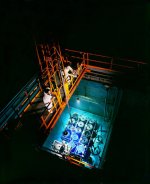
Here's a photo I made for the DOE in 1974 of the HFIR I mentioned above. The depth of the water is about 35 ft to shield and cool the spent uranium reactor cores. This is a used reactor fuel element glowing in the water. It spends about a year in the pool to cool and reach a lever that it can be transfered to an 80,000 pound shielding container for transport. The levels after a year are still so high you would die instantly if exposed.

My father designed the system to load and unload the target rods out of the reactor this fuels. Target rods contain materials that are irradiated to produce research and medical isotopes. At one time this was the most powerf research reactor in the world.
 
Igor gets immeasurable respect in my books for merely having the balls to document the Chernobyl clean-up first hand. He stood on the actual roof of the reactor building with the other workers. Unbelievable.

The radiation was so intense that the "liquidators" were ordered to count from 1 to 40, then immediately flee the building and head straight for decontamination. They received more radiation in a few seconds on that rooftop than the permissible dose for a lifetime's worth of exposure.

The initial clean-up effort was started by remote controlled robots, but their electronic circuits failed almost immediately, rendering them useless. The authorities quickly summoned human volunteers to continue the remediation. They were called the "bio-robots" because they took over the job of the original mechanical robots on the rooftop.

Many of the "bio-robots" were promised exclusive benefits and perks because of their heroics, but many of them ended up with severe health problems and little recognition for their efforts.

Hard to believe but it's the 30th anniversary of Chernobyl (in 2016).

A short video about the liquidators can be found here:

https://www.youtube.com/watch?v=PA3_PRjHxuM
 
Lubricants fail quickly in radioactive environments.

Anything that depends on large molecules will deteriorate when irradiated, as ionizing radiation will crack these molecules - whether grease, polymers or life. Life being most vulnerable of the three, the photographer still will drop first, long before his camera will run dry or lose its plastics parts...
 
Anything that depends on large molecules will deteriorate when irradiated, as ionizing radiation will crack these molecules - whether grease, polymers or life. Life being most vulnerable of the three, the photographer still will drop first, long before his camera will run dry or lose its plastics parts...

Exactly.

Here's the spent url element for on the HFIR.
 

Attachments

  • C9993.jpg
    C9993.jpg
    40.5 KB · Views: 0
Anything that depends on large molecules will deteriorate when irradiated, as ionizing radiation will crack these molecules - whether grease, polymers or life. Life being most vulnerable of the three, the photographer still will drop first, long before his camera will run dry or lose its plastics parts...
Thanks (and to x-ray too) for these clear explanations.

Strangely enough, Igor Kostin died in 2015 in a car accident. So he survived the Chernobyl event, sort of.

It would be interesting to find that TV show back. I clearly remember the Nikon F3 displayed then, with peeling leatherette, verdigris all around, a dead shutter, a dead MD-4 motor, and, of course, many many many bips per second when put close to a Geiger counter...
 
Radioactive contamination is another issue. When o worked at Oak Ridge National Lab my I always wore a dosimeter and my equipment was often checked by a hefty physicist for contamination. I hated working in areas that I had to wear a protective suit, gas mask and protective gear over the protective suit. I worked in a couple of places where I was allowed to be in the area for one hour per day. There was always the risk of exposure to deadly agents. The danger was one of the main reasons I left the lab.

Unfortunately radiation damage is cumulative. Also depending on what the dosage is and where in the body the effects can take 30-40 years to cause problems. If the dosage is high enough it can result in immediate death.

In the past year Ive delt with cancer and it's been in the back of my mind whether my exposure to radiation created the problem. Fortunately I'm now cancer free.
 
Back
Top Bottom