A question about parallax

Kodak Medalist was medium format and pretty much addresses what I was saying about aesthetics.

00L1Im-36354684.jpg


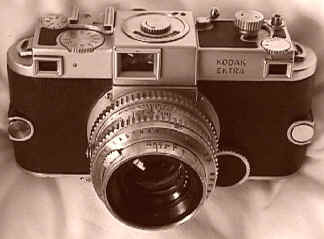
The Kodak Ektra of 1941 tried this route. It was not a success.
ektra17.jpg
 
Last edited:
...
We all know that as we focus an RF from an object at infinity to one that's close-up the FOV shifts, and we see this as the framelines shift from upper left to lower right. ...

Not correctly stated.

When you focus closer, the actual image on film does not shift in any way. What happens is that the displacement of the VF, compared to the lens, becomes a greater percentage of the distance to the subject and the difference in what they see, as a percentage of the FOV increases. To partially correct for this, may RF viewfinders shift the frame lines so that they are properly centered on the lens' FOV. This is the primary parallax issued with cameras that don't view through the taking lens, both VF/RF and TLR.

There are two other issues to consider. The first of these is that most lenses used on RF cameras focus by moving the whole optical unit forward. This causes the angle of view to narrow. Only a few of the more elaborate VF/RF systems provide active correction for this reduction in frameline size. Many just use secondary marks to indicate the approximate smaller field as some common closer distance.

The second of these additional issues is the other parallax issue. No matter how well a non-TTL viewing system corrects for the parallax at the plane of focus, the placement of objects at the plane of focus relative to that of those either closer or further from the camera will be different in the VF than it is on the final image. There is no way to correct for this other than to move the VF to the lens' position for framing and then to shift the lens back to its desired position to take the picture. One such device was the Paramender accessory for the Mamyia C series TLR cameras. It raised and lowered the camera by an amount equal to the spacing between the viewing and taking lenses. You would lower it for viewing and focusing and then raise it to place the taking lens where the viewing lens had been to take the picture.
 
Thanks for the good follow-up comments folks.

Yes, as correctly stated by Dwig, the FOV of the image on the negative itself does not shift apart from the change in effective focal length as one focuses, but the relation between the VF image and negative image does, hence the shift in framelines. I didn't use clear enough language to describe this in my previous post.

I modified my mental experiment by envisioning a scene with two telephone poles, one in the near foreground, the other in the far background. Set up an RF camera along a straight line so the image on the negative is of the two poles coinciding. If you use the VF to compose the image by centering and focusing on the nearer pole, the background pole will appear slightly off-center and out of line. However, if you simply switch focus to the background pole without moving the camera, the background pole will now appeared centered and the foreground pole slightly off-center. In either case nothing's really moved, only the VF image to compensate for the difference between the lens and the VF.

The second phenomenon Dwig describes that VFs cannot correct for, that of the visual relationship between near and far objects, is the actual parallax itself, as opposed to the shift in the image boundaries as represented by the framelines. In the above situation it is still impossible to accurately see the actual image boundaries using the VF alone, only an estimate.

So, I'm a little less stumped now.

 
Back
Top Bottom