lubitel said:
Ian thanks for the interesting reply,
but doesnt he contradict himself with photos like this?
http://www.photographer.ru/galleries/show.htm?id=37&pic=21
Isn't that exactly what he describes as "opium art" or romantic?
Lubitel, that's a very interesting point!
Rodchenko's particular school of Futurism was called Constructivism, specifically because it thought that all art should have the single purpose of helping construct the USSR.
I think that if you had asked your question to Rodchenko he would have said that his photograph was an expression of "The New Soviet Man". The viewpoint - which would still have seemed unusual - emphasizes the heroic dynamism of two people who are pretty ordinary, judged by pin-up standards. Their clothing suggests that these icons are enjoying the sort of leisure and fulfilment impossible to the working masses of the west, and in the Soviet context probably also implies communal activity.
In a sense, the clothing is the give-away. These ideal yet "normal" workers are placed in a specific
historical-ideological context, unlike the timeless nudes of classic, academic art. Their clothes also emphasise the public over the private and so on....
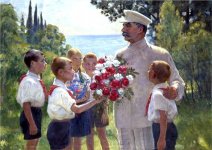
But - you are absolutely right. By 1932, when this picture was taken, the Futurists, the Constructivists - the whole Soviet avant-garde - were in desperate trouble. Lenin had always disliked modern art and Stalin's USSR had absolutely no intention of being in a state of constant creative anarchy. Instead, the despised forms of the past were re-imposed as Socialist Realism. The latter was a special sort of realism, claiming to depict the "typical" - meaning not whatever was common or real, but the ideal "type" supposedly characteristic of the time - in other words the sort of completely unreal "reality" that we in the west know from advertising, pornography or fashion magazines. Socialist Realism was by no means without remarkable masterworks, but it inevitably sank into an oppressive emptiness, particularly in the postwar years of "brigade painting" - literally mass-produced art made by great gangs of painters. Despite "modern" themes it was amazingly like the "bourgeois" art that the futurists had hated - representational, morally upright, stolid, inspirational, immobile, sex-free... Indeed, Rodchenko's emphasis on the genital area in this picture is perhaps the really daring thing about it.
Artists like Rodchenko had to repent or compromise or oppose and face the consequences. We could say this photograph shows his public compromise: in private he painted illegal abstracts, in public he took increasingly conventional party-line pictures.
A very similar situation existed in Germany, where some of the "degenerate" artists denounced by the Nazis were actually enthusiastic National Socialists...
The evidence would seem to suggest that dictatorships always aspire to Kitsch
🙂
Cheers, Ian