The early switch to popular 35mm point & shoots happened in the early 1960's. Agfa introduce the Rapid with casette to cassette feed. Kodak decided that a plastic cassette including both feed and take-up in one unit would do away with loading problems by fumble fingered amateurs. They called it the 126 Instamatic and it used 35mm wide film with a paper backing so you could read the frame numbers on the rear. No complicated frame counter mechanism needed. It had a single perforation per frame so the camera could sense when to stop winding. Having perforations only on one edge meant that the picture area could be 28mm instead of 24mm on 35mm wide film. Kodak went with the square format, 28 X 28mm.
The diagonal length of the picture area meant that standard 35mm slide projectors, enlargers, and commercial printers would have no trouble illuminating the full picture area like they did with 38mm X 38mm "super slides" on 127 film. Anyway you looked at it the idea was to get the box camera public switched over to using 35mm wide film.
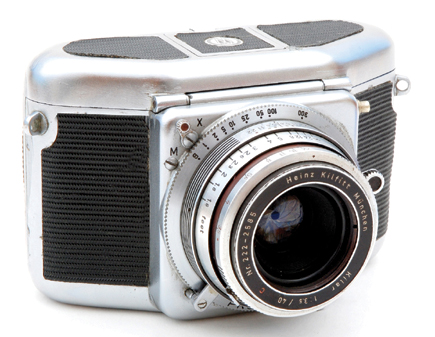
There were some pretty sophisticated "glass, brass, and chrome" cameras made by Kodak and Voigtlander, including leaf shutter SLR's, but they weren't cheap and never caught on with the public.