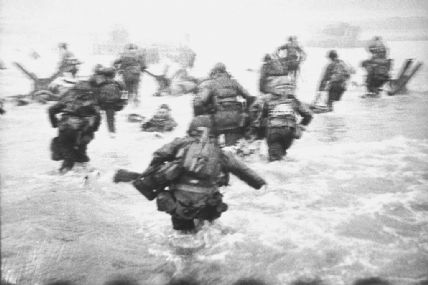
Alternate History: Robert Capa on D-Day

I also am not going to bother reading through all the pages of that article (although a little niggling part of me says I should in order to be better informed about the discussion here). I do recall from somewhere else some analysis of whether Capa was really in the first wave or a subsequent one, but again, as argued above, it hardly matters.

Probably relevant is that in my edition of Capa's autobiography, Slightly Out Of Focus, the foreword points out that in the original pressing, Capa's own liner notes stated that, in effect, nothing in the book should be taken literally. In other words - his own recollections of events were embellished.

Which brings me back to... so what? The story is what the story is, and more importantly, the photographs are what they are. I, for one, can stare at those few images for long periods of time and (at least kid myself I can) imagine what it must have been like to be there. Bravo Capa.
 
Last edited:
None of the discussion has emphasized the importance and difficulty of keeping the cameras and film dry under those conditions. Plastic freezer bags didn't exist back then.

The GIs had 'pliofilm' bags for their rifles, most of the other sensitive gear was in 'waterproof' rubberized bags.

I might be remembering this wrong, but doesn't he say in 'Slightly out of focus' that after landing he tore off the waterproof covering of his cameras?
 
I still think keeping a Contax II dry in those condition, in combat, was not an easy task.

In a larger sense, the premise of the original posting is built upon the assumption that the shoot could be characterized as a failure, thus a conspiracy is required to save face. If those were the only 11 frames taken, they still represent a photojournalistic success. The one image has become iconic, yet several others, such as the one below, capture the sweep of the event.

2004-10316_428px.jpg
 
I've always loved the motion blur in these photos... relays the chaos really well IMO. Obviously they are a bit more abstract than we are used to now, but they work for me.
 
In a larger sense, the premise of the original posting is built upon the assumption that the shoot could be characterized as a failure, thus a conspiracy is required to save face. If those were the only 11 frames taken, they still represent a photojournalistic success.

you hit the nail on the head. in the long run, it's the 11 photos that are historically important, not the soap opera behind the scenes.
 
I've only just come across this thread.

Thank you Harry (Lime) for such a reasoned, thoughtful and clearly written post, that does proper justice to the circumstances of the time. It's a forceful and utterly convincing response, and clearly must have taken you time, both to reflect on and to write. And thanks to many others as well, such as Pioneer and Sparrow, who have continued the discussion about a very serious matter (impugning a man's integrity - in this case at least two men) in such a considered and civilised way.
 
I think what bothers the Capa naysayers most is his "loose" style, both in his photography and his life. Yes, his camera technique was never great; yes, he embellished everything from his real name, to his accuracy in photo-reportage, to his shameless self-promotion, and to his exploits with women.
His complete disregard for fiscal responsibility with respect to Magnum is a fact.

My question is: could Capa have captured better images if all of the above were not so?
I doubt it.
 
i too don't care for his style. Tries to be cool but it's just amateurish. I'm not doubting he did a thorough study on the case but he's presenting it the wrong way which removes credibility. All this bashing of Capa being scared back to the boat with his tail between the legs, well, seriously, this is teenager facebook post level.
His main argument -based on the analysis of the "damaged frames" - falls on its face too, due to the hoax that indeed TIME produced in their little movie, however it should have been clear to Coleman this is not something he should analyze, since he quotes Morris several times on the idea that he (Morris) threw the damaged frames out.

I've not seen the TIME documentary before but i agree on that point, that it's a major f.up from their side to retouch the succesful frames and present them as "the damaged ones" without clarifying that it's just for the show.
Not deeply surprised, though. Watch any natgeo or discovery channel documentary, and you see they are full of "illustrations" made by computer animation or similar, just to fill time or fill holes where the real deal is missing. And not always are they honest about it (almost never indicating that it's an illustration only).
Welcome to the 21st century "documentary" style...


The rest - whether there were more good frames that got damaged, or did Capa make only these 11 (or only 9 as he seems to suggest it here n there), doesn't really matter a "diddly squat" (to quote an old RFF member 😉 )
 
I read a quote from Capa where he fully owned up to being terrified on the beach. Words to the effect that a made for an incoming landing craft with the initial intention of drying off his cameras, but had really decided 'it was time to run away'. I don't think he was putting anything over on anyone.

People today evince a remarkable level of physical cowardice, but they're really brave in their SUVs and on the internet. God help us if we find ourselves in another world war, and need to start relying on the average dick to land on a beach somewhere.

Randy

P.S. We really need to reinstate the draft, and with no college exemption.
 
I might be remembering this wrong, but doesn't he say in 'Slightly out of focus' that after landing he tore off the waterproof covering of his cameras?
You're remembering this right and wrong at the same time. I have the original issue of 'Slightly out of focus' (1946) and it's on page 145 :

"It was now light enough to start taking pictures, and I brought my first Contax camera out of its waterproof oilskin. The flat bottom of our barge hit the earth of France."
 
Capa was there. Full stop. He did not have to go but he did. And Capa himself acknowledges how scared he was and the fact that he took off when he felt he had completed his task. The soldiers could not of course, but who would not flee in Capas situation once he felt honour had been satisfied.

In fact, time and time again throughout his war Capa put himself in harms way - including jumping from a plane by parachute to go in with the airborne troops when jumping into Europe later in the war. Capa was no coward and whether his D Day shots were damaged in processing or due to a shooting error - or the stress of having someone trying to kill him, is of little consequence. My hat goes off to him. No accolades however to a revisionist "historian" trying to make a name by tearing down one of the greats. This smacks to me of the revisionists who claim that Capa's famous shot of a dying republican soldier in the Spanish was was a set up - one of a series of fakes made by Capa for his own aggrandizement. PLEASE!
 
Capa was there. Full stop. He did not have to go but he did.

+1000

Capa was no coward and whether his D Day shots were damaged in processing or due to a shooting error - or the stress of having someone trying to kill him, is of little consequence. My hat goes off to him.

Very, very well said

No accolades however to a revisionist "historian" trying to make a name by tearing down one of the greats.

It is SOOO much easier to sit in front of a computer over 60 years later and surf the internet looking for "evidence" to support your pet conspiracy theory.
 
Back
Top Bottom