Any classicists in the forum???

sfb_dot_com

Well-known
Local time
2:24 PM
Joined
Oct 27, 2005
Messages
204
Location
Cornwall, UK
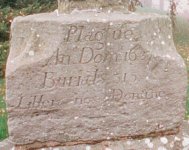
And able to translate this inscription?

It's on a cross in the small and picturesque market town of Ross-On-Wye near the Welsh borders. I'm afraid that I gave up Latin at school as soon as I could so for me it's ambivalent. The first part of the inscription is straightforward enough: "Plague An. Dom 1637" and the third line "Burials 315" needs no explanation.

However the fourth line "Libera nos Domine" has me intrigued. I used to think it was a plea, something along the lines of: "Free us Lord" but now I'm not so sure, and I think it might say: "Freed by our Lord" Maybe it means both? or maybe something different altogether?

Whatever the explanation it's a powerful reminder of those troubled times.

Can anyone help??

Oh and BTW Bessa L with Heliar 12mm

Thanks

Andy

 

Attachments

  • plague.jpg
    plague.jpg
    86.3 KB · Views: 0
  • plaguecrop.jpg
    plaguecrop.jpg
    52.6 KB · Views: 0
EDIT, sorry. There should be a commar after nos.

free us, lord.
 
Last edited:
Sobering reminder; I googled it and a liberal translation is "Deliver us, O Lord". Apparently from death and other nasty eventualities.
 
It's a standard element of a religous litany common to both the Roman Catholic and, translated into english, Anglican traditions. In this case, deliver us oh lord from the plague.

William
 
OK, I don't know Latin, but although "liberare" is literally "to free", doesn't "libera nos" in this context mean "save us"; you know, from this mortal coil, from hell, to heaven, etc. etc. ...?

I think Latin has the word "salvare" for "to save", but I'm just wondering...
 
Yes of course,

I was forgetting my Catholic background. It's a line from the Lord's prayer, and this is the way it goes in the version I was taught:
"Deliver us O Lord from Evil"
"And Lead us not into Temptatation..."

They must have prayed for the chance to be lead into temptation. Latin may be a dead language, but it has an incredible power to deliver meaning even now.

Thanks all for the feedback, it's been very helpful.

Andy
 
sfb_dot_com said:
..Latin may be a dead language, but it has an incredible power to deliver meaning even now..
Latin is more alive than ever. There's not a single Harry Potter book where there's not a Latin spell.. Granted, these are not scientific publications or religious pontifications, but nonetheless..
 
Until the sixties, the Roman Catholic celebrations were held entirely in Latin language.
"Libera nos a malo Domine" was a usual invocation in every celebration, and means "Lord, save us from evil"; this sentence is quite common in every old Italian church and cemetery.
I studied Latin at the High School (5 years), and I still think it is a fascinating language!
 
There is also an beautiful song that is often sung in Taizé and communities inspired by the Taize oecumenic movement of the late Frère Roger in France:

"per crucem et passionem tuam LIBERA NOS DOMINE"

"By means of the Cross and Your Suffering FREE US LORD"

It must be a very old tradition, dating back to the days of the Vulgata, the Latin translation of the New Testament, and obviously derived from Our Lord's Prayer, as stated above.

Beautiful language, anyway.

Jesko
 
Just had a flashback; Monty Python and the holy grail.

The entry scene shows monks chanting the Pie Jesu (dona nobis pacem) and chastising themselves by slapping themselves on the face with the book..
 
Back
Top Bottom