jlw
Rangefinder camera pedant
Ash said:With the motorbike thing having died a gruesome death, thanks to being shouted into the ground about safety and all that, my eyes were turned to classic cars.
Blame a former colleague, who let me sit in the passenger seat of his excellent condition Triumph TR7.
I'm now determined to either own a Triumph, or a similarly awesome classic car. Especially thanks to the Classic Car Insurance costs being so low, and minimal tax (or even exemption).
Anyone drive a classic car? I'm thinking if it has trunk space for camera gear, its good enough for me 😀
Oh also I don't expect to have a car as old as the Leica Standard! 1970's will do 😀
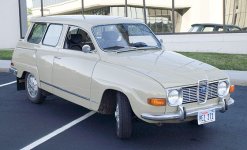
I run two cars from the 1970s, although a lot of purists would turn up their noses at describing them as "classics." One is a 1974 Saab Sonett III (click here for picture) and the other is a 1971 Saab 95 station wagon (not-very-good picture attached.)
They are not "restored" cars or "show" cars -- they're in pretty good shape (the Sonett is a bit rough in terms of looks, but I've gotten it very well-sorted mechanically; the 95 was very clean when I got it, and I've mostly been chasing minor details on it.) They don't need a lot of care, and I have no qualms about driving them whenever I want (although I have a Honda Fit that I use for everyday driving.) In fact, when I was between "modern" cars before I got the Fit, the 95 was my daily driver for about three months, and it did fine. I don't drive them on long trips because they're rather noisy at highway speeds, but otherwise they're perfectly usable everyday cars.
[By the way, don't think I'm vastly rich just because I own two "special-interest" cars. The combined price I paid for both of them wouldn't have bought one Leica MP and a 50mm lens, and I don't spend any more on their annual upkeep than I used to spend on film, paper, and darkroom chemicals before I went down the path of digital perdition. As you note, classic cars can have tax advantages, and they can be quite inexpensive to keep running as long as you buy something sensible and non-exotic.]
Anyway, I'm not trying to tout you onto Saabs specifically, as they're not for everyone. However, I agree that using the 1970s as your cutoff point is an excellent idea. Car design and materials made a lot of progress during the 1960s. Cars of the '50s, '60s and earlier are very "classic" and lots of fun, but they do need much more regular attention and upkeep, which of course would cut into your photography time!
A car from the 1970s is very much like a modern car in terms of maintenance requirements (although of course it needs a bit more looking after simply because it's older.) You still need to change fluids at regular intervals and mend things that break, but you don't have to worry about greasing gudgeon pins every 2,500 miles and other obscure tasks of bygone days. Likewise, the basic systems on a 1970s car are similar enough to those of a modern car that everyday mechanics can tackle most of them, while older cars often require the services of a "marque specialist" to perform the specialized maintenance they require.
Meanwhile, if you want to take advantage of the UK tax exemption, you're limited in how NEW a classic car you can have -- I believe it has to be at least 25 years old, doesn't it, or is it 30? Anyway, that would give you a wide range of 1970s cars that should be reasonably dependable, plentiful enough to be easy to find, and still exempt from tax.
As to what to buy, if I were in the UK and in your position I'd start poring regularly over the pages of Classic and Sports Car, Thoroughbred and Classic Cars, and Practical Classics, taking particular note of the regular "Buyer's Guide" features. These will give you an idea of what a good, original car should look like, what problems the various models are likely to encounter, and how involved it's going to be to keep one going.
If you like the Triumph TR-7, there's certainly no reason not to go after one. I'd say they're much more practical than the earlier Triumphs -- there's more space, the top seals up better, and they're easier and more comfortable to drive. The fact that old-line Triumph purists turn up their nose at this model is actually an advantage for you -- it means it'll be a lot more affordable to buy than, say, a TR-6 or earlier model.
Certainly this model earned its share of brickbats in its day for a variety of problems, notably rust (the bane of all "classic" cars) but the good news is that most of the ones that have survived until now probably have had most of their problems sorted out over their lifetimes. That's one of the things that happens with older cars: Gradually, people figure out how to deal with their original flaws and solve their design problems. (For example, the transmission used to be a notorious trouble spot on old Saabs, but thanks to years of experience and modern lubricants we now know how to solve that problem.)
If you can't find a good TR-7, think about what things you like about it and look for another car that has similar qualities -- maybe a later-model MGB or a Fiat 124 Spyder. Whatever you choose, look for mass-produced cars that sold at sensible prices when they were new; don't buy something that originally was very expensive, such as a Porsche or an Italian exotic, even if the purchase price is now in the beer-money range. Old expensive cars may be cheap to buy, but they're still just as expensive to maintain as when they were new.
The advice you'll read over and over, and it's very good advice, is: "Buy the best example you can afford." If you can't afford a good example of the car you want, decide on another car of which you CAN afford a good example, rather than getting a dodgy example of the car you like. Unless you want to turn into a car hobbyist -- someone who enjoys spending a lot of time tinkering with his car -- you'll be better off getting something on which someone else has already done all the needed tinkering and mending.
Good '70s cars have many of the same pleasures we enjoy in our "classic" photo machinery. Good luck, and have fun!