B&W or Color?

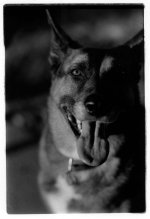
I would also add that I feel much more competent in the darkroom getting my prints just right than I am scanning and making adjustments in PS, particularly for dodging and burning. In fact the last image I posted (see below) was a scanned print that was manipulated in the darkroom. The b+w developing and printing workflow is relatively easy and fun compared to dealing with colour in the darkroom.
 

Attachments

  • Jack-M650ZM-10_06-001.jpg
    Jack-M650ZM-10_06-001.jpg
    57.8 KB · Views: 0
Bryce said:
I suspect you've got it backwards, Jon. I think B+W enthusiasts tend to use film because digital B+W still isn't comparable, whereas digital has truly obsoleted film for nearly all color use. How many B+W's do you see coming from the RD-1 crowd?

What makes you say that? It's simply not true.
The B&W handling of the R-D1 is great and compares more than favourably with B&W film.

Yes, colour is the standard output with digital but that does NOT mean digital B&W is bad, poor or scarse.
 
ARCHIVIST said:
You create with black and white.
With colour you only copy what you see.
Overall it does depend on what is required to capture the subject as desired.
Remember the words of Walker Evans - ..." colour is vulgar "

Walker Evans might have been a great photog but this remark is full of it.

And why do so many people have the idea that with B&W you "create" while colour is "copying"? Some people should spend just a tiny bit more time researching the LOOOOOONG history of colour photography.
 
I can't obtain traditional B&W film and processing, but could manage C41 B&W.

Is there any point to C41 B&W, or can I use C41 color film and take the color away onscreen with no obvious difference from the C41 B&W?
 
Jon Claremont said:
I can't obtain traditional B&W film and processing, but could manage C41 B&W.

Is there any point to C41 B&W, or can I use C41 color film and take the color away onscreen with no obvious difference from the C41 B&W?


I've done some testing recently and to my eyes if you are scanning C41 (colour or black &white) is the best process because traditional black and white film can gain a lot of grainiess in the scanning process. I'll trawl through the test and post a couple of pictures shortly.
 
Ok here's a C41 colour negative file (400asa) and the same file converted to black and white the third file is Tri X so you can compare the graininess at the same scanning setting and the general feel of the tones
 

Attachments

  • test1.jpg
    test1.jpg
    138.7 KB · Views: 0
  • test-2.jpg
    test-2.jpg
    91.6 KB · Views: 0
  • nhcf3.jpg
    nhcf3.jpg
    82.2 KB · Views: 0
I shoot mainly black and white, but have been doing more colour lately since I discovered the joy of Astia.

I don't use C41 colour much (testing new acquisitions, mainly) because I just can't get it to scan in a way I'm happy with.
 
I've shot a lot of XP2. It looks like a high contrast colour film (Fuji Superia, maybe) with the colours sucked out. Shooting it at a stop over controls the contrast but does nothing for the "look". It's nothing like HP5 or D400, for instance but is nice if you want a grain free ISO 400 film. For some reason this seemed important to me at one point.
 
I shoot mostly classic BW film, because in the type of photography I do, color more often distracts than adds.

When I shoot color, it is slide. Colors are better and processing here is cheaper than C41-
 
RML, iml, Bromo33333-
I stand corrected! Evidently many if not most of our RD-1 users shoot in B+W often or even exclusively. Sounds like I shouldn't have used the group as an example.
FWIW I went shopping for a digital camera 2 years ago and found only 2 models that interested me. I chose my Pentax dslr over the RD-1 because it's more versatile (macro and telephoto capability), because I already had a pile of lenses, and because it cost a third as much. The decision wasn't all that easy for me, and I often wonder if I'd have been better off with the Epson.
I'll stand by my argument that digital still fails relative to film for B+W's, though. Not so much because of capture limitations; digital cameras are capable of 35mm level resolution and sharpness at the capture level, and without the hassle and lost resolution/ character of scanning. The trouble comes more in printing. Hold an all analog print on fiber paper next to anything made with an inkjet; the difference is hardly subtle! The traditional process print shows more tonal range, more subtle tones, pin sharp grain instead of soft and unnatural looking dithering patterns, and no scan lines. Add a larger than 35mm negative to the analog process print and the gap gets even larger.
So I still think the rangefinder crowd tends to be B+W oriented in part because of this factor. Of course there are other reasons- intolerance for automated tools, appreciation for mechanical items, and an attraction to a traditional medium. I'm guilty on all three counts, by the way.

 
I'd use colour (chrome) and a fast handling M with a 35mm for a friends wedding candids, I used to be good at that, more difficult now.

Might load chrome for a blue sky day on hills, for nice sunsets etc.

Street shots or nice cloud scenes/dull rain days B&W in FSU cam AgBr/Cl paper later.

Thinking about a tea shirt slogan in Ru of course and red typeface. Option is either 'my other camera is digital' or 'my enlarger is FSU as well'!

My evenings activity is either reassembling a FSU camera/lens or using up the 100 off boxes of paper, I have from the past. My little enlarger is the only really reliable FSU kit I have, touch the wood on its baseplate of course. It may be because it is the only kit I have had from new.

Noel
 
Bryce said:
RML, iml, Bromo33333-
I stand corrected! Evidently many if not most of our RD-1 users shoot in B+W often or even exclusively. Sounds like I shouldn't have used the group as an example.
FWIW I went shopping for a digital camera 2 years ago and found only 2 models that interested me. I chose my Pentax dslr over the RD-1 because it's more versatile (macro and telephoto capability), because I already had a pile of lenses, and because it cost a third as much. The decision wasn't all that easy for me, and I often wonder if I'd have been better off with the Epson.
I'll stand by my argument that digital still fails relative to film for B+W's, though. Not so much because of capture limitations; digital cameras are capable of 35mm level resolution and sharpness at the capture level, and without the hassle and lost resolution/ character of scanning. The trouble comes more in printing. Hold an all analog print on fiber paper next to anything made with an inkjet; the difference is hardly subtle! The traditional process print shows more tonal range, more subtle tones, pin sharp grain instead of soft and unnatural looking dithering patterns, and no scan lines. Add a larger than 35mm negative to the analog process print and the gap gets even larger.
So I still think the rangefinder crowd tends to be B+W oriented in part because of this factor. Of course there are other reasons- intolerance for automated tools, appreciation for mechanical items, and an attraction to a traditional medium. I'm guilty on all three counts, by the way.


There is now a lightjet (ie projects small dots of light from a digital file) printer that will print directly onto fibre based black and white paper which is then processed in an adapted processor, so if you have the money this gap has been well and truly closed.
 
Back
Top Bottom