
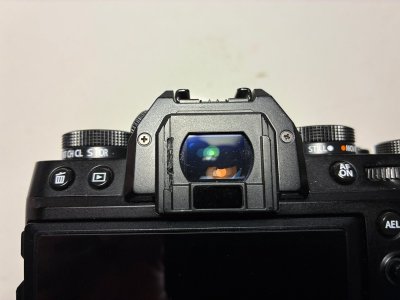
Broken eyecup mount pin/rail Fuji X-T5

Wenge

Registered User
Local time
11:49 PM
Joined
Jan 25, 2014
Messages
365
Location
Santa Fe, New Mexico
Has anyone ever had an eyecup mount where one rail/pin on one side was broken off, with other side still intact, and fixed it with a non-permanent mod?

I'm not into 3-D printing and the easiest fix would be a spare part from Fuji but the mounts on the body themselves are not available for sale. And it would cost too much to send it to Fuji for repair I believe not worth it.

I can fix it by super-gluing the eyecup to the mount, but that will be permanent (if the glue takes on this plastic material, haven't tried it yet) and if/when I sell the camera (an infrared mod), it will be a likely issue in price asked which typically would be ~$2000 today's mkt (including the $400 mod).

I have a spare deeper OEM eyecup with plastic plate and thinking the permanent superglue fix is only viable option vs the shallower OEM piece, but maybe others have done this and have a better idea? Many thanks for any info
 

Attachments

  • IMG_0572 copy.jpg
    IMG_0572 copy.jpg
    220.9 KB · Views: 11
I would not use super glue. Works on some plastics and can leave a horrible mess on other types. Fujifilm is very reasonable and fast on repairs. A $2000 camera doesn't need a bad do it yourself repair. Worth the postage to get a repair quote,
 
Could you rig something up using a 3D printed piece mounting with the hotshoe?
thanks 3D printing is a good idea too but that tricky fine-detailed part is I think best to change with OEM part, am going to send it to Fuji for repair/replacement of that piece. Turns out it's maybe only $200ish and worth it given the quality of the XT5 and the I/R mod, I think it's worth doing it right.
 
Super glue has an issue when used near any optics - it off-gasses as it dries and cures (for up to 24 hours). The gas given off can then settle on optical surfaces and harden leaving a haze which can be hard to remove. I am therefore very wary of using super glue near any optical components just in case. The problem is worse in humid conditions as humidity is what catalyzes the glue and causes it to set.
But you can avoid it by - for example by carefully covering the eye piece lens with tape or similar first.

Also there are various methods to clean the optics if it occurs. But I would be wary of using acetone as a cleaning agent (which is great at dissolving super glue) because it can also dissolve some plastics.

If you go down the super glue route I would suggest the following

The best super glues for jobs like this are the gel types - they are thicker and do not tend to run everywhere. The ordinary thin superglues always end up where you do not want them and will frequently end up inside things like camera bodies - superglue is so thin and runny it tends to go through the tiniest gaps and spaces. The thicker gels are much easier to manage.

Also, I suggest that you buy a small spray bottle of superglue catalyst / hardener. Superglue is fast to set but believe me it seems like FOREVER when you are holding onto a tiny piece that is being glued trying to keep it properly positioned and aligned where critical positioning is needed, while the glue cures. Also, you could try making some kind of small jig to correctly position the broken piece till the glue sets but this may not be needed if you use super glue hardener to speed the process. To hold a piece like the one you have to fix it may be useful to also use a surgeon's hemostat (locking tweezers) to hold the piece being glued without getting glue all over your fingers while you are positioning it and waiting for the glue to set. These are often used by fly fishermen to hold fishing "flies" while they are tying them, so they can be found for a mere few bucks on eBay (more expensive ones are also available but of course these are not really required). I use these all the time for fine jobs like this as they are much easier to manage than a pair of ordinary tweezers.
|
Also, I find modelers stores to have lots of tools and products like specialized superglues and sometimes the hemostats I mentioned above. BTW on thinking about it a fast set epoxy would probably be a superior option to superglue as it avoids many of its issues. Apply it with a thin bamboo skewer or similar to the base where it joins the camera back and keep it there using some of the methods I mention above. But one disadvantage is that this type of glue takes about 5 minutes to set - a long to to keep the part aligned.

Final afterthought............................. you might consider trying one of the new type superglues that set more or less instantly under UV light. They come with a pen type applicator which has a tiny UV LED light at the other end. This sets the glue pretty well instantly. On reflection, this might be the best option.

 
Last edited:
Super glue has an issue when used near any optics - it off-gasses as it dries and cures (for up to 24 hours). The gas given off can then settle on optical surfaces and harden leaving a haze which can be hard to remove. I am therefore very wary of using super glue near any optical components just in case. The problem is worse in humid conditions as humidity is what catalyzes the glue and causes it to set.
But you can avoid it by - for example by carefully covering the eye piece lens with tape or similar first.

Also there are various methods to clean the optics if it occurs. But I would be wary of using acetone as a cleaning agent (which is great at dissolving super glue) because it can also dissolve some plastics.

If you go down the super glue route I would suggest the following

The best super glues for jobs like this are the gel types - they are thicker and do not tend to run everywhere. The ordinary thin superglues always end up where you do not want them and will frequently end up inside things like camera bodies - superglue is so thin and runny it tends to go through the tiniest gaps and spaces. The thicker gels are much easier to manage.

Also, I suggest that you buy a small spray bottle of superglue catalyst / hardener. Superglue is fast to set but believe me it seems like FOREVER when you are holding onto a tiny piece that is being glued trying to keep it properly positioned and aligned where critical positioning is needed, while the glue cures. Also, you could try making some kind of small jig to correctly position the broken piece till the glue sets but this may not be needed if you use super glue hardener to speed the process. To hold a piece like the one you have to fix it may be useful to also use a surgeon's hemostat (locking tweezers) to hold the piece being glued without getting glue all over your fingers while you are positioning it and waiting for the glue to set. These are often used by fly fishermen to hold fishing "flies" while they are tying them, so they can be found for a mere few bucks on eBay (more expensive ones are also available but of course these are not really required). I use these all the time for fine jobs like this as they are much easier to manage than a pair of ordinary tweezers.
|
Also, I find modelers stores to have lots of tools and products like specialized superglues and sometimes the hemostats I mentioned above. BTW on thinking about it a fast set epoxy would probably be a superior option to superglue as it avoids many of its issues. Apply it with a thin bamboo skewer or similar to the base where it joins the camera back and keep it there using some of the methods I mention above. But one disadvantage is that this type of glue takes about 5 minutes to set - a long to to keep the part aligned.

Final afterthought............................. you might consider trying one of the new type superglues that set more or less instantly under UV light. They come with a pen type applicator which has a tiny UV LED light at the other end. This sets the glue pretty well instantly. On reflection, this might be the best option.

thanks for that insightful info. As a fly-fisherman, I use hemostats attached to my vest or shirt to then release the fly from the trout for catch/release, and also use them when tying flies sometimes so I know exactly what you're saying about that handy tool. I am going to send camera to Fuji. I thought it would cost alot more to get fixed. If it was a cheaper camera with low value, I'd go for the mod, but in this case the files are excellent+ now, so like Beemermark above also suggested, it's worth it to have them fix it. (am itching to try the mod too, tho lol) edit, i also build scale models and have tried various super glues and this info is helpful for that angle too.
 
Last edited:
Back
Top Bottom