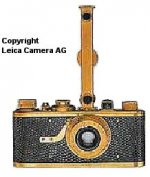
Camera Design and the Problem of Parallax

Jocko

Off With The Pixies
Local time
12:29 PM
Joined
Jul 29, 2005
Messages
1,331
Location
March, Cambridgeshire
This is probably a very stupid question, but recent posts on parallax have left me wondering why the designers of RF cameras have seldom placed the viewfinder directly above the lens, so reducing parallax problems,

I can see that some cameras have the longest possible rangefinder base, thus have RF/VF windows at opposite extremities - as in the Contax and Kiev. Yet most retain a displaced viewfinder despite a short base RF.

I assume this has struck some camera designers. The so called prewar FED II design had a reasonably central combined RF/VF with a rangefinder window on the "Left" of the camera (from the photographer's viewpoint). That seems to me to be a better solution than the usual viewfinder-on-the-left. Am I missing something?

Regards, Ian
 
The face in the middle of the back of the camera is not conducive to good viewfinder access. Noses tend to get in the way and cause the camera to tilt upwards in front.

Just my guess.

Best Regards,

Bill "Bignose" Mattocks
 
bmattock said:
The face in the middle of the back of the camera is not conducive to good viewfinder access. Noses tend to get in the way and cause the camera to tilt upwards in front.

Just my guess.

Best Regards,

Bill "Bignose" Mattocks

Good guess, but 35mm SLRs do have their viewfinders directly above their lenses ... so I guess we smash our noses when we use them. Of course, SLRs also solve the parallax problem.
 
Oldprof said:
Good guess, but 35mm SLRs do have their viewfinders directly above their lenses ... so I guess we smash our noses when we use them. Of course, SLRs also solve the parallax problem.

Yes, but SLR's don't have to look straight into the viewfinder to see the RF patch, so if it is cocked a bit, no matter, just tilt the head up or down etc.

I dunno, just taking the p*ss on this one.

Best Regards,

Bill Mattocks
 
Oldprof said:
Good guess, but 35mm SLRs do have their viewfinders directly above their lenses ... so I guess we smash our noses when we use them. Of course, SLRs also solve the parallax problem.

The Olympus DSLR's have the VF's to the left side. It's a side mounted mirror.

The left side placement is probably to allow people to shoot with both eyes open, and get the nose out of the way too.

Didn't Kyocera made a 1/2 frame camera called the Samurai that was held like a camcorder or old Super 8 camera?
 
Kin Lau said:
Didn't Kyocera made a 1/2 frame camera called the Samurai that was held like a camcorder or old Super 8 camera?
Yep, they sure did. Fun camera too.

I've often wondered why more camera manufacturers didn't/don't use a Samurai-like design. Although I could wish for more manual controls, it's still a great camera to shoot with, very comfortable and logically organized. The only issue I could see is that you would have to use a portrait orientation for full-frame 35mm, but that's hardly a major problem.
 
Last edited:
dkirchge said:
Yep, they sure did. Fun camera too.

I've often wondered why more camera manufacturers didn't/don't use a Samurai-like design. Although I could wish for more manual controls, it's still a great camera to shoot with, very comfortable and logically organized. The only issue I could see is that you would have to use a portrait orientation for full-frame 35mm, but that's hardly a major problem.

Rollei 2000. Sweet camera. Trouble-prone and expensive, though. Too bad, it was cool.

http://www.cameraquest.com/rol3003.htm


Best Regards

Bill Mattocks
 
gabrielma said:
Not if you're left-eyed, but point taken.

Tell me about it. I'm left-handed and left-eyed. Good thing like most orientals, my nose is fairly flat.

The Moskva 5 has to be one of the coolest cameras for a lefty-lefty like me.
 
Consider the lens barrel and hood. The closer the viewfinder is to the center of the lens, the more the lens itself (and its accessories) intrude into the viewfinder's field. Particularly noticeable with fat fast lenses, even with a Bessa or Leica. The new Zeiss Ikon may suffer more parallax, but you'll see less of the lens in the lower right corner...

Still, some cameras have the viewfinder way far above the lens, for example the Graflex XL and similar press cameras from Mamiya and Linhof, and I can't imagine lens intrusion could be an issue there, and parallax must be.
 
Last edited:
My Kiev gets round the problem by having vague viewfinder edges and not focussing closer than 0.9m. However if I need to do things accurately I can put a proper finder into the accessory shoe which is above the lens.
 
As Talisker said, later rangefinders did have moving bright line frame. In most cases, the parallax didn't matter much, as most photos were taken 6-8 feet out to infinity. Most lenses didn't focus much closer then 3 feet, which still wasn't too bad. Leica dual-range lenses had the clip-on finder lenses that pretty much corrected for parallax. My Yashica has an Auto-Up that places a lens in front of the viewfinder with a cross where the center of view is supposed to be. It's not bad, but I always allow for a little error. Of course if you have a Leica, there's always the Visoflex.
I think that's why most use a SLR for close work. 😎
 
Jocko, the Kodak Ektra was introduced, I think, at the beginning of the 1940s. Its viewfinder, parallax corrected *and* varifocal, was just about above the lens. The long-base rangefinder had windows at either end of the body. It had several other innovations for the time -- lever wind, removable back, etc., as well as an extensive range of lenses -- but it died because its shutter was among the worst ever made. It was also terribly expensive.

I had a Canon VT Deluxe for many years. While its main finder (50/35/telescopic RF) was at the upper left corner, accessory finders (I had one for 28mm) were tilted up and down by an ingenious arrangement. The focussing cam of the lens moved a pin in the accessory shoe vertically, which in turn moved the hinged finder. I think the L-1 had the same arrangement.

Even with a parallax corrected finder above the lens, one problem remains: converging or diverging verticals. This is when the camera is held horizontally: turn it through 90 degrees and the problem becomes different. In the early 1960s, I was taught this trick with a IIc and a VIDOM finder. First use the built-in finder to check that the lens axis is horizontal. Then adjust the accessory finder for parallax and compose. Either use a tripod or go back to check in the built-in finder. Doesn't have to be so slow as it sounds.
 
Back
Top Bottom