Dunk
Established
In March 2007 I made an offer on a Contarex Bullseye camera outfit comprising Bullseye body (also known as Cyclops), 50mm f2 Planar, 35mm f4 Distagon, 85mm f2 Sonnar, 135mm f4 Sonnar and 21mm f4.5 Biogon plus two interchangeable film magazine backs c/w dark slides, bellows and filters. I offered less than one third the advertised price because all the lenses appeared to have the dreaded fungus and I was taking a chance that any of them would be capable of being cleaned/polished and recoated. At the time I was only interested in having the 21mm lens serviced and having it converted to a Leica M mount. The 21mm Biogon is a scarce and much sought after lens. Much to my surprise the dealer (London Camera Exchange in the Strand, London) accepted my low offer and I struggled home with outfit ... it was much heavier than anticipated. I then approached a specialist lens refurbishment company (whose name I'll not reveal for fear of embarrassing them) and much to my amazement they offered to give an estimate to clean/polish/recoat all the lenses (ie the glass lens elements) and also service the camera. The camera and lenses were sent to them, estimate received and agreed and thus began what turned out to be a very long wait for the jobs to be finished. Each time I chased them as the months went by the same excuse was given ie "Two of the lenses are totally jammed and we cant dismantle them". Eventually last September they advised that they could not service the jammed lenses but that the others were almost ready .... and the camera body service was finished but they could not source a replacement selenium meter cell for it. When I asked why the work had taken so long the technician replied, "I told you he died!" ... presumably he was referring to his colleague but he had not told me that. Last month I again chased them and was finally advised they would prepare an invoice which was received and paid last week. The following were thus received back last Friday.
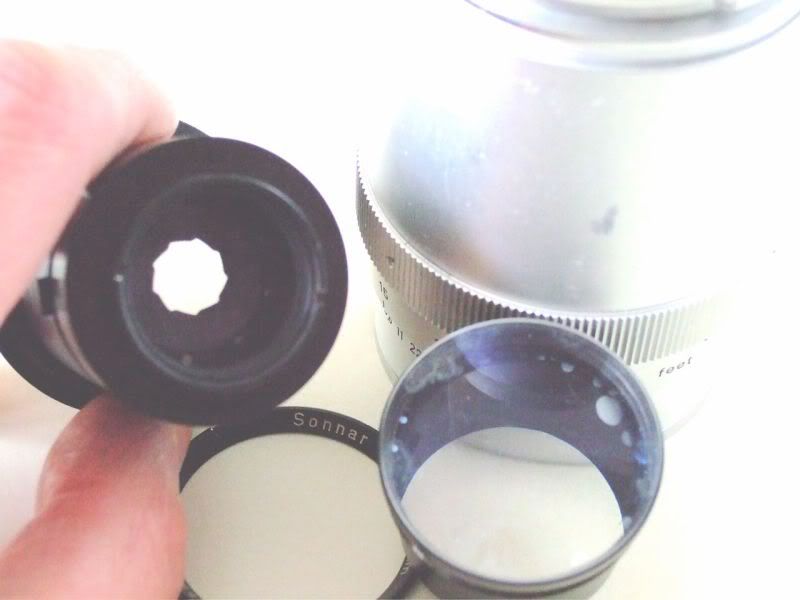
Let's start with the jammed / fungused lenses which have not been serviced because they are jammed solid ie focusing rings are immovable. All the other lenses' elements looked like these when I bought them. But I have now discovered it is NOT fungus ... it is lens grease lubricant which has evaporated from the helicoil and condensed onto the glasses ... leaving a glue-like residue on the helicoil which has jammed solid . The grease originally used is peculiar to Zeiss Ikon in 1959/60 and has this property.
Thus this is the jammed 135mm Sonnar which cannot be serviced

And this is the same lens with the similarly jammed 35mm Distagon which also cannot be serviced

Now for the good news.
This is the beautiful and scarce 21mm f4.5 Biogon with its lens' surfaces repolished and recoated together with the dedicated 21mm viewfinder
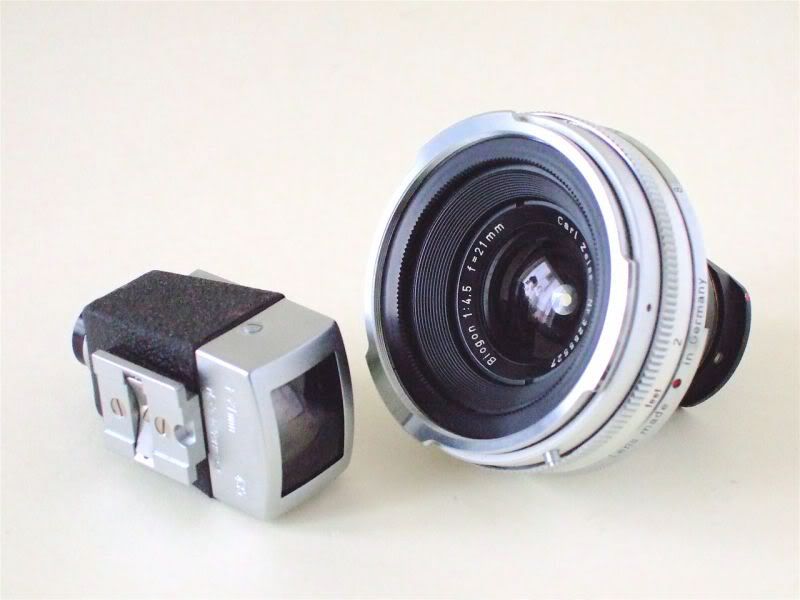
And this is the same 21 mm f4.5 Biogon and viewfinder on the Cyclops camera ... the "Cyclops" eye is in fact the exposure meter. The lens mount is so long that it can only be used on the body with the mirror locked up ... hence the need for the viewfinder in the accessory shoe.

And here are the three lenses which have been successfully serviced ie dismantled, cleaned, polished and recoated - but not every lens element required recoating. The 50mm Planar was also showing signs of balsam separation so the elements were "split" and recemented using a special jig.

This shows the 85mm Sonnar on the Cyclops body

Note the 50mm and 85mm lenses do not have aperture rings. The lens diaphragm is coupled to a cam arrangement in the rear of the lens interior which is coupled and activated by the finger operated wheel behind the Contarex logo on the body.
Here is the 85mm Sonnar attached to the bellows. The bellows is actually made by Novoflex.

And here are two interchangeable film backs for the camera complete with dark slides. These enabled the use of different types of films with just one camera body.

The camera is fitted with an ordinary non-DS back at present but the DS magazines can be substituted enabling change of film "mid-roll".
The Contarex was and maybe still is the most complicated mechanical camera ever made and has approx. 1200 parts. Although popular in Germany in the early 60s it did not sell well because it was so expensive and heavy. Also, at that time the first Nikon F models began to dominate the professional 35mm camera market because they were cheaper, more reliable and offered a more comprehensive system ie more lenses and accessories.
However, some authorities maintain that the quality of Zeiss Contarex lenses has never been surpassed both optically and mechanically.
I'm looking forward to using the camera soon and may obtain a Contarex to 4/3 adaptor thus enabling use of the 50mm, and 85mm lenses on a 4/3 digital body. I think the 21mm lens will be too long to adapt for digital use.
Two years was a long time to wait but just to have the 21mm lens has been worth the wait.
Total cost for the work was £266.80.
Cheers
dunk
Let's start with the jammed / fungused lenses which have not been serviced because they are jammed solid ie focusing rings are immovable. All the other lenses' elements looked like these when I bought them. But I have now discovered it is NOT fungus ... it is lens grease lubricant which has evaporated from the helicoil and condensed onto the glasses ... leaving a glue-like residue on the helicoil which has jammed solid . The grease originally used is peculiar to Zeiss Ikon in 1959/60 and has this property.
Thus this is the jammed 135mm Sonnar which cannot be serviced
And this is the same lens with the similarly jammed 35mm Distagon which also cannot be serviced
Now for the good news.
This is the beautiful and scarce 21mm f4.5 Biogon with its lens' surfaces repolished and recoated together with the dedicated 21mm viewfinder
And this is the same 21 mm f4.5 Biogon and viewfinder on the Cyclops camera ... the "Cyclops" eye is in fact the exposure meter. The lens mount is so long that it can only be used on the body with the mirror locked up ... hence the need for the viewfinder in the accessory shoe.
And here are the three lenses which have been successfully serviced ie dismantled, cleaned, polished and recoated - but not every lens element required recoating. The 50mm Planar was also showing signs of balsam separation so the elements were "split" and recemented using a special jig.
This shows the 85mm Sonnar on the Cyclops body
Note the 50mm and 85mm lenses do not have aperture rings. The lens diaphragm is coupled to a cam arrangement in the rear of the lens interior which is coupled and activated by the finger operated wheel behind the Contarex logo on the body.
Here is the 85mm Sonnar attached to the bellows. The bellows is actually made by Novoflex.
And here are two interchangeable film backs for the camera complete with dark slides. These enabled the use of different types of films with just one camera body.
The camera is fitted with an ordinary non-DS back at present but the DS magazines can be substituted enabling change of film "mid-roll".
The Contarex was and maybe still is the most complicated mechanical camera ever made and has approx. 1200 parts. Although popular in Germany in the early 60s it did not sell well because it was so expensive and heavy. Also, at that time the first Nikon F models began to dominate the professional 35mm camera market because they were cheaper, more reliable and offered a more comprehensive system ie more lenses and accessories.
However, some authorities maintain that the quality of Zeiss Contarex lenses has never been surpassed both optically and mechanically.
I'm looking forward to using the camera soon and may obtain a Contarex to 4/3 adaptor thus enabling use of the 50mm, and 85mm lenses on a 4/3 digital body. I think the 21mm lens will be too long to adapt for digital use.
Two years was a long time to wait but just to have the 21mm lens has been worth the wait.
Total cost for the work was £266.80.
Cheers
dunk
Last edited: