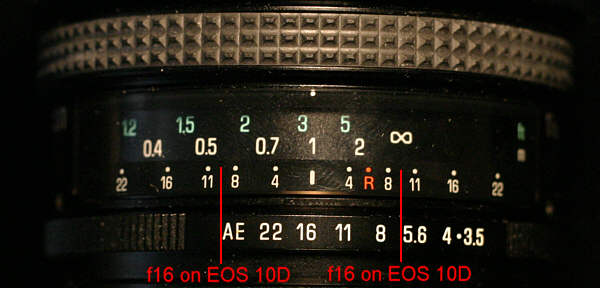
in-depth info
in-depth info
some more in-depth information from wikipedia (no pun intended..)
cheers,
-mj
Depth of field versus format size
As the equations above show, depth of field is related to the circle of confusion criterion, which is typically chosen as a fraction, such as 1/1000 or 1/1500, of the image format size. Larger imaging devices (such as 8×10 cameras) can tolerate a larger circle of confusion, while smaller imaging devices such as point-and-shoot digital cameras need a smaller circle of confusion. For the same field of view and f-number, DOF is, to a first approximation, inversely proportional to the format size. Strictly speaking, this relationship is true only when the subject distance is large in comparison with the focal length and small in comparison with the hyperfocal distance, for both formats, but it nonetheless is generally useful for comparing results obtained from different formats.
At a given f-number and field of view, a smaller camera has greater DOF than a larger camera. The depth of field on an 8×10 camera using a normal lens at f/22 is one half that on a 4×5 with a normal lens at f/22. Similarly, a 35 mm camera with a normal lens at f/8 has the same depth of field as a 6×7 cm camera with a normal lens at f/16. This can be an advantage or disadvantage, depending on the desired effect. For the same amount of foreground and background blur, a small-format camera requires a smaller f-number than a large-format camera. Many point-and-shoot digital cameras cannot provide a very shallow DOF. For example, a point-and-shoot digital camera with a 1/1.8? sensor (7.18 mm × 5.32 mm) at a normal focal length and f/2.8 has the same DOF as a 35 mm camera with a normal lens at f/13.
In many cases, the DOF is fixed by the requirements of the desired image. For a given DOF and field of view, the required f-number is proportional to the format size. For example, if a 35 mm camera required f/11, a 4×5 camera would require f/45 to give the same DOF. For the same ISO speed, the exposure time on the 4×5 would be sixteen times as long; if the 35 camera required 1/250 second, the 4×5 camera would require 1/15 second. In windy conditions, the exposure time with the larger camera might allow motion blur.
For cameras of different formats to achieve the same depth of field when shooting from the same position, with focal lengths that capture the same field of view, it is necessary to use the same absolute aperture diameter with each, not the same f-number. Consider formats that differ approximately by factors of two: 35 mm, 6×7 cm, 4×5 inch, 8×10 inch. For a chosen camera position and field of view, to keep the same depth of field, double the f-number each time you step up to the next film size. For example: f/5.6 on 35 mm, f/11 on 6×7, f/22 on 4×5, f/45 on 8×10. This doubling is not exact but is a very good rule of thumb. Also adjust exposure, ISO speed, or both by two stops (factor of four) each time: 1/60, 1/15, 1/4, 1 sec.
In some cases, movements (tilt or swing) can be used with view cameras to better fit the DOF to the scene, and achieve the required sharpness at a smaller f-number. A few small-format cameras can employ the same principle by using tilt/shift lenses.