Digital cameras are 'dinosaurs', declares Kodak chief

gabrielma said:
I know a number of friends that bought Kodak digital cameras (non-pro) around "the Holidays" and Canon as well.

I've seen the pictures taken with the Kodak cameras (is there a smiley for ::blech::?) Many of them returned them, some didn't care or know better (and that's something vsolanoy was referring to). The others are very happy with their choices.

I don't know anything about sales or anything about their numbers, but I wonder if they're considering "consumer satisfaction" in the equation. Brand loyalty is paramount in this business.

I would guess that they're trading heavily on brand loyalty and on 'knowing their customer'. And let us not forget, that customer is not the enthusiastic amateur for the most part - it is the base-level consumer, same as it ever was.

I think they've done a good job of dummy-proofing their retail camera line with docking stations and built-in printers, etc. Not that I would want one of those - and I'm sure neither would anyone here. But we're not their target audience.

I've seen photos taken with the latest generation of Kodak digicams. I thought they looked rather good. But that's just me.

Best Regards,

Bill Mattocks
 
Fedzilla_Bob said:
"Without human instruction, a picture will use its metadata to find another picture with related data and assemble into new groups based on how they relate to one another. For example, imagine being able to access every picture ever taken of your son or daughter at Christmas, whether it's part of your collection or those of relatives and friends."

Wait - has Kodak developed some form of AI? Without human instruction?

I doubt that, but then I don't know what they have in mind exactly. My guess would be that people will be prompted to enter that sort of information when they store the photos online and it will be kept as metadata, either in XML or as metadata in the EXIF data of the image itself. That would make it rather easy to do the 'six degrees' thing. Accuracy, though, would depend on humans to make those entries correctly.

Yeah right - I think that the original instruction set will have come from someone. I also can't imagine how metadata will be spontaneously generated. Would take some awesome pattern recognition to interpret, then codify all those snapshots of fingers over lenses, so that they could all be displayed with images from fiends (intentional) and family all over the globe.

Poppycock.

I don't know about that. Granted that this is in its infancy, but facial recognition routines are getting better all the time. As well, there are lots of PnS 35mm and now digicams that can supposedly identify and tell the difference between say, a mountain and the shape of a human head and shoulders. This is just an extension of that. I'm not saying the technology is there, but that we seem to heading that way, and it certainly seems within the realm of possibility.

Best Regards,

Bill Mattocks
 
dmr said:
LOL, actually, I interpret this as saying they want all of the lemmings who bought digital cameras in the past so many years to junk them and go for the Latest And Greatest<tm>.

Well, of course. We are talking about a new culture of replaceable, junkable, technology, after all.

With the PC, we spent a few years trying to fool ourselves into thinking that we could just 'upgrade' the hardware instead of having to rebuy. That's still possible at least to some extent, but generally, if you want the latest geewhiz capabilities, you have to rebuy.

Same for cell phones.

Same for digital cameras.

Same for PDA's.

And all of these companies' profits are predicated on selling the latest greatest over and over again. If they can't create dissatisfaction with last year's model and offer something shiny and new for this year that you absolutely must have, they lose.

This is not fundamentally unlike the older film camera industry, it is just that the buying cycles were much slower then. Sure there were people who kept their Nikon F2 and never went to the F5 - plenty of them. But plenty of them did move up, and not just once, again and again. The biggest differences were that the trends took decades and not half-years, and the goods were more durable - the older cameras, in many cases, were still working fine when the users upgraded.

I would not be surprised to find that Kodak, Canon, Nikon, Pentax and et al, would LOVE to slow down the pace. But they are all competing for the same dollar, yen, or Euro. If one of them calls time-out, they get eaten. It is 'trample the weak, hurdle the dead.' So they keep it up as long as they can.

I do believe that this all has to end somewhere. But I don't know whose shores these ships will crash against, or when it will happen; or what happens afterwards.

Interesting times.

Best Regards,

Bill Mattocks
 
Actually, the aspects of the "metadata" system are already available. The new Nikon DSLRs can wirelessly transmit an image to a laptop bypassing the camera's memory card. The laptop can, of course, be wirelessly networked to the web.

Next step: bulid the web access right into the camera. Already done with low-res camera phones - simply a matter of "shrinking" the hardware. Eventually, the lens size will be the final determinant for how large a camera "body" has to be. (Build the "body" into the lens?)
 
Trius said:
Anyone here believe Kodak is a software company?

Hardware and software seems to be what Kodak intends to do... particularly integration points for photography, maybe that's in line with "you take the picture, we do the rest"....

Kodak has always been more than a photographic company though... they've made industrial photo copiers, at one point, they were an innovator in textiles, they are in document management (both software and hardware), industrial scanners, scientific and medical imaging, semiconductors, etc... more than just consumer and professional photography.

There's an aspect of old Kodak that was alot like BASF, DuPont, Dow Chemical, Philips, etc... that most people don't see. Leica isn't any different... (well, Leica still makes film cameras, and they finally make better digital cameras).
 
dmr said:
LOL, actually, I interpret this as saying they want all of the lemmings who bought digital cameras in the past so many years to junk them and go for the Latest And Greatest<tm>.

I think that is the problem with new technological equivalents of old tools like cameras. Most new technologies are throw aways because of technology limitations. Don't get me wrong, I love technology, by it's starting to concern me that after and 3 or 4 years of use, it's time to upgrade, assuming that TV, cell phone, TiVO, etc... is still working and you're not forced replace. All that old stuff has to go somewhere, and only so much of it is recyclable.
 
The concept of a camera as a separate tool is itself a "dinosaur" concept. Camera phones are the first wave of integrating two historically totally separate devices. We're moving toward an eventual "uniform communication appliance" that folds in phone, camera, internet, e-mail, computing, video and no doubt other things not yet conceived of. And, as the term "appliance" implies, there'll be less sentimental attachment to the physical piece of equipment -- trade it/discard it when the next cool item comes out. Digital cameras are merely a transitional phase. (It goes without saying that we're well along the way of moving toward the disposable and away from the "keep and repair" concept.)
 
KoNickon said:
The concept of a camera as a separate tool is itself a "dinosaur" concept. Camera phones are the first wave of integrating two historically totally separate devices. We're moving toward an eventual "uniform communication appliance" that folds in phone, camera, internet, e-mail, computing, video and no doubt other things not yet conceived of. And, as the term "appliance" implies, there'll be less sentimental attachment to the physical piece of equipment -- trade it/discard it when the next cool item comes out. Digital cameras are merely a transitional phase. (It goes without saying that we're well along the way of moving toward the disposable and away from the "keep and repair" concept.)

As much as this converging is true, I for one try to keep things seperate. Not only will one thing work when another fails but I also find it easier to combine working with both at the same time. It makes organising things much easier for me. Laptop, paper notebook, pen, watch (or clock), camera, phone... they could all be combined in one item but would I want that? Not really. Sadly, these companies seem to think I do want it. Damn, one day I'll be considered a Luddite. 😛
 
Cell phones, so far, do not make for a fantastic photographic experience. By extension, I can imagine that cameras would be equally poor for making calls.

LAst two times at looking for a new cell phone the sales people seems painfully focussed on selling a phone with a camera.

Now if someone can make a decent (not the lame RokkR) cell phone, MP3, PIM device I would be very interested. So far, I haven't seen that yet.

Manufacturers have been touting convergence since around '94. More than a decade later they still haven't quite nailed it.
 
I just got back from the North American International Auto Show in Detroit. I wandered around with a Canon G-III loaded with Neopan 400 B&W film and, best I can tell, was the only person carrying a film camera in all of the 700,000 square feet of Cobo Hall. Video cell phones were everywhere! No question in mind that what most folks want today is something small, light and capable of doing several things at once. I think Kodak's CEO is on to something when he says that digicams are dinosaurs. It sure looks that way by what I saw this afternoon.

Jim Bielecki
 
For the average consumer I would agree that Cell Phone w/cameras are extremely popular. There is a large amount of marketing and social pressure promoting the sale and use of the cell phone/cams.

Digicams as dinosaurs is an overstatement, it will be a long time before they become anachronisms. Film isn't really an anchronism yet. It appears to be getting close though.

You can draw a lot of comparissons. 35mm has survived a number of formats. Even among casual photographers. Consider the instamatic cameras and their 126 cartridges, 110 format and APS film. I remember that it was even "fashionable" in the 60's, 70's and 80's to use a 35mm slr. Being seen with something else was often considered "declasse" (SP? I can't figure out how to get the accent over the "e" 🙂 ).

You could even think about it in evolutionary terms. "Ubuquity" does not neccessarily insure survivability. At least not in the item (or animal's) original form.

I think that Perez's statement was more about marketing bluster and prognostication than about any real observation of how people will continue to use photo gadgets.

He has to say something to signal Kodak's intent for the future. He wouldn't be worth his salary and perks if he didn't make statements like the one given in the article.
 
Fedzilla_Bob said:
Cell phones, so far, do not make for a fantastic photographic experience. By extension, I can imagine that cameras would be equally poor for making calls.

LAst two times at looking for a new cell phone the sales people seems painfully focussed on selling a phone with a camera.

Now if someone can make a decent (not the lame RokkR) cell phone, MP3, PIM device I would be very interested. So far, I haven't seen that yet.

Manufacturers have been touting convergence since around '94. More than a decade later they still haven't quite nailed it.

Since few of us around here appear to be "spring chickens" we've oft times experienced "hype" aspect of the techno-world and know enough to be skeptical. Often you have to sort of separate the wheat from the chaff when you read techno press releases etc.

That said, we in the US are generally lagging the convergences that are already occuring in Asia. Last night on the drive up to the house I heard one of these "tech update" segments on the radio.

Samsung is now offering a combined cell phone/camera/television. The camera LCD also serves as a TV screen. The TV service is not "broadcast media" but some kind of subscriber system. You can talk and watch at the same time - gives a whole new dimension to distracted alientation!

A version should be here soon as apparently both XM and Sirius have plans to expand into video "downcasts" from their satellite systems.

Whether and how many of these "gadgets" wind up in the kitchen "junk drawer" is a good question. But there is no doubt that we're in form some more interesting "whiz bang" consumer tech toys.
 
Brian Sweeney said:
Maybe he was talking about the DCS cameras and hasn't seen any of the newer ones. "Replace film with Silicon", "Dinosaur".

Yeah, he decribed my Kodak Digital perfectly.

http://dslrexchange.com/forums/showthread.php?t=160
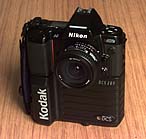
Kodak%20DCS-200%20c.jpg
The DCS 200 made it into someone's "dinosaur" museum.
http://www.digicamhistory.com/1992.html

R.J.
 
kodak sux. It's a center of non-innovation and has obviously lost out to other companies in the imaging technology field. This guy's comment about the camera being dinosaurs is pretty ridiculous in it's own right.

>Perez announced new areas of technology that Kodak is working on. These include >'e-moment technology'

Wha? does he propose we should be having something like the star trek's holodeck? What a douche-bag! Albeit it is a pretty good strategy from his perspective.. to talk down a segment of industry that his company failed to succeed in...
 
Back
Top Bottom
