Digital ISO - spoiled for choice ?

The digital sensor isn't changed when the ISO is changed.

Rather, ISO is kind of like the volume control on your electronic device. You can turn the volume up or down. It doesn't change the source, like music played from a CD, iTunes, whatever....

ISO is the volume control for digital photography. Instead of changing volume it's changing ISO. The higher the ISO the more the gain is cranked up. As you crank up, things like digital noise start rearing its head. Sometimes more noise is good, sometimes it's yuck.

Kind of... but it is more like the volume control feeding a recording device. If you feed to low of a signal to an A/D (analog to digital converter) the noise of the A/D itself also becomes an issue as it is close to the level of the signal itself. You want to feed the A/D more signal to get the A/Ds own noise further away from the signal... more SNR/DR.

Of course as you add gain you are also amplifying the noise within the signal itself. And if you amplify to much you can overload/clip the A/D.

Shawn
 
Some one can correct me if this is wrong.

The way I look at digital ISO:

It's not like film where film emulsion determines ISO.

The digital sensor isn't changed when the ISO is changed.

Rather, ISO is kind of like the volume control on your electronic device. You can turn the volume up or down. It doesn't change the source, like music played from a CD, iTunes, whatever.

Improvements are made with hardware, like sensor and software, the volume control to drive the hardware.

ISO is the volume control for digital photography. Instead of changing volume it's changing ISO. The higher the ISO the more the gain is cranked up. As you crank up, things like digital noise start rearing its head. Sometimes more noise is good, sometimes it's yuck.

You got it!

Base ISO signal-to-noise ratio is paramount.

There is a very recent exception. Sensors with dual-gain capabilities have two base ISOs (link). SONY/Fujifilm's current implementation have 200 and 800 base ISOs.
 
Back in the day ,I recall slide films of 25 and 50 ASA .
OK , it was helped with a fine f1.7 / f 1.8 prime lens .

In the late 90s , ASA 200 reversal seemed perfectly adequate, even with the slower f3.5/f5.6 typical , in my case Minolta , zoom .

I have digital DSLRs and an M8 , capable at ISO 200 equivalent , but 400 is pushing it .
Most of the time this is little difference from the 1990s with the different colours of a CCD.

I also three later cameras of varying types , SLT / Mirrorless / DSLR which push comfortably to the equivalent of 800 , 1600 a possibility and the promise of more .

Useful at times , but not essential to me .

I know that the evolving sensors open up new opportunities , but I wonder if the restrictions of older sensors are less of a 'problem' as many have us believe ?

dee

Technological restrictions are only a problem if they stop you from doing what you want to do.

I like to shoot in very dark environments. Fast lenses help, but I usually end up pushing film in to the 1600-ish territory, and I let my auto-iso on my cameras roam up to 3200.

When I shoot landscapes, an f/6.1 lens stopped down to f/22 on a view camera, shooting on ISO100 color slide proves to be no limitation. Two different cases.

Is film and its "limited" ISO range bad? No. It's still fine for most shooting.

But I am so glad I have a clean ISO 12,800 on my K-5, for those shots I can't get any other way.
 
There are no new opportunities. You cannot repeal the laws of physics. These ISO ratings that camera makers give are just for marketing bragging rights. Shooting at their highest and lowest ranges will give unusable images. Sure, you can shoot at those ISOs, but would you want to? Film has it all over digital in actual useable tonal range. Unless you love tons of noise and clipped and blown out highlights, stick to normal ISO ranges.
 
There are no new opportunities. You cannot repeal the laws of physics. These ISO ratings that camera makers give are just for marketing bragging rights. Shooting at their highest and lowest ranges will give unusable images. Sure, you can shoot at those ISOs, but would you want to? Film has it all over digital in actual useable tonal range. Unless you love tons of noise and clipped and blown out highlights, stick to normal ISO ranges.

I don't think you can categorically say this at all. The answer, like most things in photography, is it depends.
 
There are no new opportunities. You cannot repeal the laws of physics. These ISO ratings that camera makers give are just for marketing bragging rights. Shooting at their highest and lowest ranges will give unusable images. Sure, you can shoot at those ISOs, but would you want to? Film has it all over digital in actual useable tonal range. Unless you love tons of noise and clipped and blown out highlights, stick to normal ISO ranges.

My 2008 year made Canon 500D highest ISO is 12800.
This is the image taken with its ISO 12800. SOOC.

32305817670_1868dde00a_o.jpg


I could get same image with tripod and ISO 100, yes. 🙂
 
There are no new opportunities. You cannot repeal the laws of physics. These ISO ratings that camera makers give are just for marketing bragging rights. Shooting at their highest and lowest ranges will give unusable images. Sure, you can shoot at those ISOs, but would you want to? Film has it all over digital in actual useable tonal range. Unless you love tons of noise and clipped and blown out highlights, stick to normal ISO ranges.

Yes, I would want to shoot at highest ISO if needed. Some films have more range than digital, some do not.

This is ISO 3200.

25590576782_bf890e736e_b.jpg


In my experience TMAX 3200 couldn't do this though I didn't use it extensively.

This is ISO 10,000.

32349281001_19be7efb63_b.jpg


Both are JPGs from the camera.

Shawn
 
There are no new opportunities. You cannot repeal the laws of physics. These ISO ratings that camera makers give are just for marketing bragging rights. Shooting at their highest and lowest ranges will give unusable images. Sure, you can shoot at those ISOs, but would you want to? Film has it all over digital in actual useable tonal range. Unless you love tons of noise and clipped and blown out highlights, stick to normal ISO ranges.

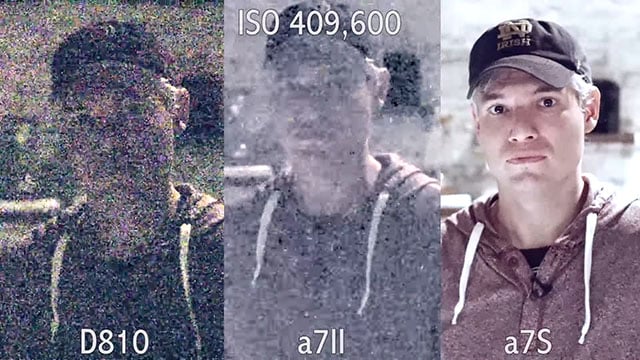
There are and have been several FF cameras which can shoot at exceptionally high ISOs: Nikon D5, Canon 1DX mk and Sony A7s and A7sii.

None of the normal FF cameras D810, any flavor Canon 5D, Leica M10, any of the other A7x, can get remotely close to what those cameras can shoot. A7s is so sensitive it has changed astro shooting, since you do not need to track for longer exposures.

The downside is these are not high MP cameras.

sidebyside.jpg


This same camera can be modified to shoot M lenses very well. It can shoot 4K by moonlight. Maybe that's not new for you. It is for many professionals.

The A7rii can shoot very nice 42mp at ISO 6400. The new M10 is also usable at that ISO, and since M9, in 2009 we have gained 3 full stops while increasing the size of the image.

So far as I can tell there have been no arrests for physics laws violations 😉
 
Back
Top Bottom