Do All Sonnars Give Similar Look?

raid

Dad Photographer
Local time
12:08 PM
Joined
Nov 2, 2005
Messages
36,440
Location
Florida
Rich recently posted an ongoing thread on his vintage 5cm/1.5 Sonnar, with creamy rendition shown in the posted images. His thread made me think about the Sonnar design lenses.

* Which 50mm and 85mm Sonnar lenses are available and for which camera
mount?

* Are vintage Sonnar lenses quite different from newly designed Sonnar lenses? If yes, what are the optical diferences and the built quality differences?

I have an old 5cm/2 Sonnar that is maybe from war-time era. What are the optical properties of a 5cm/2 Sonnar compared to a 5cm/1.5 Sonnar?

The Nikkor 5cm/2 is siad to have a Sonnar design. Is this true?What about the Nikkor 5cm/1.5 lens?

The Canon 5cm/1.5 is a Sonnar design lens. Are there are optical differences from a Zeiss Sonnar 5cm/1.5 lens?


Is a Sonnar "King" or is it the "Planar"? How do they differ they way each of the two great designs "massages" an images?


Raid
 
I'll let somebody else get into the technical stuff, but I don't think either the Sonnar or Planar can be called king. They're just different, one's no better or worse than the other.

For what it's worth, I dumped my Canon 50/1.5 in favor of the Canon 50/1.2. To me, the 50/1.2 delivers a certain "look," especially wide open, that is more unique than the 50/1.5. Strictly my opinion here, I suspect others will disagree.

Jim Bielecki
 
I have read here somewhere that some FSU lenses are Sonnar designs and they have excellent reputation.

Raid
 
Of the two sonnars I've owned, the Zeiss Contax 50/1.5 (contax mount) and the Canon 50/1.5 (LTM), I've noticed more similarities than differences. Very sharp in the middle, with very smooth OOF rendition out to the edges.

Can't speak to other lenses.
 
Tom:
Thanks for the info.

My 5cm/2 Sonnar can now give excellent results after DAG shimmed itand also cleaned it. It is very cleanwithout wipe marks, which is rare for such an old lens without a filter on it. I am curious if the Sonnar 5cm/1.5 (or Canon 5cm/1.5) give a different look.

Raid
 
OldNick said:
While discussing Sonnars, what about the FSU versions, such as the Jupiter 12. Do they have characteristics similar to the Sonnar or Biotar?

Jim N.

The 35/2.8 J-12 is not a Sonnar design, but is a Zeiss Biogon copy. The FSU Sonnars include the 50/2 J-8 and the 50/1.5 Russian lens (I have forgotten the Russian designation of the Zeiss 50/1.5).
 
dexdog said:
The 35/2.8 J-12 is not a Sonnar design, but is a Zeiss Biogon copy. The FSU Sonnars include the 50/2 J-8 and the 50/1.5 Russian lens (I have forgotten the Russian designation of the Zeiss 50/1.5).


Do you mean the 50mm/1.5 J-3?

Raid
 
I forgot to mention in my last post that the Russian J-9 is a copy of the Ziess 85/2 Sonnar, and the Russian J-11 is a copy of the Zeiss 135/4 Sonnar. Also, thanks to Raid and kvanderlag for pointing out that the Russian copy of the Zeiss 50/1.5 is designated the J-3.
 
No, the 135/4, Zeiss & Russian (& all the others I am familier with) are Tessars, not Sonnars.

William
 
Brian Sweeney is known to take a misaligned J-3 and add the right shimming to it to make it tack sharp. The price of a J-3 has jumped to $125-$150 these days, which is unusually high for a 50mm FSU lens that is not rare.

raid
 
Thanks, dexdog, for getting me on the right track on the heritage of the Jupiter 12. I thought it was a Zeiss design, but was not sure which. My copy, from 1987, is a great lens, so far as I am concerned.
 
wlewisiii said:
No, the 135/4, Zeiss & Russian (& all the others I am familier with) are Tessars, not Sonnars.

William

The Zeiss 135mm lens made for the Contax were called Sonnars, even though they were composed of only 4 elements (same as the Tessar design), although the individual elements in the Sonnar and Tessar designs are of dramatically different shape and array. If you look at the lens diagram, the 4 element 135mm Sonnar more closely resembles the "typical" 6 or 7 element Sonnar design than the Tessar design. The second lens grouping (composed of cemented second and third lens elements) in the 135mm Sonnar exhibits the same general shape as the 50mm and 85mm Sonnars, although in the other Sonnars this lens grouping is composed of 3 cemented elements rather than two. Sorry I don't have a schematic to attach, but I have no way of scanning the schematics from my reference books.

I don't have enough experience with the 135mm lens to know if it delivers the characteristic "Sonnar look" of the 50mm and 85mm lenses. This is not a focal length I use much in RFs, mostly because it is hard to focus accurately.
 
I do use the 135 focal length quite often and the signature, to my eyes is much more Tessar than Sonnar. My current 135 is a Canon 135/3.5 and it's a very classic Tessar. The difference between the Tessar and Sonnar can be somewhat subtle, but in the end, the Sonnar has a very sharp center and fades slowly out towards the edges while a Tessar has a somewhat smaller area of sharpness and the edges are noticeably less sharp. The largest true Sonnar I am aware of is the 85/2. Perhaps marketing did prevail and they called it a Sonnar, but the difference between 4/3 vs 7/3 optical designs is really noticeable to me. This does not make the 135/3.5 any less glorious when used right, BTW... 🙂

I hope this helps explain my approach to these lenses.

William
 
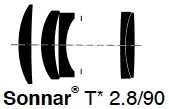
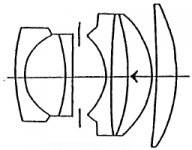
I was interested to see whether the 90mm f/2.8 Contax-G Sonnar is more than just a Sonnar by name, and dug out a lens diagram. The traditional rear cemented triplet has become a cemented doublet, but it does seem to have the Sonnar arrangement otherwise. Compared to the diagram for the 1.5/50mm Opton-Sonnar...
 

Attachments

  • Sonnar90diag.jpg
    Sonnar90diag.jpg
    13.6 KB · Views: 0
  • Zeiss Sonnar 1.5:50 diagram.jpg
    Zeiss Sonnar 1.5:50 diagram.jpg
    21 KB · Views: 0
Hi Doug, the Contax-G Sonnar 2.8/90 is what it called design-wise an Ernostar. (Predecessor of the Sonnar designed by Bertele in the 1920's) Beginning 1966 with the 2.8/180 Zeiss Oberkochen started to replace the middle element of the first cemented triplet by an "air" lens, saving weight and cost. Also the 2.8/85 Sonnar (1970) was a 4-element design, changed in 1976 into a 5-element-design (splitted rear-element) for the Contax RTS (C/Y), very similar to the Contax G-lens. Also the Rollei 35S lens was an Ernostar.

Since Zeiss owns the Sonnar trademark they are free to call Sonnars whatever they want, even a 100% Double-Gauss design like the ZM 2.0/85.

Design-wise a Sonnar is a fast lens with a low number of optical groups (classically, three) and with at least one cemented triplet. Both requirements were perfectly matched by the Contax RF Zeiss Sonnars 1.5/50, 2/50 and their counterparts mady be Nikon, the Nikkor 1.4/50, Jupiter-9 and -3, Canon 1.5/50mm, plus the telephoto lenses Sonnar 2.0/85 (Contax RF + Contarex mount), Nikkor 1.5, 2/85 and 2.5/105. The new C-Sonnar has only one cemented triplet and 4 optical groups and is more a Sonnar than anything Zeiss or any supplier (except the Russians) offered in the last four decades.
The Canon RF 1.5/85, Pentax SLR 2.0/58 and 1.9/83mm can be seen as derived from a Sonnar, because they also have one cemented triplet an 4 groups.
Some designs can be viewed here (text German, only):
http://www.taunusreiter.de/Cameras/Biotar.html
 
Hi Frank,

what makes an Ernostar, then?

Ernemann's f/2 had six elements in four groups; two cemented doublets, a single lens, the iris (between the third and fourth group), and another single lens. His later f/1.8 Ernostar had six elements in four groups, the second group is a cemented triplet, and the iris is between the third and fourth group. About the only similarity I see between the Contax-G 2.8/90 Sonnar and the Ernostars is the position of the iris.

Either you count the pseudo-Triplet with the air lens in the middle in the later Zeiss "pseudo-Sonnars" as one group, then you have a Sonnar. Or you count it as two groups, then the design consists of three single lenses, the iris, and then a cemented doublet. It could be that there's something I don't get, but where's the Ernostar in there?

Philipp
 
Back
Top Bottom