Exposure Equation Help / Ideas?

quantum-x

Established
Local time
6:47 PM
Joined
May 28, 2006
Messages
75
Hey guys.
Been playing around with the idea to cheat a little and drag exposure tables into the present day.

I'm a programmer, not a mathematician, but here's what I propose -
I'd like to build a small J2ME [Java Applet] that'd run on a mobile phone and spit out exposure information.

For me, I carry a lightmeter or an SLR w/ one in it, and would love to go..
Correct Exposure Time: 10s
Correct Exposure Fstop: f4
Correct Exposure ISO: 100


Desired Fstop: f8
and / or
Desired ISO: 50

and have it crunch the maths. Reciprocal failure for film would be nice too.

http://en.wikipedia.org/wiki/Exposure_value seems like a good reference.

OK maths geeks - step up, give me a formula 😉
 
Better to start at the beginning. For me, everythin taking longer then 1 sec must be multy by 2 (for positive). I do x 1.5 for negative. For digital I do nothing, because I can see the result and reshot, but in time I realized digital is close to positive film.
I don't like math for RF shooting, because of spontaniety.
About your setup, I propose first to check the exposure relation between the SLR metering and handheld meter. They can be different animals, because, usually SLR take reflective light metering, while handhelds are incident light meters. Take it carefully
 
Hey mate.
I should add that I'm somewhat narcissitic about this - I'm pretty familiar w/ the relationship between my RF [XPan2] and my DSLR - but I'm lazy when it comes to the mental workout, especially when I'm changing all the variables between bodies.

99% of my photography is long exposures [above 5 minutes or so] - so having this as a guide would be handy - thought it might help out some others too if I developed and released it...

Simon
 
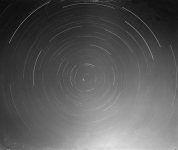
Let us see some beaities at 5 minutes or more. I go for 4 hours, 4x5 negative against the North star. Let me dig my disk about and see...

edit: one shot found against the north star (light leakege). 4 hours shot 4x5 negative with heavy tech camera. f/2.8
 

Attachments

  • bwskyair800.jpg
    bwskyair800.jpg
    51.1 KB · Views: 0
Last edited:
This is the formula that will give two identical exposures (1) and (2), with different parametersets:

N1^2 / t1 / ISO1 = N2^2 / t2 / ISO2

where
ISO1, ISO2 is the ISO setting (e.g. 100)
N1, N2 is the aperture (e.g. 4.0)
t1, t2 is the speed (e.g. 1/1000)


In your example:

4^2 / 10 / 100 = 8^2 / t2 / 50

solves t2 to be 80 seconds

This will have to adjusted for the reciprocal effect.

Groeten,

Vic
 
qx-pano-2.jpg

qx-pano-2.jpg


Non RF
qx-pittsburgh-7.jpg

qx-hanger-1.jpg
 
vicmortelmans said:
This is the formula that will give two identical exposures (1) and (2), with different parametersets:

N1^2 / t1 / ISO1 = N2^2 / t2 / ISO2

where
ISO1, ISO2 is the ISO setting (e.g. 100)
N1, N2 is the aperture (e.g. 4.0)
t1, t2 is the speed (e.g. 1/1000)


In your example:

4^2 / 10 / 100 = 8^2 / t2 / 50

solves t2 to be 80 seconds

This will have to adjusted for the reciprocal effect.

Groeten,

Vic

Ninja! Thankyou 🙂
 
Back
Top Bottom