Fairly Basic Color Film Question: Negs vs Slides

Leitz Summaron 35/2.8, Fuji Velvia 50, 81a Warming Filter
34208183391_e9f8f9b7bc_c.jpg
[/QUOTE]

I love this shot, too! So much for a kid to think about from "Which car?", to "Where'd Mom go?" to "What happened to the water?"
 
If you shoot slides, project them and enjoy their splendor.

Of course!
That is by far the best you can do with slides. Slide projection delivers by far the best image quality at huge enlargement factors.
Digital projection is much much inferior and cannot compete at all, because
- the extremely low resolution of digital projectors, which is only a fraction of slide projection
- the worse color rendition in digital projection
- the flat images in digital projection; slides have much more kind of "three-dimensionality"
- the huge costs of digital projection; costs of slide projection are about nothing.

A projected slide surpasses every scanned (or original digital) picture on a computer monitor. Because the computer monitor is a "quality destroying" medium (like a digital projector), because of its extremely low resolution and discrete LCD structure which cannot display real halftones. And the flat look.

Fortunately we have - in addition to slide projection - another perfect quality way to enjoy slides:
With an excellent slide loupe on a light table.
It is of highest quality, extremely fast and convenient, and at negligible costs.
No hassle with scans, no costs for scans.
Perfect for lower mangnification ratios.
Excellent slides loupes are those from Schneider-Kreuznach, Rodenstock, Leica, Emo or the Peak Anastigmat 4x.
Excellent light tables are available e.g. from Kaiser:
http://kaiser-fototechnik.de/de/produkte/2_1_sortiment.asp?w=381

Cheers, Jan

 
In 35 years of shooting film, I shot far more slide film than anything else -- literally, many thousands of rolls. I especially preferred slide film because I could add filtration to get exactly the color mood I wanted. I have scanned many hundreds of those slides with a Konica-Minolta Dimage 5400 at 13/19 inches with excellent results.

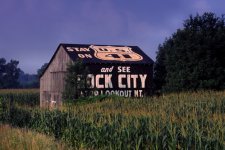
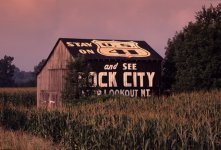
Here's an example of using filtration to create color mood: In photo A, taken just after sunrise, you get no feeling of the early light -- it could have been taken almost any time of day. For photo B, I added a #85 filter, which gives the feeling and mood of the early morning light. It's possible I could do that with color negative film, but this way I have the scene on film just the way I want it and do not have to guess at it when printing or scanning.

This photo is from my book Rock City Barns: A Passing Era, now out of print after selling more than 29,000 copies.
 
Since I've tried Portra 160, I've just ordered some Fuji Velvia (E6) film to see whether working with positives might be easiser. Won't know about "better", but we'll see about "easier". Guess I'm okay with capturing a higher dynamic range in slides and then NOT being able to scan it fully than missing it in the original ...at least as a concept. We'll see about the results. And fairly, haven't scanned my latest Portra shots... so we'll there, too.

You should add some Provia 100F (or AgfaPhoto CT Precisa) as well. Their gradation is lower, their dynamic range is higher and therefore they are easier to scan with amateur scanners.
But as explained above:
Do yourself a favour and - at least as an addition - go also the easiest, lowest cost and highest quality route with loupe / lighttable and / or projection.

Have fun and enjoy your slides, cheers,
Jan
 
Jan: THanks for the encouragement. Have a light table from way back that's working great, and a loupe, too. Even have an old 35mm projector and a bunch of old slides from the 1990's... which will eventually get resurrected, too. New-to-me is Velvia 100 for 120... which just blows my mind thinking about it. And I bought a 5-pack! plus a 1 roll of 35mm to feed to another camera... which will eat it like Cookie Monster.

Can't imagine a 120 "slide" projector though. THAT would be amazing!

And yes, I'll try some Provia. Agfa? Hmmmmm. As a kid I remember seeing references to Agfa color as "Dutch Master"... but that was when I was shooting cine, and from what I can see Agfa's not really pumping the 120 any more.

Dave: Differences between the two shots? Love the old "See Rock City"... which somehow despite 50 years of admonitions to do so, I've neglected to stop there.
 
Jan: THanks for the encouragement. Have a light table from way back that's working great, and a loupe, too.

Good for a start. But there are loupes, and there are real slide loupes 🙂. The quality differences can be really huge with loupes!
Excellent slide loupes are the Schneider-Kreuznach 4x (35mm), 3x (MF) and 10x (sharpness control), Rodenstock 4x (35mm) and 3x (MF), the Leica / EMO Macromax 5x (35mm), the new Adox 10x (sharpness control) and the Peak Anastigmat 4x (35mm, 4,5x6).
A very cheap, but nevertheles good loupe is the new Kaiser 4,5x loupe:
http://kaiser-fototechnik.de/en/produkte/2_1_produktanzeige.asp?nr=2351
It is not as excellent as the above mentioned loupes, but still good.

Excellent are the new Kaiser slimlite Plano LED lighttables:
http://kaiser-fototechnik.de/en/produkte/2_1_sortiment.asp?w=381

Even have an old 35mm projector and a bunch of old slides from the 1990's... which will eventually get resurrected, too.

Go for it! Slide projection is awesome!
Use your old projector for the start. And when you get hooked: Currently you still get the best 35mm projectors with the best lenses at extremely attractive prices!

Can't imagine a 120 "slide" projector though. THAT would be amazing!

It is indeed 🙂. Medium format slide projectors are currently also very cheap on the used market:
Look for the following models which offer an outstanding price-performance ratio:
- Rollei P 66 S
- Rolleivision 66 / 66AV
- Kinderman T66 highlight.

And yes, I'll try some Provia. Agfa? Hmmmmm. As a kid I remember seeing references to Agfa color as "Dutch Master"... but that was when I was shooting cine, and from what I can see Agfa's not really pumping the 120 any more.

The current AgfaPhoto CT Precisa 100 is just re-labeled Fuji Provia 100F, so best quality available. But offered significantly cheaper in certain markets

Cheers, Jan
 
Slides have high contrast, the issue in scanning is to capture all the density range. Seriously, Kodachrome said to have Dmax of 3.7-3.8 which is almost 13 stops, tough for scanners. But, the color is what you see in the slide, easier to get good color in your scan.

Color negatives have much less contrast in the negative so it's easier to capture all the density range that's there. But color-negs have an orange mask and varying response to colors. Mini-labs have calibrations for each film brand/type; it's harder to get good color rendition at home.

I'm experimenting now with camera-scans for color-neg with good results. See other threads here for more.

Kodak states in pamphlet E-88 that Kodachrome has 7.2 stops of dynamic range. Other transparency films might be slightly higher but many will be a little less. Color negative film can have 12 stops or more in some cases. With some motion picture films I've seen close to 14 stops.
 
Back
Top Bottom