Fed-1

nick_zima

Russian and more...
Local time
9:39 PM
Joined
Feb 20, 2007
Messages
10
Location
Limerick, Ireland
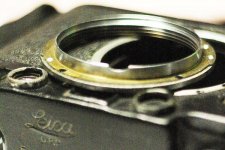
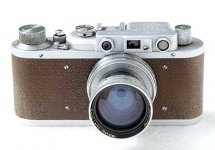
Recently acquired a FED-1 - body fine but the FED f/3,5 50mm lens has corroded diaphragm blades almost impossible to open/close. I thought the easiest solution was to buy a replacement lens in good condition. So far so good. But the 'new' lens screws on to the wrong position - i.e. the infinity lock ends up at 12 noon (obscuring the rangefinder window) rather than the correct '7 o'clock' position. I can't see any way of adjusting the point at which the thread 'bites' in order to get lens into the right position. Any thoughts?! (The replacement lens, like the original one on the camera, has the old aperture scale so I thought it would be as compatible as one could hope to get)
 
Last edited:
Hallo Nick, and welcome. If you have the old apertures you almost certainly have a prewar lens. These were mated to a specific camera in the factory, using a non-standard 39mm screw mount, thus interchangability is problematic, as you have discovered. It may be that there is a fix for this particular problem, in which case Jay or some other skilled member will be able advise you, but I suspect that a better answer might be to replace the camera's screw mount with a standard fitting allowing the use of "ordinary" 39mm lenses. This would not pose a problem for any good repairman, an obvious candidate being Oleg Khalyavin - http://www.okvintagecamera.com/index.html
- very many prewar FEDs have been updated in this way.
All the best, Ian
 
Last edited:
I have seen pictures of FEDs and Zorkis with the infinity catch at 10 o'clock. It could be that the lens mount ring needs to be re-fixed after being rotated anti-clockwise by 90 degrees. The four screws are easy to handle, but there may be shims to watch out for.
 
Thanks Ian - what you say makes sense. I'll contact Oleg and see what he says. Best wishes Nick. PS thanks for the welcome - it's good to be online with an active thread for the first time. N
 
Payasam - thanks for this, yes I was looking closely at the lens mount ring trying to imagine whether it could be rotated or whether it would have some locator pin making it possible to fit only in one position. Didn't risk a disassemble without more information/courage! N
 
A plain ring with no pin or other means of locating. The ring on my Leica IIIc has a mark which should be in the 9 o'clock position, but which can end up at 12, 3 or 6 in the hands of someone who doesn't know. My Zorki 1C has no such mark, and I think your FED won't have one either. Four screws are easy to open. Just be careful to keep the camera on its back and not dislodge any shims or packing under the ring.

If Ian is right and the body and lens are meant exclusively for each other, this may not do the trick.
 
Nick

FED thread mounts in both cameras and lenses are not always milled to start and stop at the same places. The focus tab never always stops at the same place- these could be anywhere from the 7:00 to 11:00 positions. The same can be observed of many Zorki-cameras.

Those made in the late 1940s (pre-war ones are even more iffy) to the early 1950s are prone to this. I've observed that FED-1 whose serial numbers are above 450XXX to have rather consistent entry and stop points for the threads.

The non-standardised thread entries and stop points, plus the often non-standard lens registers can make one suspect the FED to be a non-true interchangeable lens camera. The instruction manuals warn against removing the lens and unlike Zorki manuals, there is no mention of alternatives to the FED-50mm (Industar-10) lenses.

Lenses and bodies were matched in the factory. Not only in terms of focus registers, but also in terms of where the tab stops when the lens is parked for infinity.

And contrary to what one poster above has said, it is not a simple matter of reversing the lens mount. The 'solution' suggested there won't work. FED lens mounts have a milled portion on the 'upper' part to clear the way for the top plate. The lens mount cannot be simply removed and reoriented. Doing so will make the lens mount tilt because the rear of the mount will hit against the top plate. The only way this can be done is to mill or file away that back part to make space.

Ian is right, the smartest solution is to get a 'standard' lens mount to replace the one you have on your camera. But this isn't easy to do. Surplus mounts don't really show how they would orient the lens. When the mount is changed, you would have to figure out the proper shimming since camera bodies and mounts do not have the same dimensions even if these belong within the same model.

Consider too the lens you got. It could be the one which has the funky thread mount. Try to fit this lens on another body - a Leica or Canon- to see where its infinity tab stops. Many of the FED-50 lenses made prior to 1954 or so tend to park their tabs at the oddest positions on Leica and Canon cameras. Many of those I've tried stop right over the slow dial or sometimes even over the viewfinder window.

Another consideration when changing FED lenses is that bodies and lenses may allow exchanges, but the focal distances are never the same. The flange-to-focal distance found in particular body is often adjusted for the lens it was given at the factory. A lens from another body would mean that it has a slightly different register and placing it on another body would result in focusing inaccuracies. It only takes as little as a deviation of 0.02mm to make the focus go bad.

Also, what FED did you get? The FED-1 I have from the late 1940s do have standard Leica-pitch but the focus camming is slightly different. The FED-50 lenses from these cameras do not focus properly (distance marks go wrong and at infinity, the rangefinder patch doesn't align) with Leica or even later FED-1 cameras.

The variations between these cameras and the lenses they got is very great. I have two FED-1 from 1949 (serial numbers differ only by a couple of hundred) whose lenses use different focus camming, lens mount pitch, and working distances. Cameras from this period can always be recalibrated for the later lenses, but will be rendered useless with their original lenses.

Jay
 
Last edited:
Jay

Thanks for this very full explanation: I can see what you mean about the top part of the lens mount being indented on the reverse at the top.

The camera is marked NKVD-SSSR Khar'kovskii Kombinat im. FEDzerzhinskogo (is that a 1-d model?)

Would it be more realistic to disassemble both lenses and 'transfer' the uncorroded diaphragm to the lens which belongs to the body? Perhaps I should say 'get someone else to' as I'm not sure how realistic it would be for me to tackle the job!
best wishes Nick
 
Apologies, Nick. I should have said that I was speaking of a IIIc's mounting ring, not a FED's; and I should have said that you should look at the back of your mounting ring to see if there was anything which would align it only in one position.
 
nick_zima said:
Jay

Thanks for this very full explanation: I can see what you mean about the top part of the lens mount being indented on the reverse at the top.

The camera is marked NKVD-SSSR Khar'kovskii Kombinat im. FEDzerzhinskogo (is that a 1-d model?)

Would it be more realistic to disassemble both lenses and 'transfer' the uncorroded diaphragm to the lens which belongs to the body? Perhaps I should say 'get someone else to' as I'm not sure how realistic it would be for me to tackle the job!
best wishes Nick


Nick

What you've got is a pre-war FED "NKVD". These are rather difficult to work with. To begin with, the NKVD FEDs had a lot of variations in the FED line in terms of lens mount and register. All the NKVD are found (unless the mount's been changed) with non-Leitz standard thread mount pitches. Leitz' mount thread used M39X1 inch , whilst the NKVD thread was M39X1, metric. The FED mount adopted the Leica standard after WWII.

Like the pre-O Leica cameras, the focal registers (lens flange-focal plane) of the prewar and early post war FED varied. Leica had standardised their focal registers (in soviet literature, termed as 'working distance') at 28,8mm. The early FED averaged at 28.5mm, with variations as high as 0.05mm. When their lenses were produced, their back focus lengths were not standard so the cameras they went into had to be individually adjusted to suit these lenses.

Lenses from different NKVD cameras would not even readily interchange. A lens from one NKVD whose focus tab parks in an ideal position in that camera will likely have this tab park over the viewfinder in another NKVD camera. Such had been my observation amongst the NKVD FEDs I have.

Another issue with swapping lenses on NKVD FED is that the actual focal register distance of the lens is hard to determine. You would have to determine first what the actual focal register- exactly to 0.02mm- of your replacement lens before you can establish the new focal register adjusments for your camera.

Transferring lens components between lenses is also not recommended. The more original the components you have, the better the performance of your device is. Many of the parts were custom-fitted to the devices they were found in. Are the diaphragm blades deterioated beyond repair? Can't they be cleaned anymore?

You have two options here: replace the original lens and get a 1950s FED-50 or Industar-50. Replace the lens mount with one from a later FED-1 or Zorki-1. The lens mount from Zorki-C or Zorki-2C will fit on the FED NKVD. Recalibrate the camera's focal register, as well as its rangefinder, to suit the replacement lens. Recalibration in this case is easier since these lenses have 28,8mm registers and the camera needs only to be adjusted for this value. In the end, you'll get a fully functioning FED-1. However, authenticity, historical value, and considerations like shooting with an uncoated vintage lens are all lost.

Second option is to have the lens diaphragm repaired, taking care that the lens adjustments are not disturbed during the process. You need not touch the camera anymore, assuming that it has retained its original calibrations. This option will probably cost more than replacing the parts to make the camera functional. But the working FED NKVD you get in the end will allow you to shoot through a camera the way it was in the 1930s.

Click on the link below my signature (FED Zorki Survival site) for more FED info.

Jay

 
payasam said:
Apologies, Nick. I should have said that I was speaking of a IIIc's mounting ring, not a FED's; and I should have said that you should look at the back of your mounting ring to see if there was anything which would align it only in one position.


The mounting rings on the IIIc do have cutouts. There is a fine, shallow cut out running along the rear surface which coincides with the IIIc's top plate -see attached picture, this would be the "white" edge on the otherwise brass-coloured surface. Then, there is also a notch for the RF sensor wheel. When the mount is incorrectly installed, the movement of the RF sensor will be hampered.

All the three IIIc mounts I've seen have these. One of these mounts has been installed in a 1937 FED NKVD (second attachment) which now allows most Leica and Canon lenses -except those with tongue shaped cams or notched mounts - to fit.
 

Attachments

  • leica3cLM.jpg
    leica3cLM.jpg
    55.6 KB · Views: 0
  • image740.jpg
    image740.jpg
    15.3 KB · Views: 0
Last edited:
Thanks for describing the different options, Jay. I suppose it comes down to authenticity vs usability. The diaphragm blades look uniformly brown, dull, almost rough - rusty (for want of a better word). The aperture will open and close but only with a fair amount of pressure, and a broken finger nail or two! Otherwise the lens is in pretty good condition. Hasn't been roughly treated, no scratches or fungus. Nick
 
nick_zima said:
Thanks for describing the different options, Jay. I suppose it comes down to authenticity vs usability. The diaphragm blades look uniformly brown, dull, almost rough - rusty (for want of a better word). The aperture will open and close but only with a fair amount of pressure, and a broken finger nail or two! Otherwise the lens is in pretty good condition. Hasn't been roughly treated, no scratches or fungus. Nick


Nick

the diaphragm blades in two of my prewar FED-50 all look brown or at least a shade of it. Are they rough looking? The blades may be brass. It may not be rusty blades which are the main problem here, but rather the aperture setting lever itself. This part can get stuck from all the detritus it has gathered through the years.

Try freeing the aperture setting lever by injecting a very minute amount of lighter fluid in the seams/groove where the lever runs. Don't get any of it between the ring and lens. Then follow this with an injection of 50% fine machine oil (sewing machine oil will do) + 50% lighter fluid for lubrication. If the ring goes smooth, your problem is solved.

If you plan to disassemble your FED-50, see here:

http://jay.fedka.com/index_files/Page325.htm
The Industar-22/-50 are built the same way as the FED-50/Industar-10. You may be able to access the diaphragm blades and clean them. Don't be afraid of going inside the lens. 🙂 If the blades, as you said, are really rusty, you don't really lose much if you foul up the restoration process. But if your attempt is successful, you'll have a working, matched lens for your FED NKVD.

Jay
 
Last edited:
Following this thread, regarding the collapsible FED (3.5-18) lens, the middle elements on mine from my FED 1 NKVD is oiled(?). How easy is it to remove and clean it, and more importantly how easy is it to get back without ruining the register. I'm hopefully going the authentic user route.
Jon
 
JonP said:
Following this thread, regarding the collapsible FED (3.5-18) lens, the middle elements on mine from my FED 1 NKVD is oiled(?). How easy is it to remove and clean it, and more importantly how easy is it to get back without ruining the register. I'm hopefully going the authentic user route.
Jon

Jon

What you may be seeing is a water-like misty deposit which the older FED-50mm seem to be prone to. All the uncoated FED-50 I got came with this haze.
Fortunately, this can be easily cleaned. The mist is likely on the inside surfaces of the rear and second groups which face the diaphragm blades.

Follow the disassembly procedure described in http://jay.fedka.com/index_files/Page325.htm.

Once you get the optical barrel off, remove the remaining retaining ring found at the rear of the lens. The rear group (lens is quite simple- 4 elements/3 groups)
screws out and it will be possible to access and clean it. One of the surfaces of the middle group becomes accessible too, through the diaphragm blades.

If the mist is on the inside surface of the front component, this can be removed by unscrewing the retaining ring which surrounds it. Be very careful in handling this component. Once the retaining ring is off, only a tiny, thin lens is left. Do not pry it out. Stick a piece of tape on its surface to pull it out.

Gently wipe the soiled surfaces with cottonwool, or Kimwipe, or even soft facial tissue moistened with Windex glass cleaner. This should remove the misty deposit.

You need not worry about losing or altering the focal register values. As long as you screw the lens components back properly, the lens's optical values remain. The len's block position relative to the lens -which also defines its working distance- is determined by the shims found inside the barrel. Just make sure that the shim(s) you find are returned to their original location.
Jay
 
Last edited:
Diaphragms and Iris blades

Diaphragms and Iris blades

Diaphragm and Iris blades are not fun to assemble. Getting all those tiny, boomerang-shaped blades into a circular layout, with some overlapping the other blades and have their pins exactly on their pivots isn't exactly the easiest thing to do. Add to that doing all these in the cramped, tiny, tunnel-like space of the lens barrel.

During disassembly, one should take extra care not to upset the iris blade rings lest they fall out.

Jay
 
When my IIIc came back last year after a shutter problem was set right, I found that the infinity catch of the lens came to rest near the slow speed dial. The mark on the outside of the mounting ring was towards 12 o'clock. I unscrewed it and put it back after rotating it 90 degrees anti-clockwise. Since all this was done without trouble and the camera functions perfectly, I did not so much as glance at the rear of the ring. I have lived, it would appear, without learning.

So far, bad enough: but to then proffer advice about a camera which I only assumed was like the not properly observed original was, to put it mildly, criminally negligent.
 
Back
Top Bottom