FED 3 problem

N

Nikon Bob

Guest
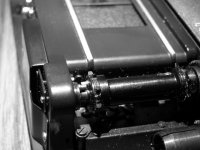
There are two opposing pins on the wind side of the FED 3 at the bottom of the camera. They are engaged when you wind on and I am guessing that the lower one winds the shutter. When releasing the shutter the lower one is pushed down out of the way and then pops up to oppose the other again. The problem is that sometimes the lower one catches the bottom of the upper pin and the upper one skips past causing me to double wind/stroke. Is there an adjustment for this or is it a file/sand situation to stop the interference? Sorry about the wording and description of the problem but I am just starting to tinker. Any help would be appreciated.

Bob
 
Yes - you can move the sprocket wheel (or drum) a little bit down. There is a screw on one side of it, between the upper sprockets - loosen, move the whole sprocket drum down and retighten.

For more info read my post in this thread (click)

If you have still more questions feel free to ask.
 
There are two screws on the sprocket, one on the very top part, above the teeth, and one in a cut-out, between the teeth.

These are both part of the rewind release clutch and there are springs inside the sprocket. Undoing either of them allows very little movement so I don't think it's a simple adjustment problem. It's more likely that the rewind clutch is full of dried grease that isn't allowing the mechanism to reset properly. When the rewind is released, do the two pins you refer to overlap fully? They should and if they don't then either the shutter release or rewind release is at fault.

I'll post a pic tomorrow showing what the pins *ought* to look like. Maybe Spyderman's idea might work, but I suspect it may not. Whatever you do, DO NOT remove either of the screws, only slacken them. Removing the one in the cut-out would allow the internals to rotate and you probably won't get the screw back in without major disassembly!

If the clutch is full of dried grease, as I think it may well be, try this: first put some tissue behind the sprocket (use plenty). Now turn the sprocket until the cut-out is uppermost with the camera face-down (remove the lens!). Squirt lighter fluid into the cut-out, noting that it will run out of the sprocket wherever it can (hence the tissue). Now work the rewind back & forth - lots! Hopefully that will free things. Allow the lighter fluid to dry thoroughly, then put a drop of oil in the cut-out and work the rewind release some more.
 
Thanks for the info guys. I will try some more in the morning.


Bob
 
Hey, another who has seen this problem,
http://www.rangefinderforum.com/forums/showthread.php?t=37201

I think maybe it has not a great deal to do with the clutch or sprocket.
If your problem is the same as I have seen in a few of my FEDs, then it is probably due to the wind mechanism.
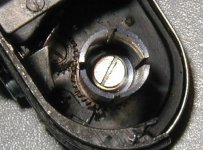
What happens is this: When you wind on (in a normal situation) the peg on the sprocket pushes the peg on the cog (facing the sprocket) round until the cog hits its end stops and thus stops the winder. The shutter tension is held in the winder by a small tooth at the base of the film spool shaft (see pic). The shutter button is pressed and the pegs are lifted apart, the cog has nothing to hold it back so turns back, the curtains do their thing etc, and the peg comes to rest in front of the sprocket peg (stopped by the other end stop acting on the cog). What happens in a my few examples is that, after the bottom cog is released, the sprocket advances fractionally so that when the cog is at its start point, it is no longer in front of the sprocket peg but on top or even behind it. When wound on, the sprocket peg must make a full turn (one frame) before it gets behind the cog peg again, then completes the wind, taking another frame to do so.
You can watch this happen quite easily, although it's usually an intermittent thing.
Why does it do this? Well, having suffered a great amount with my Zorki 6 with this problem, I think that I found the cause. As you advance the wind lever a small tooth latches into a cog in the winder assembly (you can see on the FED2 and 3 directly under the winder, next to the cog at the top of the wind up spool/clutch). In normal, well adjusted cameras, at the end of your winding-on, this tooth will hold back the winder tension quite comfortably, without allowing it to move. In a problem camera, the assembly has been wound just far enough for the tooth to drop over into the next trough (between the cog teeth), but not enough to drop fully down into place. When the tension is released (shutter button pressed) it is able to complete its movement and drop into place fully, thus moving fractionally, causing the mis-alignment of the pegs.
All this you can see, I would be very interested to know if this is the case with your FED3.

I think that the fix will be in the little catch tooth in the winder. Many of them (like the FED3) have a little slot which can be opened or closed, bending a small strip of metal which will (if closed) allow the tooth a little more movement. This tooth engages when the tension is released in the winder (when you let go) and allows the cog to return very slightly, this causes the tooth to engage in the cog. If the tooth were further away from the cog then it will stop the cog fractionally later and hopefully fully in position between two cog teeth. The attached picture shows the wind cog catch, you can see the adjustable slot. It's fairly easy to get at. I will be doing mine soon.
Just be sure, before you adjust anything that there is no debris lodged behind the tooth, holding it nearer to the cog.


Regards, Dave.....

 

Attachments

  • P1010041.JPG
    P1010041.JPG
    61.1 KB · Views: 1
Last edited:
I should say that you can also feel this in the winder. A well sorted FED 2/3/4 will have a slight amount of movement left in the winder after you have wound on. I found that a little play of around a half of a division on the frame counter is good. If a problem cam can be wound on a little further, so that no play can be felt in the winder, then you are at risk of the little pegs mis-aligning.
I guess that if the cog on the spool shaft can cause these problems if it is not mounted concentrically or by poor machining tolerances. I reckoned that one of my FEDs (3a) only did this when the frame counter was nearing 20. It would then do it for about 10 frames. I've yet to see if I can get over this.


Good luck....
 
Last edited:
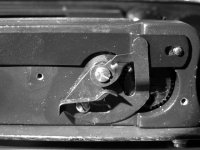
I can see what Fidget is getting at and it is a possibilty. Here's the pic of the two pins with the shutter about halfway cocked, you can see clearly the pins overlapping. Note also the position of the long spring on the bottom of the body, it should lie almost flat to the body. If it doesn't then the rewind release is probably at fault.

Another thought has come to me: one thing worth checking is the ratchet that holds the shutter cocked. It's under the cover that you can see on the bottom of the body and partly covering the long flat spring. I have known the screw on this to come loose and the ratchet not to work properly. Remove the cover (2 small screws, different lengths) and check that the central ratchet screw is TIGHT.

Hope we're helping!
 

Attachments

  • FED3_Sprocket.jpg
    FED3_Sprocket.jpg
    97.7 KB · Views: 1
Just got up and am having my morning coffee/fag combo before I tinker some more. The info has been more than welcome but with my skill level and the learning curve I think it will be a matter of tinker to destruction. The only way to learn I guess.

Bob
 
wolves3012 said:
........... the ratchet that holds the shutter cocked. It's under the cover that you can see on the bottom of the body and partly covering the long flat spring.

Hope we're helping!

On all my FED 2s and 3s the only thing that stops the shutters from unwinding after cocking is the tooth on the rewind shaft. The thing which stops the shutter releasing is the peg on the sprocket blocking the peg on the cog, and thus the first curtain drum which engages with this cog. I don't have all the models of course, but you're not thinking of the circular groove in the first cog are you? This is simply the end stop for the first curtain travel. If the screw holding this were loose or out, you might have problems in knowing when to stop winding.

Dave..
 
fidget said:
On all my FED 2s and 3s the only thing that stops the shutters from unwinding after cocking is the tooth on the rewind shaft. The thing which stops the shutter releasing is the peg on the sprocket blocking the peg on the cog, and thus the first curtain drum which engages with this cog. I don't have all the models of course, but you're not thinking of the circular groove in the first cog are you? This is simply the end stop for the first curtain travel. If the screw holding this were loose or out, you might have problems in knowing when to stop winding.

Dave..
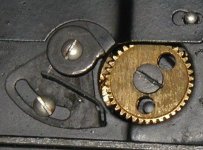
On the FSUs with slow speeds (i.e. NOT the FED 2) there is a ratchet that holds the shutter cocked. Photo 50 in my "HOW TO - Zorki 4K" sticky thread will show you (it's the silver disc-like part); it looks much the same on other models. It fits on a square on its shaft. The purpose is to hold the shutter cocked in an exact position and prevent any slack in the wind ratchet from allowing the mechanism to unwind fractionally. If that were to happen the slow-speed mechanism could unwind enough to affect shutter speed badly. Only models with slow speeds need and have this ratchet, it's what gives that slight click at the end of the wind-on.

EDIT: Here's the FED 3b version, it's the snail-shaped cam. The shutter was cocked for this picture:
 

Attachments

  • pict2307.jpg
    pict2307.jpg
    106.6 KB · Views: 0
Last edited:
wolves3012 said:
On the FSUs with slow speeds (i.e. NOT the FED 2) there is a ratchet that holds the shutter cocked. Photo 50 in my "HOW TO - Zorki 4K" sticky thread will show you (it's the silver disc-like part); it looks much the same on other models. It fits on a square on its shaft. The purpose is to hold the shutter cocked in an exact position and prevent any slack in the wind ratchet from allowing the mechanism to unwind fractionally. If that were to happen the slow-speed mechanism could unwind enough to affect shutter speed badly. Only models with slow speeds need and have this ratchet, it's what gives that slight click at the end of the wind-on.

This is interesting, although not related to this thread, I also see problems in my FED3a and 3b, where the slow speeds vary according to how tight it is wound. I took this problem to be caused pretty well by exactly the same condition where the winder stops at slightly different positions, so effecting the slow speeds quite significantly. On the 3a and 3b (early models at least), I don't recall setting up any other ratchet or catchment device. Is this a difference between FEDs and Zorkis? OTOH, I am aware that later models of FED3b were fitted with a device to ensure that the shutter could not be released until fully wound. I haven't come across one of those yet, but can't see how it could cause the sprocket to advance enough to misalign the pegs, as when the shutter is pressed, the sprocket is disengaged from the shutter mechanism. So in the case of Bob's camera, it could be interesting to establish if the sprocket does advance slightly when this problem occurs.

My apologies if this sounds to be a disagreement, it's not meant to be so, just trying to think through the problem. As I have said, I've not got round to fixing mine yet, I have 3 which exhibit this problem to some extent, so I too would like to resolve it. It is heartening to know that reliable slow speeds might be got from a later model FED3b or a Zorki 4k. Would the Zorki 4 have this disc? My example runs very reliably, never had it apart.
 
Last message posted before I saw the pic of the cam. Very nice, I think that I can see that it functions as you say. I guess that this was a development to improve the reliability of the slow speeds. They needed it!
I think that you will find that early FED3b's and probably all the 3a's weren't fitted with these.
 
Last edited:
Fidget: We are talking only FED/Zorki of course but ALL the models with slow speeds have this AFAIK. Of the models I own, the Zorki 4K, and FEDs 3a, 3b, 4 and 5 definitely have this ratchet. The point at which it locks is adjustable and *might* influence whether or not missed frames are possible. Certainly I had this come loose on my 4K and it sent the slow speeds to pot. I'd have to agree it's more likely that a gunged-up rewind release is the most likely culprit for missed frames.

And by the way, I'm not taking it as a disagreement at all, simply a discussion of how the things work! 🙂

As you can appreciate, the slow-speed mechanism has to be wound to an *exact* position to work properly, this ratchet guarantees it. Cameras without slow speeds aren't as critical so it's not fitted; the wind ratchet provides enough accuracy.
 
fidget said:
Last message posted before I saw the pic of the cam. Very nice, I think that I can see that it functions as you say. I guess that this was a development to improve the reliability of the slow speeds. They needed it!
I think that you will find that early FED3b's and probably all the 3a's weren't fitted with these.
You posted this while I was composing my last reply. I only have one each of FED 3a and b and they both have the ratchet. I have no idea if models were made without it but I can't see how the slow speeds would be reliable....or then again, maybe they just weren't and this is the reason!
 
Just had the bottom off my non-export 3a and it does have this, whereas my export model does not. Hmm, my statement that all 3a's do not have it is incorrect. Incidentally, my recently received 3a has problems in the slow speeds possibly because the arm which acts on this cam is missing.
 
fidget said:
Just had the bottom off my non-export 3a and it does have this, whereas my export model does not. Hmm, my statement that all 3a's do not have it is incorrect. Incidentally, my recently received 3a has problems in the slow speeds possibly because the arm which acts on this cam is missing.
Intriguing...my export version *does* have it! Maybe it's case of late and early models differing then. If the arm is missing on your recent one that would almost certainly be the cause of slow speed problems. Does your export version have speed problems? I wonder, if it doesn't, is there some other means fitted to ensure accuracy?
 
Sorry, it has an odd cam here, but no parts appear to be missing. It looks like some device to damp the curtain movement. OH, more puzzles.
Sorry also to lead this thread elsewhere.
How is Bob doing?
 

Attachments

  • fed3a.JPG
    fed3a.JPG
    65.8 KB · Views: 1
Back
Top Bottom