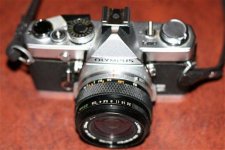
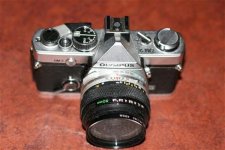
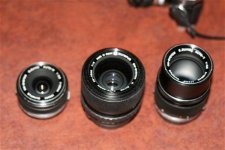
Hey, anyone care to highlight the differences between the om models? That will be helpful for most of us Leica snob 😉
OM-1 is all mechanical, all manual, match-needle metering. Uses mercury batteries.
OM-2 Looks like the OM-1 but has electronic shutter to allow autoexposure (aperture priority). Manual exposure also available with match-needle metering like the OM-1. I prefer the OM-2 because it uses easily obtained silver-oxide batteries. Offer TTL flash metering, was the first camera to do so.
OM-3 All mechanical, manual camera with the same advanced multi-spotmetering system (centerwight also available) used on the OM-4. Rare and expensive camera, and suffered from a battery-drain problem. All OM-3 bodies are black.
OM-4 Electronic shutter, auto or manual exposure. Very accurate and advanced multi-spot metering system that offers averaging of many readings, highlight or shadow biasing. Works for auto or manual mode! In manual mode, spot system's LCD in the finder readout is like a zone-system readout, with each tick mark above or below the center "normal' mark one stop or zone above or below zone V. Often available cheap now, because many suffered bad battery drain. Some have been upgraded with newer circuits that stopped this. All OM-4 cameras are black.
OM-4T Upgraded OM-4 that eliminated battery drain and added titanium bottom and top plates. Originally offered in silver, then later in black. Called the OM-4Ti outside the USA, later USA models also took on the Ti name. First camera to ever offer the now-common (on modern D-SLRs) high-speed flash sync to 1/2000 of a second if you used the special F-280 flash.
OM-3Ti The very last OM model, made as a limited edition at very high price, still sells for very high price used. An upgraded OM-3 with no battery drain and titanium top and bottom like the OM-4T. Black only. Offers TTL flash auto-exposure, despite being all manual for non-flash work.
OM-2sp (OM-2S Program in the USA). More in common with the OM-4 than the old OM-2, it had spot metering for manual exposure only, and it wasn't a multispot system like the OM-4. Offered aperture priority or full program autoexposure that worked on most OM lenses ever made. Unfortunately suffered in many cases from rapid battery drain. Black only.
OM-10 budget model that offered aperture priority auto only. Manual adapter available to add manual, this sells for higher prices than the camera bodies on Ebay! Lots of reliability problems. Larger than the pro-model OM bodies.
OM-20 (OM-G in USA) updated OM-10 that solved the reliability problems and added built-in manual mode. This was my first SLR. Metering system is crude for manual work as it reads in full stops only. OM-2 is a better choice for a manual/aperture-priority body as it is better made.
All the single-digit OM bodies use the same back, so databacks fit them all and all OM bodies use the same coupling for winders and motor drives so you don't need a different winder for each model as you do with most manufacturers cameras! All the single digit models have interchageable focus screens and use the same screens! Well almost. Near the end, Olympus made a couple of brighter screens for the OM-3/4/3Ti/4ti/2sp that do not fit the OM-1 and OM-2. Older screens fit all models.