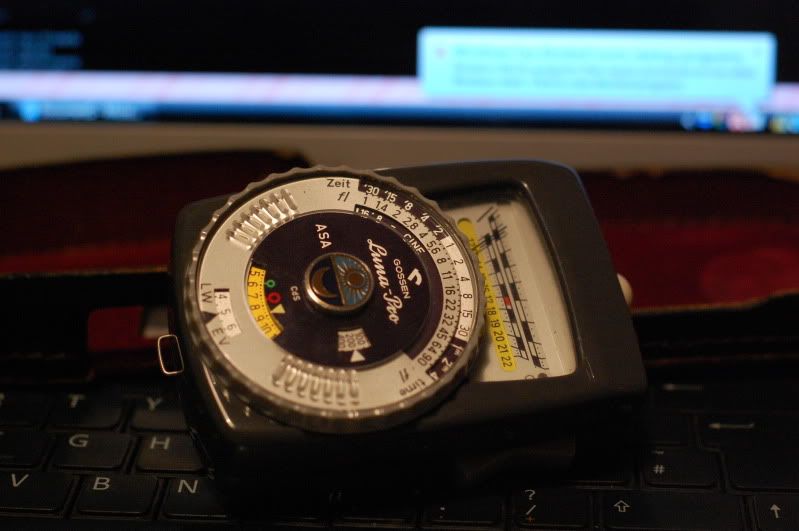
good, general purpose light meter

meezy

meezy
Local time
12:35 AM
Joined
Nov 19, 2009
Messages
69
i've hesitated getting one, relying on the built-in systems of the cameras i have. but lately, i've been wondering about accuracy of those systems and thinking that just having one, reliable meter that i can use for all my cameras (except the 5d 😉 ) would be cool.

can you get a decent one for under a $100? or am i gonna have to spend leica sized bills?

thanks,
~m
 
I'm very happy with Sekonic L-208 TWINMATE. Very simple analogue meter works as reflective and incident meters. I'm a big fan of analogue meter because you can see everything (F/speed combinations, EV, EI etc) on one dial. It's tiny, very light, mountable on flash shoe, and within your budget. You can hang it from neck all day and totally forget about it. I usually get by with "Cloudy5.6" so I actually forget about the meter often. It's super light.

Size comparison against tiny Barnack.

4386987990_9b6641922d.jpg
 
Last edited:
One of my forever-unanswered questions has to do with the accuracy and precision of non-laboratory-grade light meters. Most specifically, how to be assured that they are within a reasonable tolerance of being spot on.

The two answers which keep coming back are to compare the meter to a known-good camera or meter (vicious cycle, rinse, repeat) or check with a "sunny 16" reading.

Back in my clinical lab days, instruments would be calibrated such that they are "traceable to a known standard", and, other than purchasing a laboratory grade meter or light source, this seems like an exercise in futility.

We have convenient ways to test almost every other kind of measuring device. The accuracy of rulers, yardsticks (rangefinders) can be verified easily. We can easily check the accuracy of our clocks to some very close tolerances. For volume and weight (mass), reasonably accurate standards are commonplace.

Why not light meters?
 
Before you can answer your question, you must think about and decide what you want to do with the meter... and what you want it to do for you.

The answer so far is, "it depends". For simple measurement (reflective and incident) you can probably get something for $100. fior flash metering, maybe not. For spot metering, maybe not. for absolute precision to within a nat's eyelash of measurement perfection... ask DMR how much a lab grade photometer might set you back, and then add the cost of a laptop (iPhone???) and the software required to convert those measures into anything you can set your camera by.
 
I'd recommend the cosina voigtlander shoe mount, if you want something to use on a small / medium format camera. It works. It works well with most rangefinder lenses (wide-normal range).

It depends what kind of metering you want to do. I have at least three different external meters, and they all do the job. I have had several more, but thankfully I do not accrete light meters in the same way I do cameras. They just do it differently. Which one are you going to carry around with you? Do you need flash metering? Do you want spot?

(Spot metering is probably not going to happen anywhere near your price range, but a decent center weighted meter is).
 
Why not light meters?

We can - but nobody other than light meter service shops do actually purchase a calibrated standard light source and kit of precision ND filters. Few, if any, photograph grey cards for a living or as a hobby, so that the average photographer practically does not have to calibrate the light meter against a standard, but rather against his (skewed if not outright flawed) metering habits, film, lab and subject.

Sevo
 
I have an old Gossen Luna Pro and I meter my rangefinders with it. it doesn't need to be like something of star trek for my simple needs 🙂 it doesn't let me down and has the same vintage appeal as the rest of my kit, although as it's battery operated and not a selenium meter it isn’t due for extinction 🙂 you can pick up meters like this relatively cheaply on eBay that'll do the trick! I would guess you'd use your 5D for those really tricky shots anyway - or at least have it with you in those instances?


DSC_0011.jpg
 
In much the same way as "only one thermometer in the darkroom" works better than multiple...

Use a light meter, get to know how it works for you, and forget standards. It is much cheaper and less of a headache that way.
 
I concur with the remark about the Sekonic L-398 a great meter -- primarily incident use too which is easy. There are also older versions of this meter available for small money such as the L-28 - very similar to the 398.

The Gossen Luna-Lux is one of my favorites: it uses common 9V batteries, it's digital (in a simple way), and it's accurate.

Luna-Pro's are also outstanding so long as you've had them recalibrated to use modern batteries.
 
I used the gossen digiflash (digisix would have been enough for me, but wel...).

It's tiny, it's extremely accurate, and works with an EV dial: yo have all the apertures / speeds combinations at a glance. I love it.
 
In much the same way as "only one thermometer in the darkroom" works better than multiple...

"If you have a watch, you know what time it is. If you have two watches, you're never sure." 🙂

Use a light meter, get to know how it works for you, and forget standards. It is much cheaper and less of a headache that way.

I know, I know! Really, I do.

However, it's several years of stuff like working with lab supervisors who were absolute curmudgeons as far as calibrations and QA and such. 🙂
 
Personally I love my Zeiss Ikophot's. They're cheap... don't require batteries... accurate... and because they come with a leather case thingmy even after decades the selenium cells are almost always going strong. I have 3-4 of them now, I pick them up at fleamarkets or junk shops whenever I see them. The cool thing there's (at least) two different versions. I have one that has iso settings of 100, 200, 400, 800 etc with tick marks for in between iso settings on the dial and one that has 80, 160, 320, 640 etc with tick marks in between. Very handy as some films I shoot at the rated standard iso's... but some films like Neopan 400 I shoot at 320 or 640.
 
I solved the doubting-the-meter problem by sending it back to the manufacturers. The meter is more than twenty years old (a Gossen Lunasix 3) but was recalibrated, with traceable certificate, to better than 1/8 stop throughout the ranges. There isn't really another way to be sure of whats going on. It didn't even cost much or take very long - I was surprised.
 
I'm very happy with Sekonic L-208 TWINMATE.

+1 for the L-208 at about USD 100 new. Yes you can get cheaper buying old classic ones, subject to worries about selenium cells, voltage calibration, &c. Anyway the L-208 is good for simple, predominantly outdoor, predominantly reflective (but can do incident), non-flash metering. If you care about the sexiness of your kit, the L-208 indeed does not look fabulous in the accessory shoe like the VC meter does, but it is half the price.
--Dave
 
Back
Top Bottom