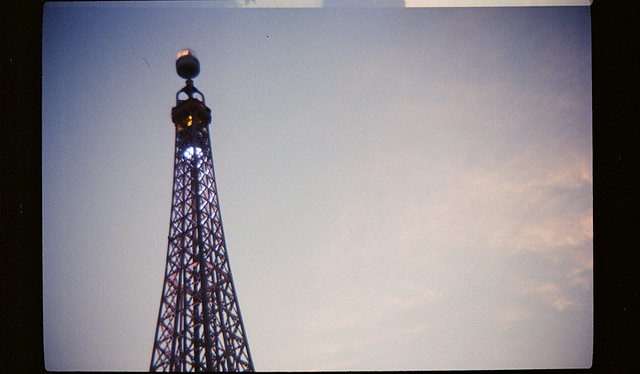
"Half frame" 120

Arbitrarium

Well-known
Local time
11:50 PM
Joined
Aug 9, 2016
Messages
320
Been reading about the Bencini Koroll cameras and the weird format. Half frame format with no double exposure prevention, sounds like a camera I might like to try for creative (i.e. daft and worthless) photography.

Did any other companies make a similar camera with a smaller negative on 120 film? Smaller than 6 x 4.5 I mean.
 
Been reading about the Bencini Koroll cameras and the weird format. Half frame format with no double exposure prevention, sounds like a camera I might like to try for creative (i.e. daft and worthless) photography.

Did any other companies make a similar camera with a smaller negative on 120 film? Smaller than 6 x 4.5 I mean.
Some makers catered for the super slide format on 120. Hasselblad, for instance, made a 4 x 4cm A16S magazine.
Cheers,
Brett
 
Been reading about the Bencini Koroll cameras and the weird format. Half frame format with no double exposure prevention, sounds like a camera I might like to try for creative (i.e. daft and worthless) photography.

Did any other companies make a similar camera with a smaller negative on 120 film? Smaller than 6 x 4.5 I mean.
Lots of older MF cameras have no double exposure prevention. Linking film advance with shutter charging was a Leica idea that caught on.

I don't imagine many cameras will waste 1/4 of their film stock width.

Still - it's the kind of idea Lomography would kill for...
 
The Rolleicord VA and VB have the option of inserting a 24 exposure mask (in addition to an option 16 exposure alternative), which is indeed 120 half frame. I use the 16 exposure mask regularly on my Rolleiflex T, but don't have a Rolleicord (yet....). Unlike other 6x4.5medium format cameras, the crop on the 120 square in the Rolleis is in landscape mode, not panorama.
 
Been reading about the Bencini Koroll cameras and the weird format. Half frame format with no double exposure prevention, sounds like a camera I might like to try for creative (i.e. daft and worthless) photography.

Did any other companies make a similar camera with a smaller negative on 120 film? Smaller than 6 x 4.5 I mean.

I'm familiar with the Bencini cameras, but didn't realize they'd made a 120 half-frame camera. I doubt there are many other examples of these odd formats (2:1 portrait is pretty unusual).

I've done a bit of fooling around with odd formats, like 6x0.25 (or some such, I didn't measure it), and just spooling a small amount of film through the camera with each shot.

If you want to play around a bit with odd formats, I'd recommend getting a Holga and masking off the film area. From that point, you should be able to drill a hole (or holes) in the back to count the frames. This was the standard on older cameras since film makers didn't always have marks for 6x4.5 (you just looked at the 6x9 numbers in two spots). I guess for 6x3, you'd have to drill two holes on either side of the regular 6x6 hole, take one shot with the number 1 at the first hole, and then at the second hole, then number 2 at the first hole and so forth.
 
I dislike half frame.
That's all I can say. 😛
You do realize this is #120 film half frame, not 35mm half frame.
Also known as 645 size, nominal negative size is 42mm X 56mm and you get 16 exposures on a standard 120 roll. Think of it as pre-cropped 6X6

I have an Agfa Isoly that shoots 41X41mm on 120 film, also 16 exposures on a roll.
 
I wouldn't consider the Koroll 24's, an other similar models', 3x4.5cm format "half-frame". I agree with zuiko85, that the classic 16exp 5.6x4.2 format the true "120 half-frame". It was a late addition to the 120 spec that was 1/2 the width of the 8 exp format.

The 24exp format is a non-standard. It does yield 24 images per roll, which is an economy compared to even the 16exp format, but it is quite a bit smaller area than the standard 16exp format. Its image area is quite similar to the non-standard 16exp 127 format used in the Foth Derby models.
 
As mentioned, 645 would be half frame for 6x6. It is normally a vertical format. I think I only heard of one in a horizontal format with the film traveling vertically. Many folding cameras had inserts to transform them from 6x6 to 645. They had sometimes double windows on the back of the camera, until Kodak began putting markings on the paper for 645. It is rare to find those cameras which accepted the mask on sale with the mask. I have a Welta an a Fujica with the mask. But I am not a fan of 645 so I don't really use them that way.

As to double exposure prevention, the closest to that I can think of would be those that have auto-wind, that is they advance the film one frame and then stop. But really is for doing that advance without needing to use the window on the camera back. I don't know how many like that were made. I happen to have two, a Welti Perfekta folding TLR, and the Mamiya Six. But again, I don't know of any that self cocked the shutter.

 
I have a Koroll 24S. The lens is low contrast, and not very sharp, even by box camera standards. If the frame were sized 6x3, it'd be a lot more fun, but it "wastes" the edges of the film to give a slightly more usual aspect ratio.

Tower by Berang Berang, on Flickr

Lake by Berang Berang, on Flickr

Also, it's really hard to keep the frames from overlapping.
 
Once, maybe 40 years ago, I'm pretty sure I saw a 120 camera that was actually masked down (officially, from new) to 35mm to allow slides. But the whole idea is so crazy that I'm beginning to wonder whether I really saw it or not. I recall it as being a pretty nasty plastic Diana-type camera. Anyone else ever see one?

Cheers,

R.
 
Once, maybe 40 years ago, I'm pretty sure I saw a 120 camera that was actually masked down (officially, from new) to 35mm to allow slides. But the whole idea is so crazy that I'm beginning to wonder whether I really saw it or not. I recall it as being a pretty nasty plastic Diana-type camera. Anyone else ever see one?

Much more expensive, but however a similar concept was the Rolleikin, I guess.
 
Medium format is so fun because it's a whole family. 😀
IIRC 6x6 and 6x9 are the original "defacto standard" 120 film formats. Roger had a nice write up in the web about the formats.
And for a slight twist , isn't my Bronica Etrsi 1/2 frame compared to my Fujica GL690 , rather than any previous comparisons to 6x6 ? Just sayin'. Peter
Also, which is amusing to me, 120 film is named "Brownie" because well, it was Brownie film. Bronica derives from it. OT: Bronica doesn't pronounce like Veronica? Would be fun to shoot a Veronica with a Bronica, wouldn't it?

Long story short, 645 is 6x9 half frame. Coincidentially it is a 4:3 aspect ratio crop of 6x6.

Rolleis did have a 16 exp adapter but I perceived it shoots a slightly shorter format (54x40) that is more rectangular.

35mm cine formats also vary in length, measured by perfs.
 
...

Long story short, 645 is 6x9 half frame. Coincidentially it is a 4:3 aspect ratio crop of 6x6.

Rolleis did have a 16 exp adapter but I perceived it shoots a slightly shorter format (54x40) that is more rectangular.
...

The 16exp format was the original "1/2 frame" 120 format that was added to the spec which originally only included the 8 and 12 exp formats. The 15exp "645" is a distinct Johnny-come-lately format that was created for mechanically measured film advances instead of the ruby-window method. This was because the mechinical advance was less reliable measuring the film advance precise enough for the narrow spacing needed for 16exp and to shift the aspect ratio from the 3:2 shape, which matched the base 6x9 8exp format, to something closer to the then popular in professional use 8x10/4x5 aspect ratio.
 
Kodak's Tourist

Kodak's Tourist

Kodak's Tourist had a 35mm mask. Unfortunately it was designed for 35mm in 828 format. A short lived paper backed film. The same camera also had 6x9, 6x6, 6x4.5 as well. There was only a fixed lens so you were stuck with a 101mm lens for all formats. 35mm would be mildly telescope with that lens.
 
Medium format is so fun because it's a whole family. 😀
IIRC 6x6 and 6x9 are the original "defacto standard" 120 film formats.

6x6 came quite a bit later into the history of 120. 120 originally only had numbers for 6x9 exposures, although rolls of various lengths were produced (4, 6, 8, 12 - depending on who was making the film). 117 film was 6x6, and the same width as 120 but used slightly different spool. 645 on 120 predates 6x6, being made possible by using two red windows to shoot one half of each 6x9 frame. The original Rolleiflex used 117 which was by then essentially a dead format, having only been used by few early box cameras. When 6x6 "moved" to 120 it needed three red windows, through which the 6x9 numbers had to be read in a certain sequence, or automatic film stop mechanism, or in the case of an Altiflex I have, a series of index numbers printed around the wind knob that you use to wind the film to the next frame (each index number is printed a progressively shorter distance from the previous one to compensate for the changing diameter of the take up spool).
 
Back
Top Bottom