Half Frame DoF Calculator?

v3cron

Well-known
Local time
9:18 AM
Joined
Nov 8, 2006
Messages
337
Location
east
I could not find a depth of field/hyperfocal calculator on Google that includes half frame. Anyone know if one? If someone can tell me the circle of confusion for half frame, I could use that too. Thanks.

 
Last edited:
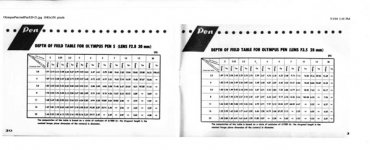
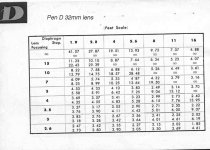
I will post 3 dof tables for hf cameras which I hope may be useful to you. They are for a 28mm lens (Pen 3.5), 30 mm lens (Pen S), and 32mm lens (Pen D). You will note that the Pen S/Pen table also indicates the circle of confusion they used in their calculations. (Maybe there is a "file post" routine on this site? if the small files I'm posting don't work and there is another way of getting them posted I'll try to do it.)
 

Attachments

  • HF-DoFPenS&-Pen3.5.jpg
    HF-DoFPenS&-Pen3.5.jpg
    72.5 KB · Views: 0
  • HF-PenD-DOF-Web.jpg
    HF-PenD-DOF-Web.jpg
    133.3 KB · Views: 0
Half Frame Depth of Field

Half Frame Depth of Field

I can read the Olympus PEN D chart, but the other charts are too small for me to read. If you can repost a slightly larger version I would appreciated it.

Does anyone have a DOF chart for half frame with a 25mm lens such as the Olympus PEN W? I would like to see that if anyone has it or knows of its location on the web.

Thanks,

Dave
 
There are a number of downloadable Excel templates to do DOF calculations. I can input a circle of confusion value in mine so I assume that is the case with most of them.

Just Google "DOF excel" and see all available. I can not remember where I got mine from.

Of course there is nothing unique about using half frame, 35mm, or any other format. DOF is a calculation using aperture, focal length, focus distance and circle of confusion only.
 
Once upon a time Kodak used to publish really neat little spiral bound books that covered tons of subjects. Usually they contain a number of circular slide rules to calculate various formulas. I remember one in particular that found DOF, you enter the film format, the focal length and distance and read off the DOF> Because it's a slide rule you can easily estimate in between values. It's late and I need to go to bed but I'm sure I have it laying around somewhere.
 
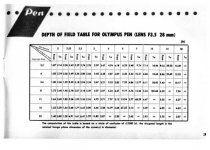
I'm sorry that the first two DoF tables I posted were too small; I was afraid of that. I will try with the table for 28mm (as on the original Pen from 1959) and see if that works any better. It is a copy of a copy so I'm afraid quality declines pretty quickly; but, maybe it would survive a + step or two in the browser. If it works, I'll do the same with the other one.
 

Attachments

  • HF-DoF28mmweb2.jpg
    HF-DoF28mmweb2.jpg
    125.4 KB · Views: 0
Looks like coc used by Olympus was .030mm

Looks like coc used by Olympus was .030mm

based on the table and note of "d/1000" at bottom for coc calculation.

btw - CoC (zeiss formula) = d / z-factor

d is diagonal of source medium (film or sensor)

z is a constant, but some references show it as being a result of:

(magnification multiplier) x (target print destination long size)

so z-factor with mag of 5x, for a 12 inch (325mm) print is about 1625, will in the range of ~1440 - ~1830 used by Canon, Nikon, Zeiss, Leica.

Waiting for the 'experts' to tell me where I'm wrong here. Sure with they could 'show' me too :angel:

I'm sorry that the first two DoF tables I posted were too small; I was afraid of that. I will try with the table for 28mm (as on the original Pen from 1959) and see if that works any better. It is a copy of a copy so I'm afraid quality declines pretty quickly; but, maybe it would survive a + step or two in the browser. If it works, I'll do the same with the other one.
 
Last edited:
I have an Excel spreadsheet in which one can specify film image area (or sensor size), as well as focal length and circle of confusion, and get depth of field. Glad to send it, and another similar spreadsheet, to anyone who writes to me at uthappam AT gmail.com.
 
based on the table and note of "d/1000" at bottom for coc calculation.

btw - CoC (zeiss formula) = d / z-factor

d is diagonal of source medium (film or sensor)

z is a constant, but some references show it as being a result of:

(magnification multiplier) x (target print destination long size)

so z-factor with mag of 5x, for a 12 inch (325mm) print is about 1625, will in the range of ~1440 - ~1830 used by Canon, Nikon, Zeiss, Leica.

Waiting for the 'experts' to tell me where I'm wrong here. Sure with they could 'show' me too :angel:

Why so complicated, Ted ? The other day you we very firm about magnification and print size not influencing DOF and claimed your M6 and M8 had identical DOF for the same lens, so M6 and half frame should be similar, too, no ? :angel:
 
Last edited:
Well- according to Rudolf Kingslake, they are. DOF scales, according to his book "Lenses in Photography", can be multiplied or divided by factors of two or more depending on the perspective of the viewer. Scene content also has to be considered. DOF is very subjective, literally.
 
For the OP: you can pretty much use the M8 in dofmaster.com. Half frame is crop factor 1.41 vs 1.33 on the M8 - pretty close. Or divide whatever COC you like for full-frame by 1.41 for the new, half-frame COC.

Roland.
 
Last edited:
Hi Roland

Hi Roland

I've verified that DOF is the same, and will be for any lens with any camera that has the same flange to medium distance (e.g. Leica M film, M8, M9, Zeiss M, Bessa M, RD1), with the same lens, and cameras on tripod.

The original Pen system uses a different film to flange distance, and different lenses.

However, if you took a 24x18 film snippet and placed it in an M9 or M8 and exposed it, it would have the same DOF as the M's. Give it a try, if you don't believe me!!

Here are 5 things to keep under consideration:

1. Use real cameras and prints. i.e., don't take the largest image you have from one system, then Photoshop it up/down and point to a random bokeh circle that is smaller or larger, from some random light point source in the background, and assume that there is a valid DOF change you are seeing.

2. Don't assume that the viewer is going to make his target image the same as whatever system your first one was.

3. Do the math. I can help you here if you get stuck.

4. Take advantage when a manufacturer provides guidance or DOF charts and they differ from your (or dofmaster's) results. See what they used for z-constants and CoC's, and if they might have a valid argument that they are in fact acceptable and reliable data they are providing.

5. Take extra care when using online depth tables of any type. Rumor is that most U-boats sunk themselves by crashing into the ocean floor. Apparently there was some wrong data at the (now defunct) site they were using: www.u2dofmaster.com 😀

Why so complicated, Ted ? The other day you we very firm about magnification and print size not influencing DOF and claimed your M6 and M8 had identical DOF for the same lens, so M6 and half frame should be similar, too, no ? :angel:
 
Last edited:
Hi Mukul

Hi Mukul

Does it do anything different than the dofmaster results or the Schneider tables here: http://www.schneideroptics.com/software/DOF_Calculator.xls

?

Thanks!

I have an Excel spreadsheet in which one can specify film image area (or sensor size), as well as focal length and circle of confusion, and get depth of field. Glad to send it, and another similar spreadsheet, to anyone who writes to me at uthappam AT gmail.com.
 
Back
Top Bottom