Help my negatives look terrible!

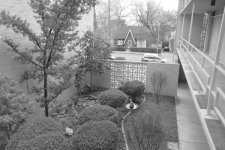
Note the above shot is probably the only thing that has come out of my developing tank that look remotely like a photograph.

That shot coming out okay could also mean that it was the only properly exposed image on the film or the only over-exposed image on the film.

If the former is the case, then there could be a problem with the camera's meter. If the latter is the case, then your development time is too short.
 
I have an Ion Film2SD scanner which is a very cheap negative scanner. The negatives don't look right at all on a light table. The Kodak writing on the edges of the film does not look right.

I agitate based on a video I found on UTube where I twist and invert at the same time. I do it for five inversions at thirty second intervals. I pour in the dev, rap it on the counter, start the timer and invert five times to start.

I'm drying a roll that I developed for six minutes as we type. They do look better but the proof is in the pudding.

Ok, if they look funny on the light table, it's not the scanning. Agitation sounds good too.
 
I don't know if I can help your negatives look terrible besides advising you to develop at high temps and to refrain from storing them inside. The weathering process makes them look pretty bad...
 
Last edited:
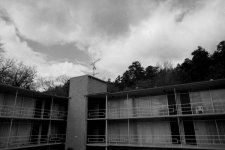
Here's a few from the last roll developed for six minutes.
 

Attachments

  • PICT0341.jpg
    PICT0341.jpg
    48.4 KB · Views: 0
  • PICT0342.jpg
    PICT0342.jpg
    47.8 KB · Views: 0
  • PICT0340.jpg
    PICT0340.jpg
    27.9 KB · Views: 0
I will try a new roll for six and half and see where that takes me. It seems like an awful lot more development than Kodak recommends.
 
Dear Click,

Thanks for taking it in good part.

I find that I get better results from 'overdevelopment' too.

The Zone Taliban and 'never overdevelop' seem to miss the point that the aim is good, printable negs, not doctrine. Manufacturers' recommendations are starting points, nothing more. It took me years to accept this. I always reckoned that if I diverged from these recommendations, I was doing something 'wrong'. It was that view which was wrong...

Cheers,

R.
 
Dear Click,

Thanks for taking it in good part.

I find that I get better results from 'overdevelopment' too.

The Zone Taliban and 'never overdevelop' seem to miss the point that the aim is good, printable negs, not doctrine. Manufacturers' recommendations are starting points, nothing more. It took me years to accept this. I always reckoned that if I diverged from these recommendations, I was doing something 'wrong'. It was that view which was wrong...

Cheers,

R.
I always need to develop for a good bit longer than the recommendations, but I tend to neglect the agitation! my attention seems to get taken by something else - while the timer is ticking away!
Dave.
 
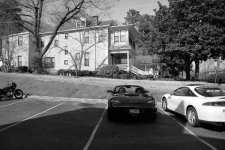
Here are the results from six minutes and fifteen seconds. Things are looking up for certain.

Right now I'm drying a roll that I did for six and a half minutes and the negatives look even better. It seems that the recommended times from Kodak are so off the mark it's laughable. I had read that Tmax Tmy-2 was very sensitive to changes in development so I thought I was doing something wrong. As it turns out my water, chemicals and techniques are fine. I'm certain that I can refine this process to produce excellent highlight detail.
 

Attachments

  • PICT0370.jpg
    PICT0370.jpg
    51.7 KB · Views: 0
  • PICT0363.jpg
    PICT0363.jpg
    54.5 KB · Views: 0
5 and a half minutes seems a rather short time for any developer. I have never used T-Max developer, but with other Iflord, Kodak and Fuji products, my developing time at 70 degrees is usually 6:45 to 8 minutes. the 1 to 4 dilution of your Kodak rapid fix is correct.

My preferred film/developer combination now now is Tri-X and Microdol X. I get good contrast and minimal grain.

Digitaltruth.com is a good resource for developing times for pretty much any film/developer combination.
 
I just went by Kodak's advice. I looked on digital truth and it didn't have much info for Tmax Tmy-2 developed with Tmax RS.

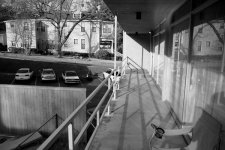
Here's the set done a six and a half minutes.

How does these look to you? I don't have a trained eye so it's hard for me to judge. When I look at the negatives they seem to be pretty good but again I'm no expert. Based on these scans should I increase development time more for this amount of subject brightness range?

Thank you!
 

Attachments

  • PICT0371.jpg
    PICT0371.jpg
    51.5 KB · Views: 0
  • PICT0375.jpg
    PICT0375.jpg
    46.9 KB · Views: 0
  • PICT0378.jpg
    PICT0378.jpg
    42.7 KB · Views: 0
Looks good to me. I don't think there's any such thing as a 'trained eye'. What looks good, is good...

Contrast looks OK too but my e-mail computer doesn't have the best monitor.

Cheers,

R.
 
This last batch looks good. The more you process your own film the better you will become...it just takes some time. And as you have found out you can ask questions here and get excellent advice (and some ribbing as well).

Best regards,

Bob
 
Thank you guys for all your help! I sincerely appreciate your insight and advice. I think my negatives look better than my scanner can display at this point. When I examine them on a light table I can see great detail in the highlight and shadow areas that isn't visible in the scan. I'm still going to work to improve them.

The next two items on my agenda are investigating the Plustek 7300 negative scanner. Anyone have experience with it on a Mac computer? And figuring out how to push Tmax Tmy-2 to 1600 so I can shoot in lower light.

Thank you all again for your help and your ribbing! What's life without a healthy sense of humor?
 
Scans look good to me. I almost always overdevelop b&w, whether it's Tri-X, HP5+ or Tmax. And I tend to trust the Massive Dev Chart more than manufacturer specs.
 
And figuring out how to push Tmax Tmy-2 to 1600 so I can shoot in lower light.

Don't overlook the faster films too. TMAX 3200 and Delta 3200. They'll go away if we don't shoot them 😀 Seriously though, while grainier, they'll have more shadow detail than pushed 400 speed film. It's a fun thing to experiment with.
 
Back
Top Bottom