How to test development times?

ChrisN

Striving
Local time
8:32 AM
Joined
Apr 6, 2005
Messages
4,495
Location
Canberra
How would you go about determining development times for a new film? I've got 10 rolls of ERA 100 coming from China, and can't find a development time for DD-X, the only developer I use. I'd rather stick with DD-X, as that is readily available here and nothing else and works fine for the Ilford films I also use.

I've found one discussion of ERA 100 that suggests it is close to FP4, which suggests 10 minutes in DD-X 1+4. I guess that would be a good starting point. And I would also assume that I might want to try a minute either side of that figure too.

By that stage I'll have shot and developed three of my 10 rolls! Is there a more clever way? I don't have a darkroom, but use a changing bag. I guess I should just shoot a test roll all with one standard exposure, then clip 1/3 of the roll and develop it at 9 minutes, then another 1/3 at 10 minutes, then the last 1/3 at 11 minutes. The interesting bit will be trying to measure off 1/3 of the roll in my changing bag!

Am I on the right track here? Thanks!
 
1. On a test roll, leave a couple of blank frames at the beginning.
2. Using a grey card or similarly evenly toned surface, make exposures for Zone I, bracketing from 1/2 the box speed to 2x box speed, in 1/3 stop steps. Document.
3. Finish out the roll with any photos you want to take, bracket if you wish, but document.
4. Develop for your starting point time.
5. Find the Zone I shot that measures .08 to .10 density over film base + fog. Film bse + fog = the blank frames. If you don't have or don't have access to a densitometer, a lab can do it for you or a properly made contact sheet can tell you. Here you are trying to determine film speed for your meter/developer combination.
6. Once you have determined film speed (personal EI), shoot another roll and make Zone VIII exposures of a grey card. Zone VIII has barely visible highlight detail ... think brightly lit snow on a brilliant day. Make enough of these exposures to be able to divide the film into 3 segments.
7. Develop one segment @ the starting point time. When these negatives are contact-printed in the exact same way as the proper contact sheet, you will see whether the test frames are developed properly or not, i.e. too long, too short, or just right. The proper developing time will render barely visible detail in the Zone VIII test frames.
8. Repeat 7 above, varying development time (obviously agitation will affect this, so keep the same routine ... change only one variable at a time) until you get it right.
9. Alternatively, you can measure the density of the Zone VIII test frames if you don't want to use the contact printing method. For the life of me I can't recall what the "proper" density should read, maybe someone else can chime in.
10. Read Zone VI Workshop by Fred Picker for a more thorough explanation ... he was a better writer than me, too.

Earl
 
Without a densitometer, you would just be guessing. I would just shoot a roll and try your 10 minute development - any problem in contrast can easily be compensated with a multigrade paper or in the scanning. If you find the contrast a little high or low, then compensate the developing time for the next roll you shoot. Eventually you will hit a good processing time.
 
Without a densitometer, you can do it ... like I said Zone VI workshop (and some other books) explain it very well. As precise as a densitometer? No. Good enough for general photography i.e., not scientific/technical where ultimate precision is required? Absolutely.
 
Trius has it exactly right here- this is the correct method, and if this film is going to be a much used one then you want to be sure to do this. An abbreviated version, which I use to see how I like a film is to shoot a grey card at the meter's indicated setting, then another frame 2 stops over and another 2 stops under at the start of the roll. I shoot some regular scenes with a good range of tones, then reshoot the grey card as above at the end of the roll. I run the first half of the film at my suggested or guess of a time and proof it. My usual test is a proofsheet where the sproket holes are barely visible. If the grey card is 'grey card grey' then you've got it- check your other card exposures for white and black but more importantly make a print of one of the scenes and check your shadow details and highlights. The rest of the roll can usually get you pretty darn close after seeing the above. This is how I start with any new film- but the procedure Trius outlines is what I do once I've decided that a film is worth pursuing.
 
Trius and sepiareverb have exactly the right methodologies. The only thing I will add is to shoot a bracket test repeated two or three times on a roll (depending on whether or not you will clip the roll in 1/2 or in 3 sections for your tesing. I'd to 1/3's to get three possible tests from one roll, andconserve more film for shooting once you've established speed and processing time).

Run the first clip test at your best guess, and judge the resulting negs before deciding on your second clip test times/agitation. Post your results, and considering sending them too the massive dev chart.
 
Last edited:
I am not questioning the methodology, just this:

5. Find the Zone I shot that measures .08 to .10 density over film base + fog. Film bse + fog = the blank frames. If you don't have or don't have access to a densitometer, a lab can do it for you or a properly made contact sheet can tell you. Here you are trying to determine film speed for your meter/developer combination.

Without a densitometer (which is why I think you suggested to take the film to a lab), you cannot know if something is 0.8 to 1.0 above base plus fog. Making a contact print just adds more variability into the method (but that is not going to make the test invalid if done properly). The eye is only accurate in determining comparitive density, not absolute density. And it does not matter the type of densitometer - a comparitive densitometer, which is based on visual inspection, can be used.

Like I said, there is no problem with the method. But unless you are developing to a certain lens/shutter combination or contrast index to match a paper grade or scanner contrast, you might as well try my method, especially since you have so little film.
 
drewbarb said:
...The only thing I will add is to shoot a bracket test repeated two or three times on a roll (depending on whether or not you will clip the roll in 1/2 or in 3 sections for your tesing. I'd to 1/3's to get three possible tests from one roll, andconserve more film for shooting once you've established speed and processing time).

Run the first clip test at your best guess, and judge the resulting negs before deciding on your second clip test times/agitation...

This is good. I'll run my grey cards 3 times sometimes- depends on how crazy the initial suggested time seems, or if I'm using a developer that isn't like what's suggested. I usually end up tweaking stuff over the 5 rolls I get to try something out. By then if I'm not happy with it I'm done.
 
Zone I frames will print with barely discernible detail/tonality over the film base plus fog frames. That is the reason for having blank ("Zone 0") frames at the start of the roll. You will be able to discern Zone I from Zone II frames, hence the bracketing.
 
Thank you each and all for your suggestions and information. I will need to do some more study before I can put this information to good use.

I lack any training in the technical aspects discussed above, and have not studied the Zone system at all, so much of the approach discussed above is over my head, at this stage.

I did find an article by Michael Johnston on his "Not much of a system System" (http://theonlinephotographer.com/the_online_photographer/a_simple_system.html) .

I'd be interested in people's reactions to the article and in particular his endorsement of the "ring-around" as a practical means to determine a good working practice with a new film and developer.
 
Mike Johnston's "not much of a system system" is something I can understand, Chris. Barry Thornton proposes the same methodology in Edge of Darkness which I've been using with great results for some time now.
To return to your original question, let's assume you have a time for D76/ID11. You could then compare the relative times for (say) FP4 in D76 and DDX and use that difference to calculate a starting time for ERA100. It should get you in the right area. Earl's methodology is spot on but laborious (no criticism intended here, Earl, I'm just allergic to the "z-word").
 
Thanks Mark - yep, the comparison you describe has me at 10 minutes as a starting point. I'll give that a try.

John - thanks! I've just had a quick look and there seems to plenty of interest there. Cheers!
 
Time to report on results.

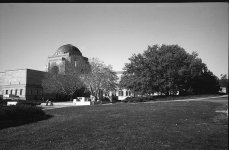
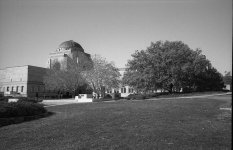
I shot a single roll of the ERA 100 film for a test. All shot of the same subject (see below), all within a few minutes, consistent lighting, using a tripod, and all shot at f/8. I decided to test for three development times, so shot three groups of exposures spaced so I could clip the film into thirds for developing. Exposures were EV -1 (one stop under-exposed), EV 0 (normal), and EV +1 (one stop over-exposed). I didn't fuss too much over metering - my meter agreed with my guess of one stop over sunny-16, which equated to 1/250 at f/8 as my normal exposure. Bright sun on a clear winter day.

Because I am not working in a traditional darkroom, I was not able to make contact prints, but needed consistent scanning to allow comparison of the negs. That lead me to turning off the auto-exposure options in the scanner. I used an Epson 4490 scanner with standard software.

This produced what looked to be very dark scans, but in fact they proved to be excellent material for later adjustment in Photoshop. Indeed this was one of the real discoveries of this test - that I have a better "digital negative" by turning off the auto exposure in the scanning. This held true for both Epson 4490 and Nikon Coolscan V scans. I believe Photoshop gives me a lot more control over the eventual appearance than I have by handing responsibility over to the scanning software to let it make its best guess.

I assumed 10 minutes in DD-X 1+4 as my standard time for the test, and also tried 8 minutes and 12 minutes. Some of my scans are dusty and blotchy, because I rushed drying the negs!

Overall, the best results came from the 12-minute development time, and the EV +1 exposure. This produced the best detail in the shadow areas, without doing any harm to the highlights. The 8-minute dev time produced very high contrast with little shadow detail if under-exposed, but was surprisingly good if given decent exposure. If this small test is any indication, I'd say the film is pretty forgiving with development (in this developer) but is less tolerant of under-exposure.

I'll attach just two pics, the first shows EV -1 and 8 minutes dev, and the second shows EV +1 and 12 minutes.
 

Attachments

  • 1__EV-1-8_min_-dev--PS_cust.jpg
    1__EV-1-8_min_-dev--PS_cust.jpg
    145.8 KB · Views: 0
  • 9__EV+1--12_min_dev-PS_cust.jpg
    9__EV+1--12_min_dev-PS_cust.jpg
    140.7 KB · Views: 0
Last edited:
Hi, Chris.
Glad you are getting good results. As you say, there is plenty shadow detail and the highlights seem good too. Now you are in the ball park, the odd tweak along the way will see you right.

Regards, John.
 
Back
Top Bottom