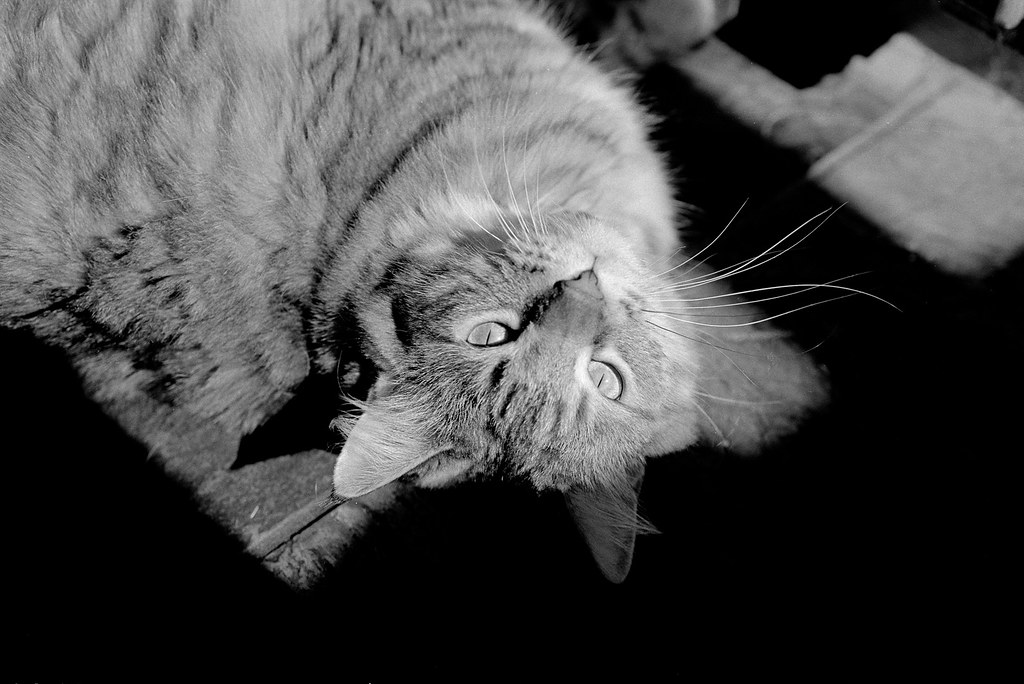
HP5+ Rodinal and grain.

Wasn't Salgado's stuff developed in Rodinal Rodinal can be used for everything and every situation but you have to like the results you'll get. Some People love Rodinal and some people dislike Rodinal it's a matter of personal opinion.
 
What are Tri-X and HP5+ designed for ?

Street/outdoor/daylight/available light 35mm (or MF) candid photography. Many situations where the light conditions are tricky, with contrejours and the like. Not for studio or LF when you can do some spot metering and/or follow Ansel Adams' tracks. 😉

Given this, developing such films in Rodinal doesn't look to be the best option IMO. This isn't a matter of "blaming the developer", rather a matter of common good sense ! 🙂

It is a matter of blaming the developer, and that is exactly what you are doing. You are saying that Rodinal is incapable of retaining highlights or shadows.
Tricky lighting situations call for careful exposure, that is the key. So as a photographer you need to give the correct combination of exposure and development to preserve that scene brightness range on the film.

Your decision, and Rodinal (at most dilution) is quite up to the task of preserving very wide SBR with a whole host of films even Tri-x.


This is the Internet and this is a forum, our opinions differ, so what ? People will read us, try out what they want, pick-up some advices here, some tips there, and come to their own conclusions. Spirited discussions like this one are always good ! 😉

It's not about differing opinions, that's not a problem in a forum. What is a problem is when someone makes an absolute statement, here are two statements:

Here's what you may mainly get @ iso 400 with properly exposed shots:
- Rodinal 1+25 : buried shadows, unpleasant "beans soup" like grain
- Rodinal 1+50 : more defined yet still very (i.e., too much) visible grain, correct shadows but clipped highlights


or this

Rodinal may not be the best developer for faster films as not everyone will like the grain pattern, also care must be taken with exposure to ensure the best quality. If you test and experiment you might get results like this (then post an image)

One statement is an absolute 'you get this' and the other is informative.

Which one is more helpful to the OP or people working with materials?

You've made a lot a false assertions in this thread about a developer; this will be very unhelpful to people reading this and they may take your false statements about Rodinal to have some basis in truth, and that is a shame.
I get it you don't like Rodinal–I really do; but just lying about the results is just unhelpful.

I find the discussion 'babylike' and grossly over opinionated rather than spirited or informative.

Following is Rodinal 1:25 Tri-x shot at EI 1600, Leica M4P in very bad lighting–according to you this insn't possible...

73761617.jpg


Blown beans?
 
What are Tri-X and HP5+ designed for ?

Street/outdoor/daylight/available light 35mm (or MF) candid photography. Many situations where the light conditions are tricky, with contrejours and the like. Not for studio or LF when you can do some spot metering and/or follow Ansel Adams' tracks. 😉

Given this, developing such films in Rodinal doesn't look to be the best option IMO. This isn't a matter of "blaming the developer", rather a matter of common good sense ! 🙂

Of course, there is Ralph Gibson... 😉 BTW there is a very nice interview of him here.

Anyway - I'm not the only one who dislikes Rodinal with those two films out there.

This is the Internet and this is a forum, our opinions differ, so what ? People will read us, try out what they want, pick-up some advices here, some tips there, and come to their own conclusions. Spirited discussions like this one are always good ! 😉

Just wondered what you think to this

img190-XL.jpg


26 years out of date TriX developed in Rodinal i don't know how it was stored before it was given to me, but it was on my wardrobe in a bag for 6 months
 
Would it be allowed to link to a very nice read on Rodinal I found over at the neighbours from MFLenses.com?

I have read it, very interesting re. Tri-X and HP-5 :

- at 1+25 you can't develop iso 400 films exposed at box speeds (you must pull and expose for shadows) unless you'll get totally dark shadows (and the biggest grain)
- at 1+50 grain is OK and you can expose at box speed yet you may have too much contrast (i.e. highlights may not get well controlled depending on the shooting conditions) if you don't meter very carefully outdoors
- at 1+100 : maximum acutance yet "we don't like what this does with either Kodak Tri-X or Ilford HP-5 (...) with least brilliance" ; they recommend to go for 1+75 : "this is the safest solution for indoor/outdoor dark/bright shooting particularly when careful meter readings aren't taken for any situation" (because of the compensating effect the Rodinal begins to have at this dilution). Yet at 1+75 and depending on what you shot you may have to bracket and/or fiddle with the dev. time and temp. ; clearly uneasy for street photo and when you come back home without several shots of the same still subject and without having metered differently and noted how you would further develop this or that.

If you compare this with what I've written some hours ago I can't find anything "rather silly" in what I wrote, sorry.

And the last paragraph tells, according to the authors, that the good old D76 1+1 is a better path to follow for all-around no-brainer shooting than any attempt to mix Rodinal with something else to both reduce grain and control contrast.
 
Well, I'm impressed by some of the pictures here, so clearly Rodinal can be made to work. Equally clearly, from some of the other pictures here, it is quite easy to make Rodinal pictures that are grainy, contrasty, hopelessly blocked in the shadows, or muddy; sometimes, a mixture of two or three of the above.

Cheers,

R.
 
if I could get blocked shadows with any 400 iso film and Rodinal 1:50 I'd be on them like white on rice.

unfortunately, I get this instead:

Untitled by redisburning, on Flickr

if I'm lucky and there is some real black blacks in the scene I can get tolerable results for what I like:

Untitled by redisburning, on Flickr

this is more to my liking (acros in rodinal):

Untitled by redisburning, on Flickr
 
I have read it, very interesting re. Tri-X and HP-5 :

- at 1+50 grain is OK and you can expose at box speed yet you may have too much contrast (i.e. highlights may not get well controlled depending on the shooting conditions) if you don't meter very carefully outdoors
-

You really are shameless aren't you!

Here's what they actually say about the 1:50

A lot of Rodinal's magic happens at higher dilutions (1:50+), high sharpness as well as highlights that 'fall back' holding shadow density and detail. The defining 'Rodinal quality' occurs when tiny specular highlights glow with light and even the brightest parts of the image possess clear tonal differentiation.


Where in that paragraph do you get the information that it blows highlights and has shadow black holes as you suggest?

The facts of developer kinetics don't support your 1:25 no shadows, 1:50 blown highlights.
The higher dilutions of any developer will act as a compensating by lowering the part of the curve where the highlights are recorded.
In fact the d-max will always be lower with higher dilutions even if you increase times.
Shadow detail is governed by exposure, if you expose so that the emerging detail is recorded correctly at fb+fog add 0.1 density (where density rapidly builds) most developers will be able to show that.

Contrast is variable, you can take any film developer combination and vary the contrast by lowering the development time or the developer activity.
In fact when we test we often produce a family of curves with different contrasts for each developer/film combination normally between gamma 0.55 and 0.70 Rodinal at all dilution's can give these values by adjusting times.
Contrast is not a fixed value, neither is shadow detail or the ability to record a range of tones.
 
You really are shameless aren't you!

Here's what they actually say about the 1:50

A lot of Rodinal's magic happens at higher dilutions (1:50+), high sharpness as well as highlights that 'fall back' holding shadow density and detail. The defining 'Rodinal quality' occurs when tiny specular highlights glow with light and even the brightest parts of the image possess clear tonal differentiation.


Where in that paragraph do you get the information that it blows highlights and has shadow black holes as you suggest?

The facts of developer kinetics don't support your 1:25 no shadows, 1:50 blown highlights.
The higher dilutions of any developer will act as a compensating by lowering the part of the curve where the highlights are recorded.
In fact the d-max will always be lower with higher dilutions even if you increase times.
Shadow detail is governed by exposure, if you expose so that the emerging detail is recorded correctly at fb+fog add 0.1 density (where density rapidly builds) most developers will be able to show that.

Contrast is variable, you can take any film developer combination and vary the contrast by lowering the development time or the developer activity.
In fact when we test we often produce a family of curves with different contrasts for each developer/film combination normally between gamma 0.55 and 0.70 Rodinal at all dilution's can give these values by adjusting times.
Contrast is not a fixed value, neither is shadow detail of the ability to record a range of tones.

I have got 12 rolls of Agfa APX100 for my holiday tomorrow i have shot one roll and developed it in rodinal and it looks great, have you used any if so what do you think is the best dilution
 
I have got 12 rolls of Agfa APX100 for my holiday tomorrow i have shot one roll and developed it in rodinal and it looks great, have you used any if so what do you think is the best dilution

I use APX 100 at dilution 1:50 for 13 mins at 18°C when rated at 100
In actual use rate it at between EI64-160 depending on the range of tones in the scene, on a dull foggy day I'll rate at 160 and 15min when faced with SBR of 10,000:1 you'll rate 64 and 11 min.
Those figures are personal and based upon my densitometer readings, yours may vary.

Here is APX @ 100 on a blisteringly bright day (for the UK)

64399183.jpg
 
I have got 12 rolls of Agfa APX100 for my holiday tomorrow i have shot one roll and developed it in rodinal and it looks great, have you used any if so what do you think is the best dilution

Rodinal @ 1+50 works perfect with APX100 (expose for the shadows and don't overdevelop ; exposing at iso 50-64 and developing 10-11 minutes may please you more than exposing at 100-125 and developing 13-14 minutes).

Be careful about what film you've got, if it's the "APX-100-New" it's a rebadged Kentmere iso 100 film which differs from the old Agfa APX100 and developing times differs as well (you must apply shorter times with this "New" film ; you will find out the developing times easily on the web, depending on how you expose it).

With classic 35mm iso 100 films, the best bang for the bucks to use Rodinal with is Fomapan 100. The film itself is more defined than APX100 and with Rodinal you get extremely sharp images. And darn - it is cheap ! And contrarily to its 120 equivalent (unfortulately, many emulsion drops or scratches with Fomapan 100 in 120, as well as problems with the backpaper), factory QC isn't an issue with Fomapan 100 in 35mm, so it's a no-brainer if you like Rodinal and don't need fast films. Expose it @ iso 80 and develop 11 minutes in 1+50. You will be delighted, really.

Well, I'm impressed by some of the pictures here, so clearly Rodinal can be made to work. Equally clearly, from some of the other pictures here, it is quite easy to make Rodinal pictures that are grainy, contrasty, hopelessly blocked in the shadows, or muddy; sometimes, a mixture of two or three of the above.

Cheers,

R.
😉
 
Well, I'm impressed by some of the pictures here, so clearly Rodinal can be made to work. Equally clearly, from some of the other pictures here, it is quite easy to make Rodinal pictures that are grainy, contrasty, hopelessly blocked in the shadows, or muddy; sometimes, a mixture of two or three of the above.

Cheers,

R.

Some people can play the violin well, others get poor sound even from a Stradivarius.

Stradivarius or Guarnerius? I guess making either sing could be down to skill?
 
No dispute. What surprises me is that some people appear to be proud of pictures I'd keep quiet about.

Cheers,

R.

You have to be good to know the difference between good and bad. And even in a world of 6 billion people and the immense resource that is the internet, the number of truly good photographers living is probably in the quadruple digits.

I am not good, but I know what I like. So I am proud of the stuff that achieves the goal I started with. The third picture I posted is my favorite that I've ever taken and I have an 11x14 of it that I AM terribly proud of. But no one has ever even bothered to say it was bad. I suspect it is not to your taste, Roger, what with having 0 shadow detail.

Maybe it is bad. Maybe I am misunderstood. Certainly there are a good number of examples in this thread which hit all the tick boxes of things that annoy me (the biggest these days is the improper setting of black and white points in scans) in a b&w photo but I can't outright say they are bad.

They do not fit what I like. And yes, I would use the word "bad" as a descriptor in an internal monologue, but what I really mean is I don't see much redeeming quality in it.

By that definition, when cooked in Rodinal I'd call HP5+ bad and Acros 100 transcendental. But I have a friend whose opinion I trust and whose photos I like very much that does not like the latter combination at all.

I disagree with the assertion that in art there is not good and bad. What I do disagree with is the idea that much more than the best .0001% is any good.
 
You have to be good to know the difference between good and bad. And even in a world of 6 billion people and the immense resource that is the internet, the number of truly good photographers living is probably in the quadruple digits.

I am not good, but I know what I like. So I am proud of the stuff that achieves the goal I started with. The third picture I posted is my favorite that I've ever taken and I have an 11x14 of it that I AM terribly proud of. But no one has ever even bothered to say it was bad. I suspect it is not to your taste, Roger, what with having 0 shadow detail.

Maybe it is bad. Maybe I am misunderstood. Certainly there are a good number of examples in this thread which hit all the tick boxes of things that annoy me (the biggest these days is the improper setting of black and white points in scans) in a b&w photo but I can't outright say they are bad.

They do not fit what I like. And yes, I would use the word "bad" as a descriptor in an internal monologue, but what I really mean is I don't see much redeeming quality in it.

By that definition, when cooked in Rodinal I'd call HP5+ bad and Acros 100 transcendental. But I have a friend whose opinion I trust and whose photos I like very much that does not like the latter combination at all.

I disagree with the assertion that in art there is not good and bad. What I do disagree with is the idea that much more than the best .0001% is any good.
We disagree little, if at all. What puzzles me, though, is those who say "Rodinal is good -- look at this" when they must surely understand that quite a lot of people would disagree on the most basic technical quality.

Cheers,

R.
 
Back
Top Bottom