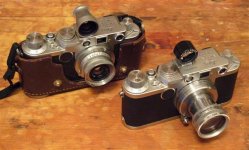
Well, I can give you my experience: if you don't have slow speeds, you will need to use flash one of these days. The IIF is a great way to be minimalist and yet have everything that you need.
I first started out with a Russian FED-1. Great little camera, except no slow speeds, no provision for flash, and the killer was that it was compatible only with its own lens. This is basically what the early Leica II were like. Within its limited parameters, it was quite a competent picture taker.
Then I got a FED-2, because it had the standard Leica lens register of 28.8mm, and it had a Russian version of the Leica M combined RF/VF. I found that I liked the Leica II style separated RF/VF better. The 0.7x magnification finder in the FED-2 made focusing difficult, especially for 135mm lenses where the distances are longer. The 1.5x magnification of the Leica II style cameras made focusing so much easier, even for the 135mm lenses.
I'm now Russian camera free, although I kept a really beautiful Jupiter-9 that actually focuses properly (after CLA) from 1.15m to infinity on my Leicas.
The IIF was my next camera, and it pretty much has everything that I need.
The thing that people don't pay attention to is that all of these cameras are over 50 years old, and if they haven't been serviced, they need service. I've spent far more than the purchase price of the IIF to have it brought back up to spec, and it was not a beater to start with. First it went to Youxin Ye to get the shutters up to spec. Then, while Youxin was in China, I sent it to Don Goldberg to change the RF beamsplitter. That reallly made it a joy to focus with this camera - the clarity and contrast in the finder is incredible. Now it's back to Don Goldberg along with a IIIG to have all my cameras and all my long lenses focus properly in a mass collimation festival. (I succumbed to the IIIG because I wanted the compensating VF frame lines for the 50+90mm lenses, and the slow speeds, and the big viewfinder!)
The older the camera that you get, the more you're going to have to put into repairs to get decades of neglect out of it. But, afterwards you'll have a really nice picture taker.
Heck, even my much younger Nikon F3 (ca. 1983) finally needed service after more than 20 years (flash synch was flaky due to a loosened wire, shutter was off by more than 1/6 f/stop). Yet, I don't see people going around to warn "Paul, don't get a Nikon F-mount camera".