Denverdad
Established
Hi everybody,
I have similar challenge.
I would like to shoot infrared and planned to use the following combination:
Leica M6 (classic), CV 35mm color-skopar, Rollei Infrared 400S, Leica HOOET 13126 D Infrared-Filter. Alternatively I would also have a light red filter available. HC-110 developer.
I'd like to shoot in bright sun, forest with light coming through and also give night shots a try.
Do you have any recommendations for the f-stop, shutter speed, ...
Wish you all nice Sunday.
Thanks and best regards, Miguel
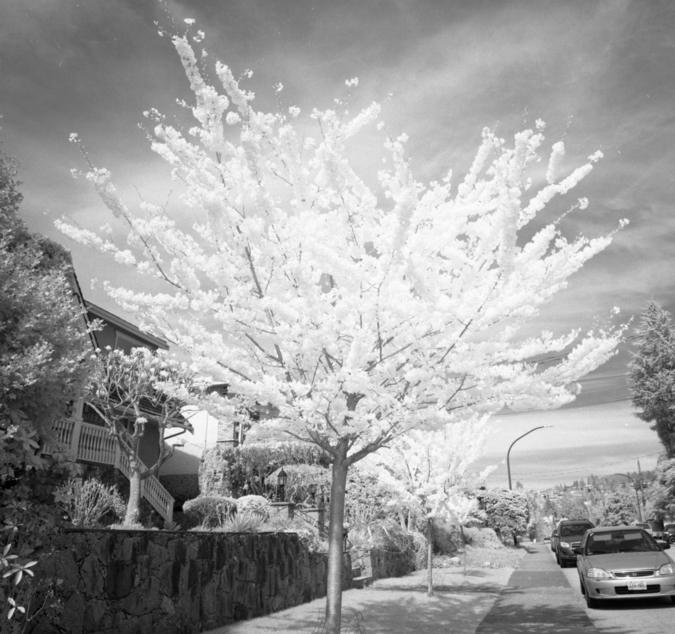
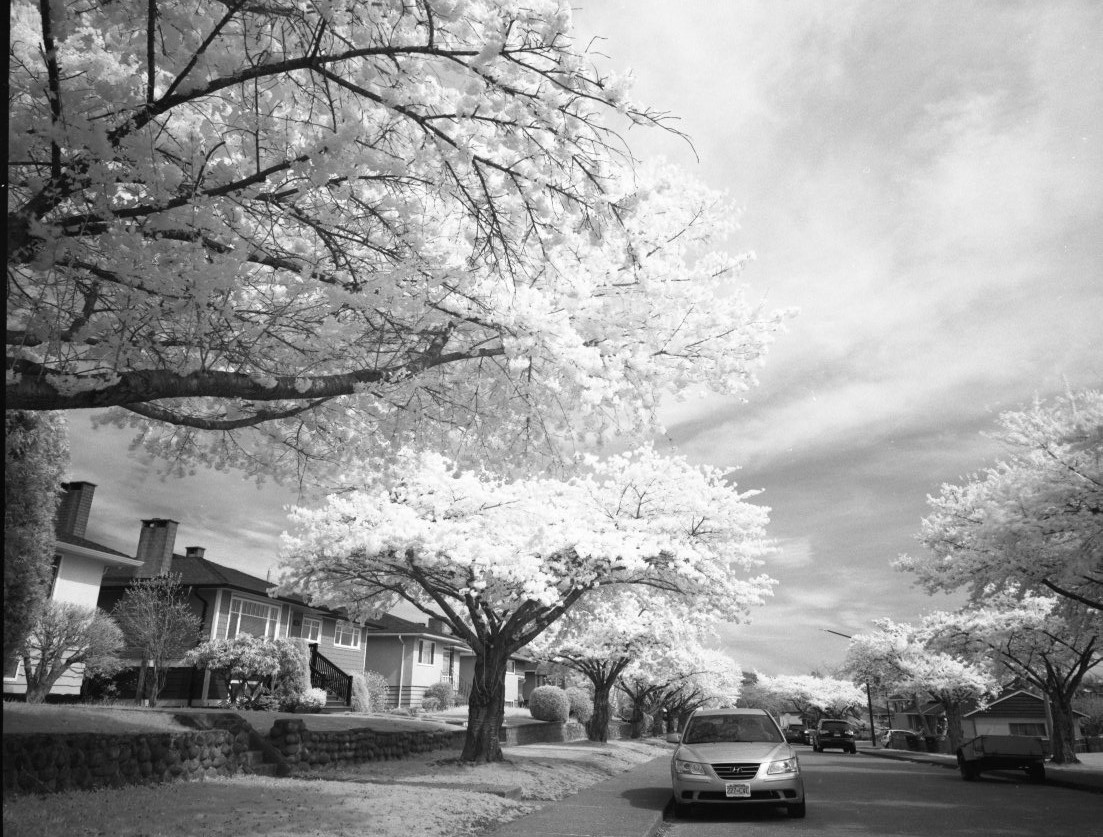
Miguel, [FONT="]the sensitivity of [FONT="]the Rollei 400 [/FONT]extends just barely into the near infrared, unlike [FONT="]some of the older films [FONT="](like HIE) that[/FONT] people are thinking of[FONT="] [FONT="]which went [FONT="]significantly [/FONT][/FONT]further out. [FONT="][FONT="][FONT="][FONT="]This film's sensitivity [FONT="]is already [/FONT][/FONT][/FONT][FONT="]"[FONT="]falling off the edge" [FONT="]by [/FONT]wavelengths i[/FONT]n the [FONT="]low 700nm region, [FONT="]and that [/FONT]is right about where [/FONT][/FONT][/FONT][/FONT][/FONT][/FONT][/FONT][FONT="][FONT="]the[/FONT] good stuff of infr[FONT="]ared imaging[/FONT] [FONT="]starts to kick in (especially the Wood effect or "glow" that foliage exhibits)[FONT="].[/FONT][/FONT] To capture that the filter[FONT="]'s [/FONT]characteristic cut-on wavelength [FONT="]has to be matched just right in order to get a [FONT="]reasonable [/FONT]infrared effect[FONT="].[/FONT] If it is too low (a r[FONT="][FONT="]ed filter [FONT="][FONT="]for example) you [FONT="]will [/FONT]get images [FONT="]that are[FONT="]n[/FONT]'t [FONT="]m[/FONT][/FONT]uch different [FONT="]from what [/FONT]any "normal" B&W film would produce with [FONT="]the same[/FONT] filter[FONT="]. But [/FONT][/FONT][/FONT][/FONT][/FONT][/FONT]going [FONT="][FONT="]too high [FONT="]in [/FONT][/FONT]cut-[FONT="]on[/FONT] wavelength[/FONT] [FONT="]will [/FONT]quickly get[FONT="] you [/FONT]to the point of [FONT="][FONT="]getting no [FONT="]image at [/FONT][/FONT][/FONT]all due to [FONT="]sensitivity being so poor[/FONT].
[/FONT]
[FONT="]For [FONT="]any of the [/FONT]Rollei films [FONT="]a filter [FONT="]of around [/FONT][/FONT]720nm is usually recommended. That would include [FONT="]filters like [/FONT]the Hoya R-72 (and others with "72" in the name), Cokin 007, and Wratten 89B equivalents. Unfortunately I don't know [FONT="]wh[FONT="]ether[/FONT][/FONT] the 13126 D filter you mentioned falls into that category or not.
As for exposure, [FONT="]I've always used a version of t[FONT="]he [/FONT][/FONT]"sunny-16" [FONT="]approach[FONT="] ([FONT="][FONT="]in sunny conditions at[/FONT] f/16 set the shutter to the reciprocal of the [FONT="]film speed value)[FONT="] in which [FONT="]I use [/FONT]a[/FONT][/FONT][/FONT][/FONT] [FONT="]much [/FONT][/FONT]reduced effective film speed[FONT="] [FONT="]which accounts for the effect[FONT="] of[/FONT][/FONT] [/FONT]the filter. With the Rollei 400 and a 720nm filter [FONT="]a good starting poi[FONT="]nt for [/FONT][/FONT]this effective film speed would be in the range of 10 to 25[FONT="]. [/FONT] All of this depends a lot on the developer though[FONT="], so you are going to have to experiment a bit[FONT="] to get it dialed-in.
[FONT="]For [FONT="]aperture [/FONT]and shutter speed you could of course use any combination that [FONT="]gives the same equivelent exposure as the sunny 16[/FONT] calcu[FONT="]lation[/FONT]. [FONT="][FONT="][FONT="][FONT="]But [FONT="]with [/FONT]the [/FONT]potential for focus shift [FONT="]when working in [/FONT]the infrared [FONT="]there is a tendency to [/FONT][/FONT][/FONT][FONT="][FONT="]lean towards smaller apertures [FONT="]so that depth of field will cover any error in focus. [FONT="]So for 35mm we're looking probably at something around say, f/11 and 1/[FONT="]25 [/FONT]second, assuming a [FONT="]bright sun-lit [/FONT]scene. [/FONT][/FONT][/FONT][/FONT][/FONT][/FONT]
[/FONT] [/FONT][/FONT]