Infrared Landscape Photography - Advice?

sf

Veteran
Local time
10:45 PM
Joined
May 14, 2005
Messages
2,825
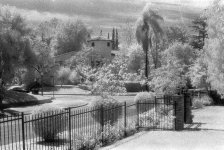
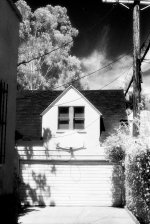
I have attached an image that I captured years ago - back when I was first taking pictures. Kodak HIE film, I don't think I was wearing a filter. Canon AE-1. One image looks filtered - the other does not - but I don't really know.

I have done some reading on the RFF and the internet, and have come up with a collection of facts and rules to consider.

1. Handle the film in the dark.
2. Make sure to focus properly.
3. make sure to meter properly
4. Make sure to meter properly according to the filter used.
5. Consider the IR brightness of the scene - snowy, cloudy day vs sunny, hot day
6. consider the speed of the film being used.

Questions :

Is an IR filter really necessary? I don't think so, from what I have read, but I want to come up with images that have some glow - like the one attached. I don't remember if I used a filter. I like the overall glow of the second image, but the black sky and contrast of the first is nice.

I used Kodak HIE for that shot - how about the look of Rollei Ir 400? Will it be very different?

Prices for B+W IR filters are very high for my budget - is it worth the price? I DO want high quality images, but how about some impressions from people using Hoya red filters.

Developing IR film - if I rate it at 400 ISO, do I develop it in the same developer as my 400 general B&W film?
 

Attachments
  • IR-side-of-houseRFF.jpg
    IR-side-of-houseRFF.jpg
    189 KB · Views: 0
  • IR-front-yardRFF.jpg
    IR-front-yardRFF.jpg
    303.4 KB · Views: 0
Last edited:
I'm trying to shop at Freestyle photo, and they don't seem to carry that film (SFX).


The rollei has pretty strong full spectrum sensitivity. I am going to go ahead and shoot without a filter, but please someone clarify that filterless IR work is going to produce the sort of very glowy image as seen in the second one in the first post.
 
Filters for Kodak HIE

Filters for Kodak HIE

shutterflower Questions : Is an IR filter really necessary? I don't think so said:
The deeper the filter into IR the better the effect. For a start use Wratten 29 deep red after that try Hoya R 72 or Heliopan 715. Wratten 29 will cost you 2-3 stops, while R72 will be more like 3-4 stops. A #29 can be used on other films as well while a R 72 can only be used with IR sensitive films.
For strongest effect try Wratten 87 series, which will lose 5-7 stops film speed.

The lightmeter inside an Leica MP will work with filters like #29 and Heliopan 695/715 quite well. Otherwise calculate your exposure based on filter factors in combination with external/handheld lightmeter.

For the glow effect consider Lucky film as their anti-halo layer is crap. This film should be pretty cheap, around 2 Euros.

I use either B&W or Heliopan filter, what ever is in stock or cheaper, also use Hoya filters, but they are not very common in Germany. A gel filter could be the cheapest solution, I have a 87 glued into a Cokin P for using with larger lenses.

Regards,

Wolfram
 

Attachments

  • Lucky400antihalo.jpg
    Lucky400antihalo.jpg
    32.4 KB · Views: 0
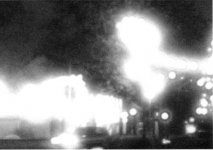
that's a very cryptic image. What is it?

Thanks for the help, I'm currently considering whether to spring for a good B+W or not. $100. . . yikes.

Might just go with something cheaper.

What happens without a filter?
 
How about Rollei IR? Perhaps otherwise known as Maco IR? Freestyle has none of the Kodak films.
 
shutterflower said:
I'm trying to shop at Freestyle photo, and they don't seem to carry that film (SFX).


Ilford stopped producing SFX last year. Robert White do have some 120 format but it's not cheap - wish I'd stocked up with 120 last year before it was discontinued instead of simply 35mm as it would have cost me less! :bang:
 
Oh, and I can't use HIE because I'm shooting medium format. Wish i could . . .love the film.

What is closest to HIE?
 
Last edited:
The cheapest way to get an infrared filter is to develop a roll of unexposed E6 film and then use sections of the developed film as a filter.

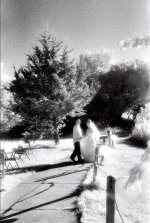
I have found that even a red 25a filter will give a glow to photos with the Maco if the lighting conditions are right. Normally bright sunshine between the hours of 10 AM and 2 PM will give the most intense IR effects.

Attached photo is with Canon Ql17 and 25A red filter.

Wayne
 

Attachments

  • Infared Wedding 4.jpg
    Infared Wedding 4.jpg
    260.8 KB · Views: 0
Last edited:
I wonder if I could a add question? I've always wanted to use infrared film, but two things have troubled me:

1) A photodealer assured me that infrared film could not be used in cameras with cloth shutter blinds, as these were not proof against certain wavelengths of light and fogging would invariably result. Is this true?

2) If it is true, would leather camera bellows be light-tight? I'd like to try infra red with a 6x9 folder, so on the same basis would light penetrate through the "red window" whilst winding on?

Thank you for any help!

Ian
 
Many digital cameras are sensitive to IR wavelengths to a greater or lesser extent, and an IR filter works on them just as it would on a film camera with IR film. And yes, IR sensitive film is required for the genuine 'glow' you are describing, although there are supposedly filters in PS that will approximate this effect.

The effect you are describing is known as the 'Woods Effect' and involves a darkening of skies, and a lightening of foliage. However, some items reflect infrared differently than others of the same color, so it is not simply transposition of colors, which a PhotoShop action could easily handle. Some objects are seemingly unaffected (like the trunks of trees) and others are deeply affected. Sometimes even two coats of paint from different batches reflect IR differently and you can see where a painter of a wall or barn ran out of one and switched to another - weird! Other times, you can 'see' beneath a layer of paint that you would swear was opaque - read old advertisements or lettering that have been painted over.

The reason I mention this is only because you have said how hard it is to find good IR film nowadays. In addition, it is difficult to handle IR film - it requires a lot of extra precautions. With a digital camera that is sensitive to the IR spectrum, you just shoot RAW, go home, and process the red channel, reducing it to B&W and (usually) leaving out the green and blue channels.

I am using a Hoya R72 on my Pentax *ist DS (very coincidentally one of the most sensitive to IR of the latter-day DSLRS), and I have had great results with it. Others prefer a point-n-shoot digicam, because it can show you the image through the filter (I look into a black hole when I shoot, I have to compose and focus with the filter off, then put the filter on and take the photo).

Here are some resources.

http://www.wrotniak.net/photo/infrared/

http://www.jr-worldwi.de/photo/index.html

I realize this is not what you asked, but it might be a quick and easy way to get the effect you described. To my way of thinking, it has made true infrared photography a whole lot more accessible and fun.

Best Regards,

Bill Mattocks
 
Lots of good information here. Shutterflower - are you sure you aren't getting in a bit over you head with so many changes to your process all at once?

First off, develop HIE yourself. It's just too finicky to trut to others, and since it can be extremely high contrast you need the development control.

The "glow" has nothing to do with IR. It has to do with a lack of an antihalation layer. You can take any film, pull off the AH layer, and you'll get the glow in the highlights. Lucky film was mentioned before because at least the 100 speed variant lacks the AH layer.

There really isn't a point in shooting any IR film without a filter. As others have mentioned, they are all (kinda) panchromatic films with increased red sensitivity (HIE isn't truly panchromatic - it's already rather reduced in its blue sensitivity). HIE goes way out to 900nm, Konica (which I loved as a low grain alternative...) to 750, the Maco to 820 and I forget about SFX. Like 720ish, I think.

To get an IR effect with HIE all you need is a red 25 filter. Nice and easy, inexpensive to buy, and only a 3 stop filter factor. For the other films, you need an opaque filter, which can be a lot more expensive.

It might be considerably cheaper to just get a Cokin P system with the $45 89B-equivalent filter. That'll set you back about $100 total but you can use it with any lens thread down the road.

http://davidromano.com has HIE in 120, but it's like $20 a roll, 2 roll minimum order.

allan
 
Over my head? No. I've always had labs do my processing. I did process a roll of HP5 once - came out fine.

I'm just changing films to something cheaper, and using a developer that has a good reputation and is low cost.

I have always liked IR photography, but never even knew they sold it in 120 until last night. So, I have to buy some, and I forgot if I used a filter of the lens of that Canon AE-1.

I am going to buy some Rollei IR 400 (like the Maco but extended sensitivity and smaller grain).
 
Cokin P +89 filter

Cokin P +89 filter

I think this is the best solution, you might be able to pick up their red filter as well looks like a #25 to me, and should work well with regular films as well.

Oh, that picture is christmas illumination. So if you like burnt out high lights and halos ...

Wolfram
 
I think that what I'll do is buy some Rollei IR 400 and a Hoya R72 filter when I am flush with cash.

Going to hold off for a while - till summer probably. When the sun is bright and the weather is steady.
 
Actually, summer is already a bit late for IR photography. The heat is already beginning to kill of vegetation by then. April and May are the best. If it weren't raining constantly here I'd be out there myself..

allan
 
I've just got the RF645 58mm threading to screw a filter into. Probably the Hoya, since it is 1/3 the price of the B+W - and darker too.

I do wish they would make a B&W digital sensor. Just imagine the dynamic range, resolution, etc you could get without the worry for color. Maybe I don't know what I'm talking about.


I'll pop down to Glazers . . .yuck . . . and buy a roll of something IR maybe this week, and a filter for it. Post some shots of the gorgeous Washington farmland in IR. A windy, sunny day would be perfect.
 
So what's the process for using Lucky film as IR? If got a roll of HIE that I am about to put in my FM2 as well as the red and opaque filters. I've also got some left over Lucky in the drawer which would be cool to use as IR. Anyone have any examples of this film shot as IR? Any tips? 😀

dan
 
You can't use Lucky film as IR film. it is not sensitive in the IR range. It merely lacks an antihalation layer so it glows like IR. The glow has nothing to do with IR, though.

allan
 
Back
Top Bottom