


karateisland
Established
In anticipation of my CLE arriving, I have been thinking of what I can do to smooth my transition to film from digital. I started by using my Fuji in fully manual mode to mimic the restrictions of film. That is, I set the ISO to 400, and set the shutter speed and aperture according to the sunny 16 method.
It has been an eye-opening experience. I have come up against some limitations in terms of light gathering—which I have never really dealt with before. Since the little Fuji has such great high-ISO performance, in the past I would simply set auto-ISO, pick an aperture that suits me and run with it. In low light, I set it to F/2 and the camera would take care of the rest. Now, shooting it like a film camera, with ISO 400 (or 100), I am coming up against the limitations of the F/2 lens *sometimes.*
So I started to wonder, is F/2 fast enough? The answer, of course, is that it depends on who you are and what kind of subjects you shoot. If you shoot film, you can learn from experience--you’ll likely just know that you rarely hit the limits of your F/2 or F/2.8 lens. If you shoot digital and let your camera do it all for you, then, well, you lack the same lived experience.
Many of you reading this will probably think, “Then just go out and shoot with film, get the lived experience, and you’ll find out!” This is true, of course, and excellent advice. However, in my excitement for my new camera to arrive, I decided to try the next best thing: data analysis!
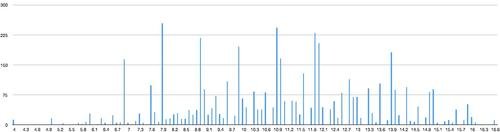
I extracted metadata for aperture and shutter speed for every digital picture I took in 2017. Next, I plugged those numbers into a formula to calculate the EV for every shot, which I tallied and converted to a chart. This gave me a quick visual guide that shows me how many pictures I took at each EV during 2017. (See attached chart.)
I took more than 90% of my pictures over EV 7, which Fred Parker’s handy dandy Ultimate Exposure Computer guide rates as "[FONT=Verdana, Arial, Helvetica][FONT=Verdana, Arial, Helvetica]Bottom of rainforest canopy. Brightly lighted nighttime streets. Indoor sports. Stage shows, circuses." (http://www.fredparker.com/ultexp1.htm) Furthermore, my guess is that most of the pictures I took under EV 7 were the result of my playing around with the camera at night in my condo--so I'd put the actual number of shots taken below EV 7 much lower than 9 out of 10.[/FONT][/FONT]
Using that information, I can check Fred Parker's EV exposure factor relationship chart, which gives me a way to see if a lens would be up to snuff for my normal use. My M-Rokkor 40mm (original version) opens up to F/2 and can be handheld down to 1/30. Finding those numbers on Fred’s chart, I see that this can be used comfortably in lighting down to EV 5 if I use ISO 400 film, and EV 7 if I use ISO 100 film. The lens is likely to be more than good enough!
Th[FONT=Verdana, Arial, Helvetica]is also helps me when [/FONT]thinking about what lenses might be the best use of my (limited) funds in the future. Let’s say I want a wide-angle to accompany my normal 40. Would the VC Color Skopar 25mm be fast enough? To find out, I can repeat the same steps as above: The lens opens to F/4 and can be quite comfortably handheld down to 1/30. Using ISO 400 film means I can shoot in light as dim as EV 7, ISO 100 gets me workable results in light as low as EV 9, which is still good enough for most landscape shots. Alongside my rokkor, that would make a rather affordable and extremely small two-lens kit with my Rokkor that would get me pretty far.
I can run the same analysis for a 50mm F/2.5 and see that shooting ISO 400 film gets me a little below EV 7. That makes it more than passable for daytime outdoors work and portraits, which, again, is probably good enough for me as part of a small kit. F/2 would get me even further.
Some of you may say this over-complicates things, that my preferences may change in time, that I may decide to move on to new lenses after my initial purchase, or even point out that there are plenty of other factors to take into account—those are all fair points, and this is definitely not a perfect system. For me, however, any concrete metric that makes me feel more comfortable buying a slower, cheaper, and easier to correct lens is a good thing. It will save me money for film.
In the end, it eliminates one more unknown factor, helping me to maximize the quality of my lens kit, and minimize the cost. It's a very personal thing, of course, but this helped me a lot and I thought I would share in case anyone else could benefit.
It has been an eye-opening experience. I have come up against some limitations in terms of light gathering—which I have never really dealt with before. Since the little Fuji has such great high-ISO performance, in the past I would simply set auto-ISO, pick an aperture that suits me and run with it. In low light, I set it to F/2 and the camera would take care of the rest. Now, shooting it like a film camera, with ISO 400 (or 100), I am coming up against the limitations of the F/2 lens *sometimes.*
So I started to wonder, is F/2 fast enough? The answer, of course, is that it depends on who you are and what kind of subjects you shoot. If you shoot film, you can learn from experience--you’ll likely just know that you rarely hit the limits of your F/2 or F/2.8 lens. If you shoot digital and let your camera do it all for you, then, well, you lack the same lived experience.
Many of you reading this will probably think, “Then just go out and shoot with film, get the lived experience, and you’ll find out!” This is true, of course, and excellent advice. However, in my excitement for my new camera to arrive, I decided to try the next best thing: data analysis!
I extracted metadata for aperture and shutter speed for every digital picture I took in 2017. Next, I plugged those numbers into a formula to calculate the EV for every shot, which I tallied and converted to a chart. This gave me a quick visual guide that shows me how many pictures I took at each EV during 2017. (See attached chart.)
I took more than 90% of my pictures over EV 7, which Fred Parker’s handy dandy Ultimate Exposure Computer guide rates as "[FONT=Verdana, Arial, Helvetica][FONT=Verdana, Arial, Helvetica]Bottom of rainforest canopy. Brightly lighted nighttime streets. Indoor sports. Stage shows, circuses." (http://www.fredparker.com/ultexp1.htm) Furthermore, my guess is that most of the pictures I took under EV 7 were the result of my playing around with the camera at night in my condo--so I'd put the actual number of shots taken below EV 7 much lower than 9 out of 10.[/FONT][/FONT]
Using that information, I can check Fred Parker's EV exposure factor relationship chart, which gives me a way to see if a lens would be up to snuff for my normal use. My M-Rokkor 40mm (original version) opens up to F/2 and can be handheld down to 1/30. Finding those numbers on Fred’s chart, I see that this can be used comfortably in lighting down to EV 5 if I use ISO 400 film, and EV 7 if I use ISO 100 film. The lens is likely to be more than good enough!
Th[FONT=Verdana, Arial, Helvetica]is also helps me when [/FONT]thinking about what lenses might be the best use of my (limited) funds in the future. Let’s say I want a wide-angle to accompany my normal 40. Would the VC Color Skopar 25mm be fast enough? To find out, I can repeat the same steps as above: The lens opens to F/4 and can be quite comfortably handheld down to 1/30. Using ISO 400 film means I can shoot in light as dim as EV 7, ISO 100 gets me workable results in light as low as EV 9, which is still good enough for most landscape shots. Alongside my rokkor, that would make a rather affordable and extremely small two-lens kit with my Rokkor that would get me pretty far.
I can run the same analysis for a 50mm F/2.5 and see that shooting ISO 400 film gets me a little below EV 7. That makes it more than passable for daytime outdoors work and portraits, which, again, is probably good enough for me as part of a small kit. F/2 would get me even further.
Some of you may say this over-complicates things, that my preferences may change in time, that I may decide to move on to new lenses after my initial purchase, or even point out that there are plenty of other factors to take into account—those are all fair points, and this is definitely not a perfect system. For me, however, any concrete metric that makes me feel more comfortable buying a slower, cheaper, and easier to correct lens is a good thing. It will save me money for film.
In the end, it eliminates one more unknown factor, helping me to maximize the quality of my lens kit, and minimize the cost. It's a very personal thing, of course, but this helped me a lot and I thought I would share in case anyone else could benefit.
Attachments
Last edited:


