J. Lane Glass Dry Plates

9x12cm J Lane Dry Plates by Nokton48, on Flickr

Just bought 20 of Jason's 9x12cm dry plates, to shoot in my Plaubel Makiflexes. Which will give me a 9x9cm dry plate image on a 9x12cm glass dry plate. Should be cool.


Also going to try PMK+ Pyro Developer with these dry plates. That will require a lot of testing, but it seems like a natural use for these. May require more exposure/more concentrated Pyro solution? We will see...............
 
RADA 9x12 holders Makiflex 9x12 Back by Nokton48, on Flickr


Here I am getting my 9x12cm plate stuff together. On the right, a Plaubel Makiflex Plate Back I bought on German Ebay. On the left, a RADA Normalfalz 9x12cm Plate Holder. Normalfalz in German translates to "Standard Folding". RADA made over a dozen different styles of 9x12 Plate Holders. It took a while to sort it all out. A friend sent me a large sheet of "mohair" which I have used to redo the light trapping on some of these plate holders. Was an interesting winter restoration project.

I have fifteen of these RADA holders, and the "Kodak 9x12 Film Sheath" is an accessory to use the holders with modern sheet film. I have plenty of those also. So I can shoot glass plates or modern 9x12 sheet film.

Jason has shipped my 9x12 glass dry plates.
 
Examining sacrificial J Lane Dry Plate 6.5x9cm by Nokton48, on Flickr

OK Here we go. Opened the box under a Paterson safelight. Jason beautifully packages these plates, interleaved with paper, and four strips of spun fibre strips inside on all sides, as a cushion. So far, so good. Tried to load a Plaubel Makina Plate Holder under the safelight, it wasn't going well, so I sacrificed one plate as a "Dummy" to practice loading in the light. As you can see, very smoothly coated and perfect.

Learning to load J Lane Dry plate into Plaubel Makina Plate Holder. by Nokton48, on Flickr

The Plaubel Makina Plate Holder has an clamping mechanism which tighten the film septum down inside the plate holder. Now after playing in the light I will simply slide the top edge of the glass under the ridge at the top of the holder. I will store and transport the loaded holders oriented dark slide down, so the plates don't slide loose inside the holder. Next order I will ask for a slightly larger size plate, but these are usuable as is. Who would know?

So now I know how to load 6.5x9 Makina holders. I've worked some with these holders using regular sheet film. Now I am ready to load some test glass plates. If I'm lucky I'll get out today to test shoot. It's a cloudless day. We will see.
 
RADA 6.5x9cm fits J Lane plates like a glove by Nokton48, on Flickr

It's lovely today for early December in Ohio (58F and full sun). So I bagged up my Makiflex Standard and three lenses, grabbed a tripod (it's very windy!) and found a strong fully lit test subject. Ended up using the 360 Tele-Arton, and exposed 120 6.5x9 Ilford Fp4+, 120 6.5x9 Foma Retro Soft 320, and three 6.5x9cm J lane Dry glass plates. When I find a strong subject, I often shoot the same scene with different kinds of film. I think of this as a form of "bracketing". And I end up with a choice of different negatives. And because I'm using a tripod this is easy to do.

Years ago a good friend who collects all sorts of cameras, gave me a large box of 6.5x9 and 9x12 plate holders. It turns out that these 6.5x9cm RADA holders fit the J Lane plates like a glove, and have a superior spring loaded flap that ensures there is no way the plate will move around. So I will use RADA holders with these smaller glass plates. All I have to do, is re-do the light traps on about twelve of the RADA holders. Luckily I still have a large sheet of mohair left available. This will be a good winter project. The Makina holders I will use with regular modern sheet film. Three of my RADA plate holders look like new, and are perfect ready to load with dry plates. Enough to get started at this point.

Test exposures were made at f16, 2 sec, 4 sec, an 8 sec. Exposures were based on what I have read and seen as examples of excellent results on the internet, not by using a light meter (as it was done in the 1890s). I've read reciprocity characteristics are very good. The toe is extremely long. It will be interesting to see how this responds. I will use either HC110, or PMK+. Have yet to decide.
 
6.5x9 glass neg 1B Dallmeyer Plaubel by Nokton48, on Flickr

Here is an image from the internet that I greatly admire. I am not the first to have this idea; 6.5x9 dry plate, Plaubel camera.

This image has something about it............
I love the way MF cameras draw an image and how quickly and smoothly the sharp areas dissolve into soft blur. This one looks as if it has had some post processing done (which is fine by me - I PP all of my images) but iI would love to see the original
 
Super Cinephor by Nokton48, on Flickr


Obviously not dry plate, but a good example of what can be done with the B&L Super Cinephor theatrical movie projection lens. I want to incorporate this "look' into my dry plate work. It is uber speed F2 MF optic, so that will work very well with ASA 2 dry plate 🙂 Could even be handheld! This Guy was using a Pentax 6x7. I want to shoot 9x9cm.


DSC01430 by Nokton48, on Flickr

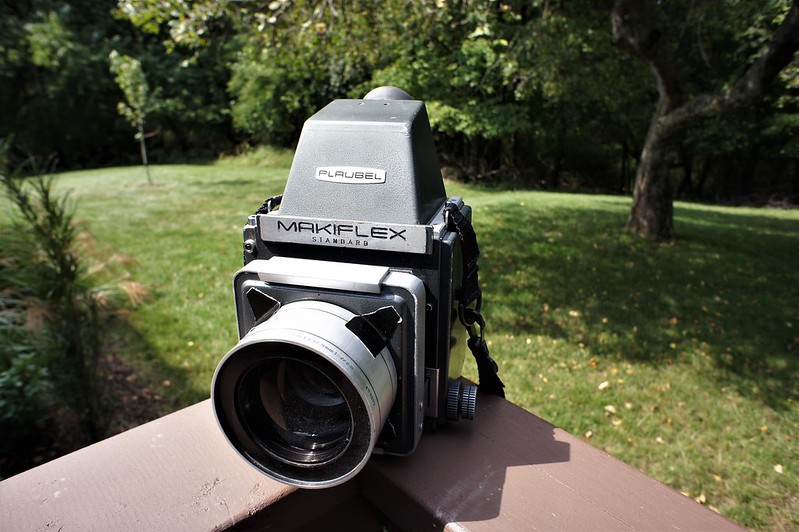
"The Beast". Need to mount this hefty baby onto a Peco Jr/Makiflex board. I think I will use JB Weld, and a LOT of metal cutting. Shown here mounted temporarily with strips of Gorilla Tape. 🙂

Here's another Super Cinephor, slightly longer lens. Would love to have one.

B&L 6.25 inch F2 Super Cinephor by Nokton48, on Flickr

Geoff 210 F3 Cooke Makiflex by Nokton48, on Flickr

As you can see, the Makiflex is bulky, but easily portable.
 
159mm F2 B&L Super Cinephor by Nokton48, on Flickr

My (new to me) Bausch & Lomb 159mm F2 Super Cinephor lens. Originally intended for movie theatre projection of 35mm and 70mm motion picture films. Weighs a ton.

I call it "The Beast No.2". Now I have two Super Cinephors, 5.5 inch, and now 6.25 inch. Mounting these lenses will be a creative challenge for me. Luckily I have a metal shop in my garage.

Mucho fun ahead. F2 is plenty fast for dry plate. 1/125th in full sun (fastest shutter speed on Plaubel Makiflex Standard). Dry plate emulsions respond to UV light as well as visible light.
 
Back
Top Bottom